Governors pledge to oppose federal overreach — even when their party runs Washington
Sep 28, 2026 | 1:25 pm ET

Description
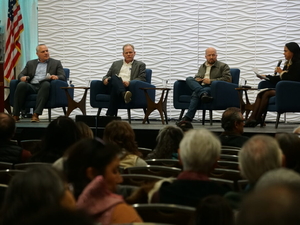
Vermont Gov. Phil Scott, a Republican, and North Carolina Gov. Josh Stein, a Democrat, shared the stage at the National Governors Association meeting this summer in Oklahoma City. The pair recently led a bipartisan working group studying the importance of federalism, the uniquely American system of dividing power between the states and federal government. (Photo by Kevin Hardy/Stateline)
Democratic and Republican governors say they will more aggressively push back on federal overreach regardless of which party controls Washington.
Earlier this month, the bipartisan National Governors Association for the first time in over a decade updated its internal principles on federalism — the system of power sharing between Washington, D.C., and the states. That document now says governors must defend state sovereignty, including through public criticism of federal overreach, legal challenges to federal action, and declining to use state resources to enforce federal laws.
The new policy comes as more state leaders during President Donald Trump’s second term elevate the importance of federalism, the uniquely American structure created by the framers of the Constitution.

The National Governors Association’s new policy calls for the federal government to respect the constitutional balance of power on pressing issues such as artificial intelligence, election administration and immigration — all of which have sparked state-federal conflicts under Trump’s presidency. And it takes aim at deployment of the National Guard after Trump last year moved to send troops into Democratic-leaning cities he characterized as crime-ridden, sparking major concerns about state sovereignty.
The new policy says the president should seek the consent of governors before deploying National Guard members and says such action should be limited to instances when federal resources are insufficient.
“Additionally, absent rare and extraordinary circumstances, the President should not deploy or transition a State’s National Guard from one state to another without the consent of both the sending and receiving states’ Governors,” the policy states.
Governors say they must resist federal overreach under Democratic and Republican presidents.
“I think it’s just a real test of how much you believe in federalism or not when your team is in power,” said Vermont Republican Gov. Phil Scott, who worked on reshaping NGA’s federalism policy for months, along with the governors of Maryland, North Carolina and Oklahoma.
He said governors of both parties have been increasingly interested in issues of federalism since Trump’s deployment of troops last year. A GOP leader of a politically liberal state, Scott publicly criticized the president’s deployments last year and defended the Democratic governor of Illinois.
While he said tension over troops has largely subsided, he said he expects governors will remain vigilant about power sharing between Washington and the states.
“Republican and Democratic governors won’t agree on every policy and shouldn’t, but we should all agree that the constitutional balance of power really does matter,” Scott said. “I think that there will be more attention paid to this and continue to push forward on this because again, it doesn’t matter whether it’s the Trump administration, or a future administration of the other party, it’s doing what’s right for our states.”
States will shape America’s future as nation confronts a pivotal choice
Governors say states must be allowed to experiment on programs, compete with each other and pursue sometimes divergent policies.
“It’s the best way to ensure that you really get locally driven solutions to problems, which creates a laboratory of democracy, laboratory of ideas, of innovation,” said North Carolina Democratic Gov. Josh Stein. “And it’s a way of ensuring that too much power doesn’t aggregate in any one person or body because it’s spread out among the 50 states and the federal government.”
Stein said governors across the political spectrum largely agreed on issues of federalism, which were studied by a dedicated working group and later approved by the organization’s executive committee. He credited his Republican colleagues for speaking out about issues of federal overreach while their party controls Washington.
“I’ve got all kinds of respect for them and their willingness to do that because I know that it’s not the easiest thing to do in these inflamed times,” he said. “I’ve only been in the job for a year and a half, and I haven’t had a Democratic president, so I hope that I would have as much principle as what I’ve witnessed out of a number of Republican governors.”
Stateline reporter Kevin Hardy can be reached at [email protected].