Louisiana congressional candidates weigh in on federal disaster recovery
Sep 28, 2026 | 1:00 pm ET
Description
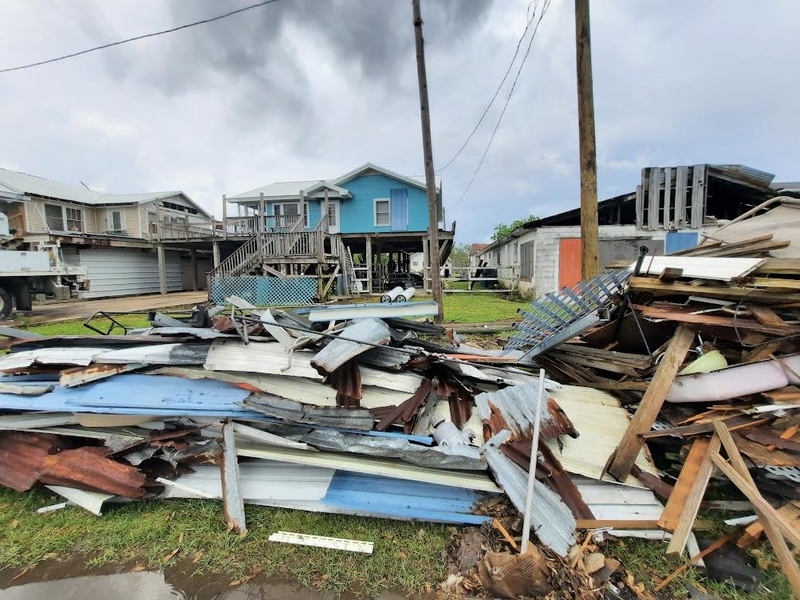
Most Louisiana candidates for Congress said they would not support reducing the amount of federal funding states receive after a disaster. But Democrats and Republicans are divided on whether massive staffing cuts at FEMA under Trump should be reversed. (Photo by Rachel Mipro/Louisiana Illuminator)
Since starting his second term in office, President Donald Trump has made efforts to overhaul the federal government’s approach to natural disaster assistance. Louisiana, which is especially prone to hurricanes, would likely be affected more than almost any other state.
Trump initially said he wanted to eliminate the Federal Emergency Management Agency, which provides frontline assistance and funding following catastrophes, but he has backed off those dramatic statements in recent months. Instead, an advisory council he’s appointed made sweeping recommendations in May to keep the agency intact but completely revamp how it provides disaster aid.
The president’s council has suggested shifting more the costs of disaster cleanup from the federal government to states and local communities. The recommendations mirror statements Trump has made about his desire to push more responsibility for disasters onto states in general.
Many of the changes Trump’s council suggests require Congress to pass new laws.
In Louisiana, candidates for U.S. Senate and U.S. House races in the 5th and 6th districts mostly said they would not support changing the level of federal funding states receive after a disaster. But Democrats and Republicans are divided on whether massive staffing cuts at FEMA under Trump should be reversed. Democratic candidates also criticized Trump for taking a partisan approach to disaster funding approval.
Congresswoman Julia Letlow, Republican nominee for U.S. Senate, and state Sen. Blake Miguez, R-New Iberia, a candidate in the 6th District, could not be reached for comment for this report.
Shifting disaster cost responsibility
Earlier this year, Trump’s FEMA advisory council suggested reducing the federal government’s minimum cost responsibility for emergency declarations from 75% to 50% of expenses. Congress would have to approve such a move that would leave state and local governments with a far larger financial burden.
“I don’t think we need to look at increasing the requirements of local government shares of response dollars. I think the levels that they’ve got it at are adequate,” said state Sen. Stewart Cathey, R-Monroe, a 5th District candidate.
Several rural communities in Northeast Louisiana, part of the 5th District, struggled to come up with money to respond to a winter storm earlier this year, Cathay said. Increasing their responsibilities would slow down emergency response efforts and put people’s lives at risk, he added.
State Rep. Gabe Firment, R-Pollock, another 5th District candidate, agreed federal financial support for natural disaster response shouldn’t be reduced. But he said local and state officials should assume more authority for response efforts.
State Sen. Rick Edmonds, R-Baton Rouge, who is running in the Baton Rouge-based 6th District, also said he’s in favor of transferring some power over natural disaster response from FEMA to local and state governments.
“It’s not that you want to eliminate all regulations but transfer some of that control to your locals,” he said.
Pat Forbes, a Democrat running in the 6th District, disagreed with Edmonds.
Forbes spent two decades working for the state on disaster recovery efforts. He initially worked for the Louisiana Recovery Authority, which was set up in 2005 to bolster long-term recovery after hurricanes Katrina and Rita. He then ran the state’s Office of Community Development, which distributes federal disaster funding to local communities, for 13 years.
Even a state like Louisiana still relies on the expertise of FEMA staff to help communities after a natural disaster, Forbes said. Many other states simply don’t have the professional experience or bandwidth to properly handle severe weather fallout without FEMA’s support, he said.
“There are tons of states and communities around the country who are not as experienced as we are,” Forbes said. “It’s going to be worse when they don’t have the expertise on the ground.”
Democratic candidates Lindsay “Rubia” Garcia, who’s in the 6th District race, and state Rep. Pat Moore of Monroe, in the 5th District field, said they want to reverse FEMA staff reductions. The Trump administration cut thousands of jobs from the agency in 2025.
“How are we truly helping people when we do that?” Moore said. “You have almost dismantled the department, and we are still going to have disasters.”
Two GOP 5th District candidates, Louisiana Board of Regents chair Misti Cordell and state Rep. Michael Echols, both of Monroe, said they didn’t have enough information to evaluate whether the FEMA job cuts were appropriate at this time.
Red states vs. blue states in disaster relief
Since the beginning of 2025, Trump has been more likely to deny disaster aid to communities in states that didn’t vote for him in the 2024 election, according to an Associated Press analysis in July.
During his second term, Trump has denied more disaster requests than any other president since 1989, according to the AP. More than 75% of those he approved came from states that supported him in the 2024 election, while fewer than half came from states that did not.
The preference puts Trump out of step with his predecessors. No other president has had such a wide partisan divide over disaster declarations, the AP reported.
“It’s weaponized bureaucracy,” said Chauna Banks, a former Baton Rouge Metro Council member running as a Democrat in the 6th District.
Earlier this month, Trump joked about withholding FEMA funding from North Carolina if the state didn’t elect a Republican over a Democrat in its upcoming U.S. Senate race. Many parts of western North Carolina are still struggling to recover from Hurricane Helene in 2024.
In interviews, Forbes and Democratic U.S. Senate candidate Jamie Davis, former police juror in Tensas Parish, explicitly criticized Trump for taking a partisan approach to disaster recovery.
“To make people have to go along with what he wants them to go along with to be able to receive benefits when disaster strikes, that sounds crazy,” Davis said.
Baton Rouge, LA