Ag commissioner challenger highlights data centers; incumbent calls move ‘grandstanding’
Sep 28, 2026 | 6:00 am ET
Description
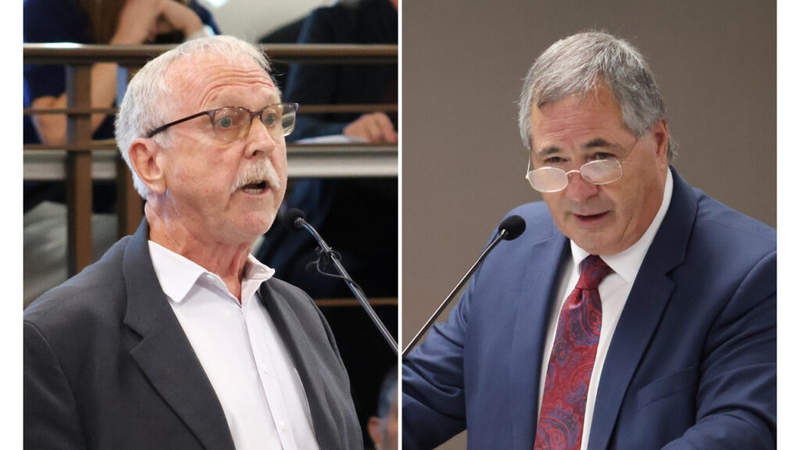
Vern Thompson, left, a Democratic-NPL candidate for agriculture commissioner, and Republican Agriculture Commissioner Doug Goehring, speak during legislative committee hearings. (Photos by Michael Achterling and Jacob Orledge/North Dakota Monitor)
Vern Thompson is challenging Doug Goehring for North Dakota agriculture commissioner, but has been most vocal about controversial data center plans in the state.
Thompson, a Democrat, said he is running in part because the ag commissioner is one of three members of North Dakota’s Industrial Commission, which has committed to supporting a natural gas pipeline that Thompson said will ultimately benefit data centers.
But many residents are apprehensive about those data centers, Thompson says.
Thompson has led a series of meetings on data centers, with attendees concerned about health effects, using up prime farmland and the state being overwhelmed by demand for electricity and water.
Goehring, a Republican, called the data center discussions “political grandstanding.”
“He’s running for the wrong office,” Goehring said. He said Thompson should be running for the Legislature, which is considering regulations on artificial intelligence and listening to data center concerns.
Thompson has previously served in the Legislature and originally announced a run for North Dakota’s only U.S. House seat. After Trygve Hammer earned the Democratic-NPL endorsement for the congressional office, Thompson turned to challenging Goehring.
Thompson points to the state’s financial guarantee of up to $500 million for the WBI Energy natural gas pipeline and loans to Minnkota Power and Reliant Carbon Capture and Storage for Project Tundra as bad public policy.
“People are tired of the corporate welfare,” Thompson said.
Goehring said the money to support a pipeline to bring natural gas to eastern North Dakota was appropriated by the Legislature. He said the Industrial Commission’s job was to evaluate the proposed projects to ensure viability.
He said the state’s backing should help get the project moving and attract other customers, with little chance that the state money will be needed.
The WBI Bakken East Pipeline needs approval from the Federal Energy Regulatory Commission. The project’s customers have not been made public. State officials have said customers could potentially include utilities, industrial users and others such as data center developers.
Goehring, who farms and ranches with his family near Menoken, has been ag commissioner since 2009, when North Dakota was on the verge of a major oil boom. He points to positives from the Industrial Commission, such as reducing the footprint of oil development by encouraging grouping oil wells together. He also points to a pipeline reclamation program and projects and loans to improve water supply and housing in the state.
The Industrial Commission oversees the Bank of North Dakota, which has implemented a loan program to help ranchers rebuild their cattle herds, help farmers repair or replace storm-damaged storage facilities and loans to help ag producers through difficult financial times.
As an energy-rich state, Goehring said it is important to encourage pipeline and transmission line development, which the Industrial Commission has done.
He also has worked to develop export markets for North Dakota ag commodities.
“We’re a state that exports commodities because we have an abundance, but we also have an abundance of energy. So taking and developing those resources is a big deal,” Goehring said.
Thompson said North Dakota residents are feeling run over by those projects.
He pointed to rural roads rutted by construction traffic, property owners being threatened with eminent domain and industrial development changing the rural landscape.
Thompson runs a trucking company in Fargo but has a farm background in Benson County.
Thompson said one priority for him is to address food affordability by pushing for a meat processing cooperative in the state.
He said consumers are paying for the high transportation costs of North Dakota beef going to out-of-state processing and then having the processed meat come back into the state.
He said limited competition among the “big four” meat packers keeps meat prices high.
“Farmers and ranchers aren’t the problem when it comes to the high cost of food,” Thompson said. “When it comes to the high cost of beef in the grocery store, it’s the meat packers.”
Goehring said he doesn’t have a list of priorities for the next four years, if reelected, but said he would continue to support ag research and opening up trade opportunities.
But he said he mostly takes direction from the Legislature, executing their directives.
North Dakota livestock relief program funds 470 projects as most of state remains in drought
“My vision and plan is: How can we continue to be responsive and accountable? How can we make sure that we’re doing a good job in providing regulatory oversight?” Goehring said.
He said he hears from people that get frustrated by rules on a variety of topics that his agency doesn’t set, from federal food aid eligibility requirements, to diesel fuel regulations and meat inspection and sales.
“A lot of times we’re just fielding questions about that, trying to help people understand,” he said of the Ag Department.
He said the agency is limited in what it can do by state statute.
“You just don’t venture out into things that you don’t have the authority to do,” Goehring said.
Reach North Dakota Monitor deputy editor Jeff Beach at [email protected].
Bismarck, ND