Democratic gubernatorial contender Jerri Green talks affordability, Republican supermajority
Sep 28, 2026 | 6:01 am ET

Description
Memphis Councilmember Jerri Green is the Democratic candidate for governor. (Photo: John Partipilo/Tennessee Lookout)
Democrat and Memphis City Councilmember Jerri Green stood in Paris, Tennessee’s Eiffel Tower Park Sept. 20 in sweltering heat to tell a crowd of about 300 people why she should be Tennessee’s next governor.
Paris is the seat of Henry County, a rural West Tennessee county of about 32,000 people that went 77% for President Donald Trump in 2024.
Her platform: Use unspent Temporary Assistance for Needy Families funds to erase medical debt, waive housing security deposits and clear childcare waitlists. Issue an executive order to ensure doctors can practice women’s healthcare without fear of prosecution under Tennessee’s anti-abortion laws. End the Tennessee Highway Patrol’s cooperation with U.S. Immigration and Customs Enforcement. Stop state incentives for data centers. Stop renewing private prison contracts. Appoint an education commissioner with classroom experience. Stop giving tax rebates to big businesses and eliminate the grocery tax.
“Part of my plan is to start using the funds that we’re hoarding right now to relieve some pressure on everyday citizens, and then we can talk about that $2 billion rainy day fund, and if that’s how much we actually need … or if we need to consider that it’s Noah’s Ark out there for a lot of the residents and citizens in Tennessee, and we need to be helping them now,” Green told The Lookout in an interview.
In Lawrenceburg, near the Alabama border, 130 people showed up to meet her. In Claiborne County, 125 attended.
At each campaign stop, Green said she meets self-identifying Trump voters looking for a change. She always asks them why.
“They’re tired of the chaos and the culture wars, and they just want somebody who’s going to not gaslight them about grocery prices or gas prices and talk about real solutions,” Green said.
Will it be enough to give her the upper hand in a race that’s gone solidly to Republican candidates since 2010? Green thinks so.
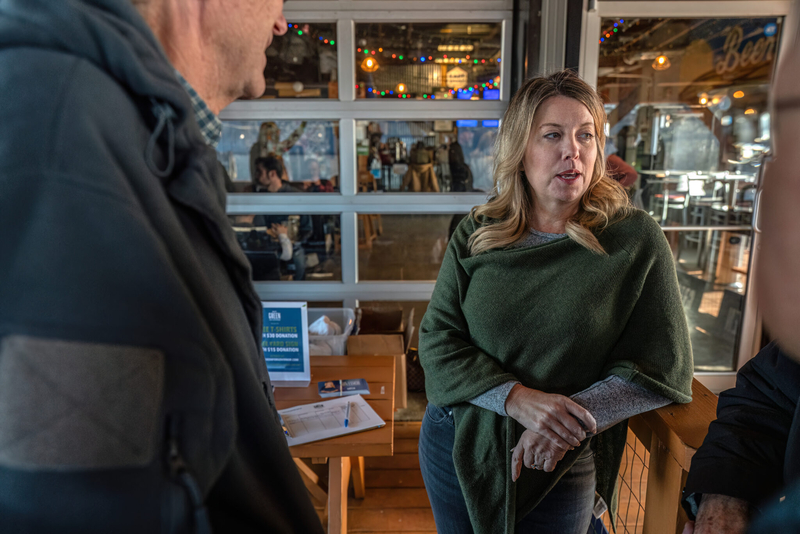
(Photo: John Partipilo/Tennessee Lookout)
Outgoing Gov. Bill Lee is term-limited, leaving the state’s top seat open for the first time in eight years.
Green is campaigning against Republican U.S. Sen. Marsha Blackburn, a constant in Tennessee electoral office since 1999 and a Trump loyalist. Also in the field are businessman David Hatley, a conservative-leaning independent who is personally financing his campaign with up to $7 million, and Lauren Pinkston, a former Lipscomb University professor running as an independent with a moderate political bent.
Recent polling suggests Blackburn could claim between 46-51% of registered voters — less than Lee’s margins, which topped 60% in 2018 and 2022. Blackburn’s campaign recently funded a website attacking Hatley for a 1998 felony conviction, indicating she may see him as a threat to her overall support.
Green isn’t concerned about Hatley or Pinkston, the latter of whom she formally called on to drop out of the race on Wednesday. (Pinkston rejected Green’s request.)
“(Hatley) seems to be attacking and pulling from Marsha Blackburn’s voters, so he can continue to dump tens of millions of his own dollars into the race,” she said. “He’s not polling above 10% in any independent statewide poll.”
A mid-September poll of 600 likely voters, paid for by The Progress Fund, a Knoxville-based political action committee supporting Green, put Blackburn at 45%, Green at 36%, Hatley at 10% and Pinkston at 2%.
Green said her campaign has raised more than $1.5 million from all 95 counties, with an average donation of under $50 and 95% of donations coming from within Tennessee.
The latest campaign finance reports are due Oct. 13. Green’s pre-primary report shows she raised nearly $147,000 in July, on top of nearly $550,000 she previously reported. While she has accepted funds from labor unions, her coffers contain no donations from corporate PACs, pro-voucher groups, “big Pharma” or “big data,” Green said. Green’s largest donation — $15,400 — came from The Progress Fund.
The independent candidates should drop out and support her campaign, she said.
“If they’re really worried about seeing Marsha Blackburn (win), they need to stop vote-splitting, they need to stop doing these vanity projects and actually think about the people in Tennessee and say, ‘We can’t have Marsha Blackburn. I’m asking you to vote for Jerri Green. She’s the only one with a viable path to beat her.’”
Memphis attorney, councilmember takes a swing at governor’s seat
Green, interim Chief Public Defender of Shelby County, holds a law degree from Georgetown University and previously served as Shelby County Mayor Lee Harris’ deputy chief of staff and senior political advisor. Her political tenure is brief compared to Blackburn, who entered elected office as a state senator in 1999, served eight terms in the U.S. House of Representatives and was first elected to the U.S. Senate in 2018.
Green revived the “One Tough Mother” tagline she used in the 2020 race against Mark White to represent District 83 in Tennessee’s house. She lost that race to White, the Republican incumbent, securing 46% of the vote to White’s 54%. She thought that would be her first and last political campaign, Green said.
But in 2023 she returned to the campaign trail in a bid to represent Memphis’ District 2 on city council. While the council is nonpartisan, District 2 was held by Frank Colette, a state Republican committeeman who had represented the district since 2016. He did not run for reelection in 2023. Green clinched the seat in a runoff election by 1.6%.
“I learned a lot about what it takes to actually flip a seat, and the kind of effort you have to put in,” Green said.
She never planned to run for governor, but after multiple people pitched the idea, she thought of her kids’ futures and decided to give it a go, Green said.
“My youngest is autistic, and they want to dismantle the Department of Education and take money out of our public schools,” she said. “My daughter has less rights than her grandmother. My oldest will be going off to college soon, and I don’t know if he’ll still have a $7.25 an hour job when he gets out.”
“The future is just really bleak out there for a lot of people, and I just kept coming back to the fact that I’ve got to look them in the eye every day and … I wanted them to see their mom actually did everything she could,” Green said.
District 83 matchup features “one tough mother” against five term incumbent
Working alongside a Republican supermajority
If Green does win the race, she’ll be working with a Republican supermajority in the Tennessee General Assembly.
She plans to model her governorship after Democratic Kentucky Gov. Andy Beshear, who also works in a state whose legislature is solidly red. Green posted a video with Beshear on social media earlier this month.
Tennessee legislators have gerrymandered the state so “they’re picking their voters instead of voters picking them, and they represent a lot of extremism because of that,” Green said.
She said she plans to hold lawmakers accountable for voting in ways their constituents don’t agree with — even tiny towns in red districts may not like vouchers, Flock cameras and data centers. She’s ready to host press conferences and town halls and post billboards to put pressure on legislators.
Still, she’d be “happy to work with them” on some issues, giving the legalization of cannabis as an example (Republican legislators have introduced bills that would legalize medical marijuana over the years, but none have passed).
Green said she’ll use gubernatorial veto power in cases where legislators seek to pass bills that could harm LGBTQ communities, Muslims, immigrants or women, for example.
“I’m not going to continue to do what they’ve been doing, which … is passing more lawsuits than laws,” she said, citing her experience as an attorney.
If she could convince the state legislature to do one thing, it would be to adopt Medicaid coverage expansion under the Affordable Care Act. Tennessee is one of 10 states that haven’t, citing concerns of financial burden on the state’s budget. Accepting the expansion would extend healthcare benefits to about 300,000 uninsured Tennesseans currently in an eligibility gap.
“The number of people that I have met across this state that have been bankrupted, that are losing their homes, being forced out of retirement, making decisions about cutting medications in half versus having food versus paying their utility bill is terrifying, and there’s no reason for it,” Green said.
Green said she sees New York City Mayor Zohran Mamdani as an example of how to work with President Donald Trump and his administration.
“You can still speak your truth, which is, I think (Trump) is an authoritarian, I think he’s detrimental to democracy … Mamdani said all that, and he’s also been to the White House and had conversations with them to get investment in public transportation,” Green said.
Nashville, TN