After a fight for equality in the 1980s, Chattanooga civil rights activists prepare for new effort
Sep 28, 2026 | 6:00 am ET
Description
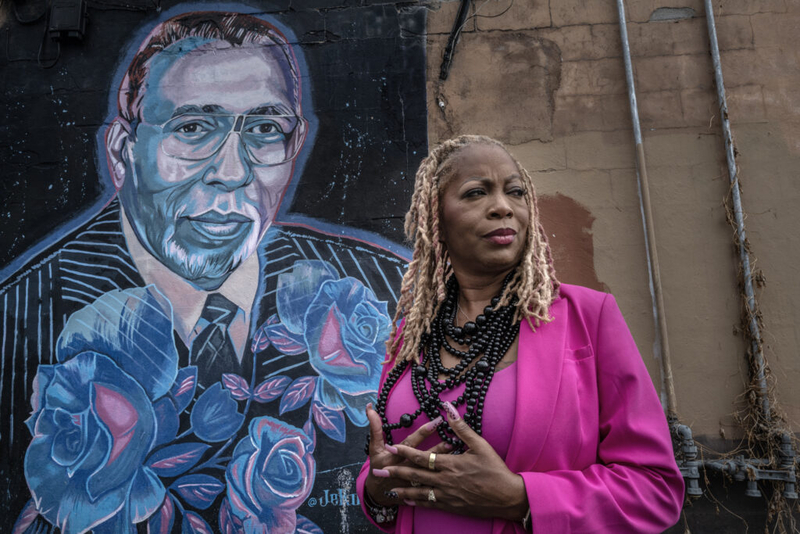
"They're trying to take away the vote we had," says Fran Pierce of the Louisiana v. Callais decision. Pierce stands in front of a mural of her father, Leamon Pierce, a longtime member of Chattanooga City Council. (Photo: John Partipilo/Tennessee Lookout)
CHATTANOOGA, Tenn. — Afternoon light slipped through the curtains of a dimly lit room on Martin Luther King Boulevard in Chattanooga. Black residents, clergy members and activists gathered in early May to organize opposition to Tennessee state lawmakers’ congressional redistricting effort, aimed at eliminating the last Democratic-held seat in the state.
The rapid redistricting effort in May by Republican state lawmakers came in response to a major U.S. Supreme Court decision, Louisiana v. Calais in late April carving out Section 2 of the Voting Rights Act, a cornerstone of the Civil Rights Movement.
During a meeting hosted by the Hamilton County Branch of the National Association for the Advancement of Colored People, NAACP, Chattanooga resident Fran Pierce stood in front of the podium. She apologized to the crowd, sitting in folding chairs, for arriving late.
“They are trying to take away the vote we have. I think about the things my dad endured before I was even born. My dad Leamon Pierce went to Selma, Alabama for the march, sat in a church with Martin Luther King. They gathered to go make a change,” Pierce said. “Where are we at? Because it’s our voices that need to be heard, our vote that they’re trying to take away.”
Her father, Leamon Pierce, was a plaintiff in the 1989 case Brown v. Board of Commissioners of the City of Chattanooga, where a federal court found Chattanooga’s system of government violated Section 2 of the Voting Rights Act by diluting Black voting power and depriving Black residents of meaningful representation.
Leamon Pierce went on to become one of Chattanooga’s first Black and longest-serving council members.
In late May, Fran Pierce sat in a small office at Liberty Bonding Company, tucked away just off Martin Luther King Boulevard in Chattanooga. Her father started the business in 1974, as one of the first black-run bail bondsmen.
Pierce, who has continued to run the operation after her father’s death, gestures to the wall behind her where a portrait of Leamon Pierce attached to a city council plaque hangs on the wall.
“I realized I can’t keep sitting down, I gotta stand up,” Pierce said. “As I was growing up, I didn’t see it, didn’t understand it, but I know my dad was preparing me for something much bigger than me, and that I got to be ready to move.”
Pierce said she was in her early 20s when Brown v. Chattanooga went to trial, and her father’s involvement in the case and its impact on voting rights for Black Chattanoogans hadn’t fully registered until now.
Now, decades after the civil rights case, Brown V. Chattanooga, forced an overhaul of city government to ensure greater Black representation, the strength of the Voting Rights Act that underpinned that decision has been weakened.
Lorenzo Kom’boa Ervin, 79, was a plaintiff and championed the class action lawsuit.
It’s likely the most important civil rights decision ever in East Tennessee, Ervin said.
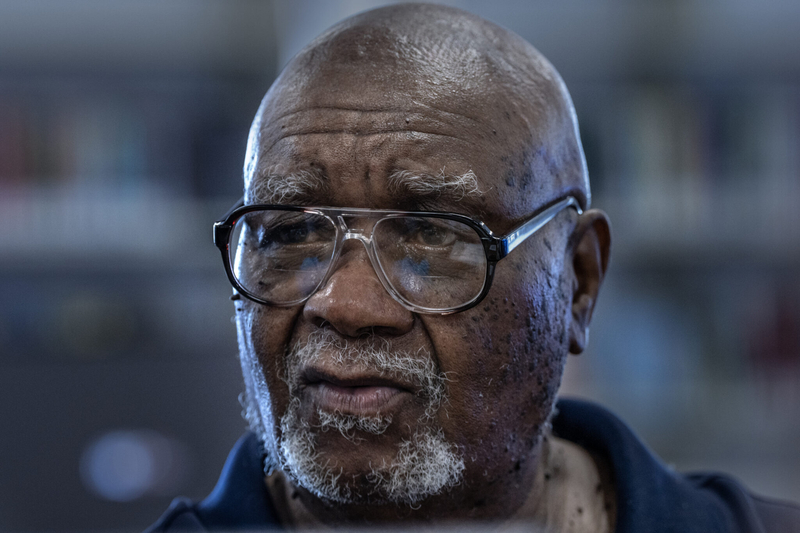
“The decision was that they had to completely change this government. So it was revolutionary in that sense,” said Ervin.
A judge ruled that the adopted structure had discriminatory intent to curb Black political influence and impaired the ability of Black voters. He ordered it be changed, creating three council districts with a majority Black population to ensure greater representation in Chattanooga.
Before the ruling, local government existed as a board of commissioners whose members were elected at-large. The top five vote getters, regardless of location, served on the board.
A Black person was not elected to the commission until 1971. Black people made up nearly 32% of Chattanooga’s population in 1980, according to court documents.
“Of course, it (the lawsuit) wasn’t appreciated by the authorities, and even by some elements in the Black community it wasn’t appreciated, but they had to acknowledge that it was going to happen, with or without their say so. So they realized they couldn’t stop it,” Ervin said. “There’s no way to stop it. That was the power of the Voting Rights Act.”
From 1982 to 2024, nearly two-thirds of the more than 450 challenges invoking Section 2 involved local government practices, according to a study by the University of Michigan Voting Rights Initiative. Ten of the cases were brought in Tennessee, including six targeting local government bodies.
Before the Callais decision, in cases like Brown v. Chattanooga, plaintiffs could prove racial discrimination in the way district maps were drawn by showing consistent lack of representation. Now, a legal challenge of a map must prove districts were intentionally drawn to disadvantage a racial group, which dissenting judges said is nearly impossible.
The ruling prevents intentionally considering race as a factor when drawing a district, which directly contradicts the previous practice of purposefully drawing districts to have a majority black or minority population as a way to ensure representation for populations that have been historically disenfranchised in the U.S.

The Callais ruling allowed Tennessee Republican lawmakers to swiftly pass redrawn congressional district maps in May, three months before primary elections, cracking the majority Black Congressional district of around Memphis into three.
But the ruling is not limited to congressional districts; it applies to all electoral maps, including state House and Senate district maps as well as county and city districts.
Up till now, state Sen. Bo Watson, a Chattanooga Republican, said to his knowledge the Hamilton County state delegation hasn’t been involved with local redistricting, but he expects that to change.
“I think state leaders will look more closely at local maps than perhaps we did in the past, only because there’s a heightened awareness to it, not necessarily because of any desire to do anything outside what the locals might want to do,” Watson said by phone. “Certainly I think state leaders are going to be more interested in how local leaders are drawing their maps than perhaps we have in the past.”
Local offices could draw redistricting effort
Every 10 years, based on new census data, city and county governments are required to meet and decide whether to redistrict. New maps are drawn and voted on by local elected officials. All district maps for city and counties must comply with both state and federal laws and if they are in violation they can be challenged in court.
Watson said he is not currently focusing on redistricting efforts before the 2030 cycle, but he won’t be surprised if there is a legislative push in the next session.
Democratic state lawmakers Sen. Charlane Oliver of Nashville and Rep. Yusuf Hakeem, the only Democratic state lawmaker representing Hamilton County, both said in interviews that they are prepared for Republican state lawmakers to make a play for control of local redistricting
“I would not be surprised if we had some Republicans try to redistrict county government and school board, city council,” Hakeem said in an interview. “I think the reality of it is this has awoken the coinsciouness of people that have been misused and abused by the Jim Crow.”
Our representation is thin, to say the least, but my concern is that it will totally be eviscerated with time.
Existing state laws already exist for the creation of new local districts.
Watson said he is proud that in the three times since 2010 Republican state lawmakers have passed new maps, including the most recent congressional one, they have withstood legal challenges.
“So at least the time that we’ve [Republicans] been drawing the maps, we have drawn them within the requirements of the law,” Watson said. “Whether you like them or not, that’s a different question. But the fact of the matter is, we draw them within what the law requires us to do.”
For decades, Councilmember Ron Elliot said the city has maintained three majority minority districts honoring the directive made in the Brown v. Chattanooga decision.
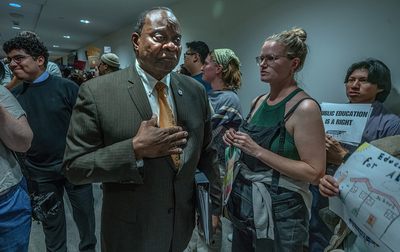
“But there’s a lot of concern. It’s a lot of unease. We see it at the congressional level. I’ve heard some whispers months ago about our state looking at local redistricting and particularly partisan races, and cross your fingers and hope like, hey, hopefully that stops at some point,” Elliot said.
Rev. Ernest Reid of Chattanooga’s Second Missionary Baptist Church, a voting rights activist, said in an interview directly after the Callais decision that he had grave concerns about the future of the local majority-minority districts.
Reid said he is particularly wary about Hamilton County Commission districts.
County commission maps, which also define school board districts, passed ahead of the 2022 election cycle and maintained two majority-minority districts, currently represented by two Black men.
What if the commission, currently majority Republican and white, aims to merge the two districts, he said, or racially gerrymander them? If those seats are drawn out, Black people will likely have no representation in county governance, Reid said.
And now there will be few options for legal recourse if that happens, he said.
“Our representation is thin, to say the least, but my concern is that it will totally be eviscerated with time,” Reid said
A lawsuit was the only path to progress
In the 80s, Ervin said legal action felt like the only path to progress.
The legal case against the city’s government was not won easily, Ervin said; other attempts to rectify mistreatment of Chattanooga’s Black community and address representation were futile.
In the years leading up to the lawsuit, Ervin said he worked with an activist group, Concerned Citizens for Justice, and held protests at city hall, attended meetings, brought experts and met with the mayor in an effort to compel the city to address issues afflicting the Black community in Chattanooga.
None of it, Ervin said, brought about change.
“We were able to put together the case based around the long history of racial discrimination in the electoral process itself, but also years of racial animosity, created by the local government and local officials against the Black population,” Ervin said.
Ervin, along with members of the Concerned Citizens for Justice, spent more than three years combing the city’s libraries and state records to document Chattanooga’s police brutality, the disproportionate number of Black people killed by police and racial discrimination in housing, employment and public benefit programs before any legal representation agreed to take on the case.
Some 20,000 exhibits were compiled for the case, Ervin said, which went to trial after another two years of preparation in 1989.


“The lawsuit changed this place in a lot of ways,” Ervin said about Chattanooga. “We brought an end to a certain kind of racial segregation where black people couldn’t run for office, it’s just amazing. I think about it sometimes that all the people that are in office now, and practically all the ones who came before and after them, were as a result of that lawsuit.”
Pierce said the precedent set by the court case is reflected in her late father’s legacy on Chattanooga City Council.
Pierce said after the Supreme Court decision and subsequent redistricting effort spurred a new understanding of her father’s work she plans to take action to protect his contributions and defend Black civil rights.
Since May, Pierce said she has been driving around and handing out voter registration forms. Pierce plans to run for city council. She said she wants to stand up as her father did.
“My goal is to get the next generation, we got to reach the community, the ones that don’t know, like I didn’t know back then,” Pierce said. “Let’s get out, because you got a voice and if you don’t use your voice, it’s going to be taken away.”
Ervin credited the power of the Voting Rights Act for forcing change in Chattanooga but said it was the preceding protest movement that made the case possible.
“It was the people in the streets. It was especially working class black people in Alabama and Georgia and Mississippi, and everywhere else that created this movement that couldn’t be stopped, and that ultimately led to the stage of they created the Voting Rights Act,” Ervin said.
Ervin said creating a movement is the only way to push back.
“So, our role in this period is to not accept unjust authority, to not accept a return back to the outright racism and white supremacy that ran this country, ran the South especially, back in the 1960s and 50s,” Ervin said “So in that sense, I’m not afraid of what the Supreme Court does or whatever, because the Supreme Court ever only responded to what the people have done, if the people are willing to stand up and to fight back against these unjust conditions, as as happened back in the 60s and has happened before that, then they can stop anything.”
Nashville, TN