Hinson highlights support for bills to support rural cancer treatment, research in rural Iowa
Sep 25, 2026 | 8:15 pm ET
Description
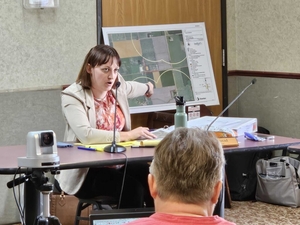
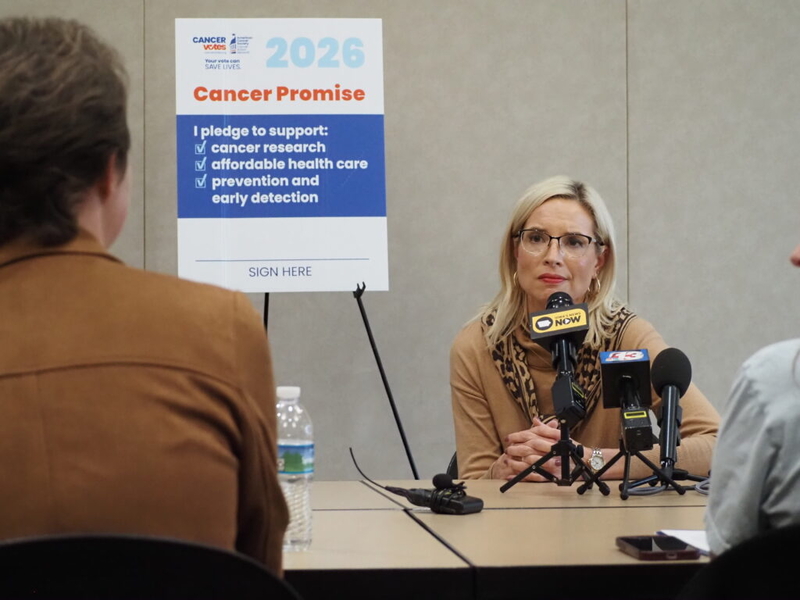
U.S. Rep. Ashley Hinson, who is running for Iowa's U.S. Senate seat in 2026, met with advocates with the American Cancer Society - Cancer Action Network at the Urbandale Public Library Sep. 25, 2026. (Photo by Robin Opsahl/Iowa Capital Dispatch)
U.S. Rep. Ashley Hinson highlighted her support for measures to detect cancer and increase clinical trials in the U.S. House while speaking with advocates Friday, saying she would continue this work if elected to the Senate in 2026.
Hinson met with volunteers with the American Cancer Society Cancer Action Network (ACS CAN) as part of the organization’s “coffee cancer chat” series, nonpartisan events to discuss cancer with Iowa candidates ahead of the midterms. Many other candidates, including Hinson’s general election opponent, Democratic state Rep. Josh Turek, have met with ACS-CAN advocates in recent months to discuss their plans to address cancer in the state.
Cancer has been a defining issue in the 2026 Iowa election cycle because the state has the nation’s fastest-rising cancer rate, as well as the second-highest number of new incidents of cancer.
After cancer patients, survivors and family members shared their stories with Hinson about battling cancer, Hinson shared her own family experience of having her grandmother and two aunts who died of cancer. When she was thanked for sharing her own family’s experience with cancer, Hinson said “unfortunately, it seems like everybody has one,” saying, “that’s why we’re here and that’s why we do what we do.”
Some of the work on cancer treatment, prevention and research is already underway in Congress. ACS-CAN advocates thanked Hinson for cosponsoring the Clinical Trial Modernization Act.
Lori Johnson, one of the advocates at the meeting who was diagnosed with cancer in 2025, said the measure was “one of our big asks as ACS-CAN at the national level.”
She thanked Hinson for having staff meet with advocates about the bipartisan proposal that would create a grant program supporting outreach, education and recruitment efforts for medical clinical trials specifically for underrepresented populations — including people in rural areas.
Hinson said the bill “really clarifies the gray area in making sure people feel like they can participate” in clinical studies.
Access to clinical trials is not the only issue facing Iowa’s rural healthcare system. Several rural hospitals have closed in recent years, and Democrats say the 2025 One Big, Beautiful Bill Act — the large tax and spending bill supported by Hinson and other Republicans in Congress which included Medicaid cuts — has worsened financial struggles for struggling healthcare systems and hospitals in the state.
But Republicans have argued the infusion of money from the federal Rural Health Transformation Program, authorized through the OBBB, will help rural healthcare providers in Iowa. The state was awarded $209 million in December 2025 through the program, which is set to allocate a total of $50 million to states between 2026 and 2030 in order to offset an expected $137 billion decline in rural Medicaid spending over the next decade.
Hinson said the Rural Health Transformation Program ensures money is going to facilities most in need.
“You talk about targeting those resources directly to rural counties in rural America to keep those facilities open (so) they can continue to provide cancer care where people are — I think is really really critical,” Hinson said. “So that was a funding stream that I was very proud to support.”
Hinson also said she would also support increasing pediatric cancer research funding, pointing to legislation she introduced in August to provide funding for pediatric and rare forms of cancer through a “a portion of federal funds collected on imported tobacco products,” according to a news release. This measure, Hinson said, mirrors the 2025 state law signed by Gov. Kim Reynolds in May creating a tax on nicotine products like vapes and pouches with the first $3 million in generated revenue going to research, clinical therapy trials and leadership at the University of Iowa children’s hospital.
Hinson’s federal proposal would create “a dedicated funding path” for this research, she said.
“If this was able to pass, (it would) take some of the tobacco import tax money basically, and put it toward cancer treatment and research,” Hinson said. “So, if it had passed, it’d be $24 million just this year. So, it’s a little, but hopefully a little can turn into more. But, specifically for rare cancers and for pediatric cancers — and so those are two places that are traditionally underfunded or under-resourced as well.”
Des Moines, IA