Kansas attorney general’s campaign amends finance report to address donation-limit controversy
Sep 25, 2026 | 2:37 pm ET
Description
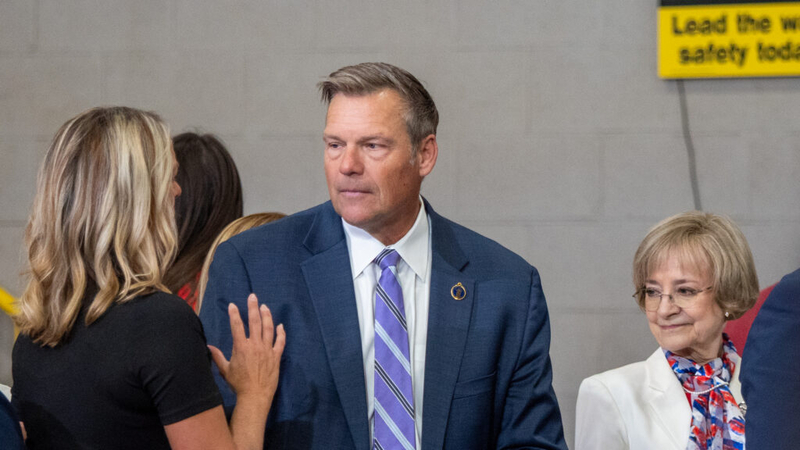
Kansas Attorney General Kris Kobach appears at a Sept. 14, 2026, rally by Vice President JD Vance at Webco Manufacturing in Olathe. Kobach's July finance report showed contributions from two donors that exceeded legal limits. (Photo by Sherman Smith/Kansas Reflector)
TOPEKA — Attorney General Kris Kobach revised his July reelection campaign finance report after questions were raised about individual donations that appeared to violate the maximum contribution limit under Kansas law.
Requests for a formal inquiry by the Kansas Public Disclosure Commission, which is responsible for monitoring, investigating and regulating campaign finance statutes in Kansas, centered on the July report submitted by Kobach. The first point of contention was tied to two donations of $8,328 each on the same day in June by Steve Noller of Kansas. The second red flag was in regard to a pair of donations May 5 totaling $10,000 from Christopher Ruddy of Florida.
In 2025, the Legislature doubled the individual donation cap on candidates for statewide office to $4,000 for the primary and $4,000 for the general election. The manner in which Kobach originally documented donations by Noller and Ruddy exceeded those amounts.
“Kris Kobach’s own campaign filings appear to show that he either violated Kansas’ campaign finance laws numerous times this election cycle or he submitted inaccurate reports. He should be investigated either way,” said Tiffany Muller, president of End Citizens United.
End Citizens United is an organization dedicated to nullifying the 2010 U.S. Supreme Court decision enabling corporations to spend unlimited amounts on campaigns.
In response to issues raised by Muller, Kobach’s campaign filed an amendment report in September covering the primary election cycle. It attributed portions of contributions initially credited to Noller and Ruddy to members of their respective families. Half of Noller’s donations were transferred to Virginia Noller of West Palm Beach, Florida. In addition, $2,000 of Ruddy’s donation was assigned to Sonja Ruddy, also of West Palm Beach, Florida.
Danedri Herbert, a spokesperson for Kobach and chair of the Kansas Republican Party, said the documents were amended in early September.
“The donations are from married couples,” Herbert said.
Muller’s complaint to the state Public Disclosure Commission also pointed to the Kobach campaign’s depiction of Noller paying donation processing fees of $656. Under Kansas law, the fees could be interpreted as contributions to Kobach in excess of the state cap.
A spokesperson for Chris Mann, the Democratic candidate for attorney general seeking to oust Kobach in November, said there was no excuse for shortcomings in Kobach’s campaign finance report.
“After running for nearly every major office in Kansas and currently serving as the state’s chief law enforcement officer, there is no excuse for not knowing or following the rules,” said Leah Rymer, a spokesperson for Mann. “Kris Kobach either doesn’t understand Kansas campaign finance laws or he is flouting the rules to improve his campaign’s financial standing.”
Before elected attorney general in 2022, Kobach served from 2011 to 2019 as Kansas secretary of state, a job making him the state’s top elections officer. He ran unsuccessfully for Kansas Senate in 2000, U.S. House in 2004, governor in 2018 and U.S. Senate in 2020.
Steve Noller is part of a prominent Kansas automobile dealership empire, while Christopher Ruddy is CEO of the cable news channel Newsmax.
In addition to the End Citizens United complaint about Kobach exceeding the aggregate donation cap, the Kansas Coalition for Common Sense said Kobach’s shortcomings in terms of campaign reporting should be considered in light of his previous role in fundraising controversy.
“Kris Kobach has a long history of ethics complaints and questionable dealings, including his work for a nonprofit whose founder pled guilty to wire fraud and was accused of money laundering. Another ethics complaint comes as no surprise,” said Ashley All, spokesperson for the coalition.
Muller, of End Citizens United, asked the state Public Disclosure Commission to investigate potential recordkeeping violations by Kobach that were reflected in his January and July reports. She said Kobach categorized contributions to his reelection campaign as donations for the primary election. The attorney general didn’t submit a last-minute contribution report, she said.
Muller said it was odd Kobach reported no in-kind contributions during the 19 months covered by finance reports associated with his reelection bid. Kobach didn’t note, for example, his campaign kickoff at Sedgwick County Republican Party headquarters that was promoted by the state party.
“Kobach’s filings are littered with apparent violations that raise serious red flags, and he owes Kansans a full accounting of what happened,” Muller said.
The predecessor of the Kansas Public Disclosure Commission in 2011 ordered Kobach to pay a $5,000 fine for inaccurate reporting of $75,000 in contributions and expenditures during his initial campaign for secretary of state in 2010.
Kobach was chairman of the Kansas Republican Party from 2007 to 2009. After leaving that position, a Federal Election Commission audit found the Kansas GOP had accepted unlawful contributions while under his leadership.
In 2022, the FEC said Kobach’s 2020 campaign for U.S. Senate accepted unlawful in-kind corporate support from We Build the Wall. Kobach, who worked as general counsel to the organization, failed to report his under-market rental of We Build the Wall’s 295,000-person donor list while striving to raise money for his U.S. Senate race.
The FEC ordered We Build the Wall and Kobach to pay a $30,000 civil fine. Four other leaders of We Build the Wall were found guilty of fraud by diverting donations for personal benefit.
Topeka, KS