Poll: Wording of redistricting amendment difficult for voters to understand
Sep 24, 2026 | 10:52 pm ET
Description
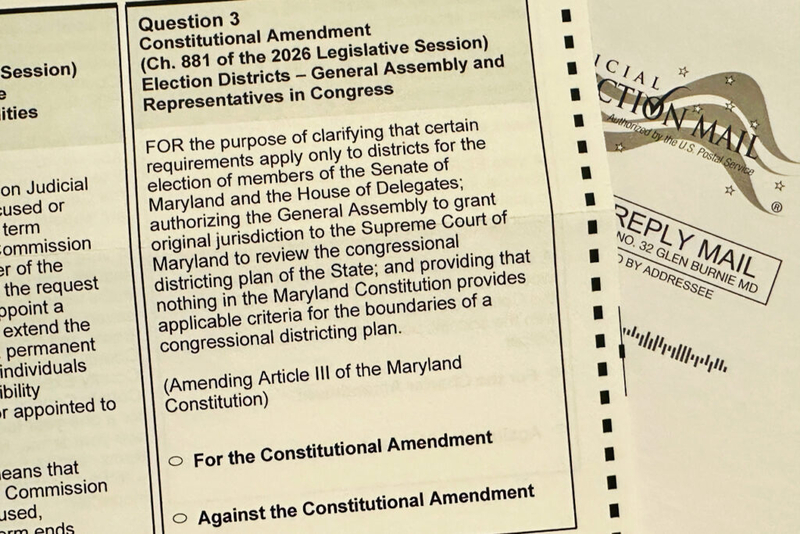
A new poll finds that a ballot question related to a constitutional amendment that would eliminate state standards in congressional redistricting is hard for voters to understand even after the Supreme Court of Maryland rewrote the original question after finding it was misleading. (Photo Bryan P. Sears/Maryland Matters)
A ballot question asking Maryland voters to approve a sweeping change to the state constitution on congressional redistricting may be too convoluted for most voters to understand.
One in four voters in a new poll released by Fight Back Maryland, which supports passage of Question 3, were undecided when asked about the proposed constitutional amendment that would remove state standards for drawing congressional districts. The reason appears to be the amendment itself.
The poll, released Thursday, said that when people were read the question as it appears on the ballot, 40% supported it and 35% said they opposed it, while 25% were undecided. But when the same voters were provided with a “positive messaging statement” and read the question, undecideds dropped to 11% and support rose to 53%.
The Fight Back Maryland poll contradicts one released earlier this week by Protect Maryland Votes, a group that opposes the change. The earlier poll showed a plurality of voters opposed Question 3.
Doug Mayer, a spokesman for Protect Maryland Votes, dismissed the latest poll as a survey conducted by “a lifetime partisan pollster.”
“Clearly somebody’s boss forced them to put this out. The best they could do is 40% with a totally partisan push poll in Maryland? Guess we got under their skin,” Mayer said.
Hart Research Associates, a firm that works with Democratic Party candidates, conducted the survey of 600 likely Maryland voters for Fight Back Maryland from Sept. 8-10. The poll has a margin of error of plus or minus 4%.
In a memo on the poll released Thursday, the firm wrote that “the playing field is FIRMLY in favor of Question 3, not just ‘demographically’ in terms of the state’s large Democratic registration advantage, but equally important, the strong opposition to Trump/MAGA and the importance that Marylanders place on electing a Democratic majority to Congress.”
The poll also highlights a distinct challenge.
Following a first round of questioning in which the ballot question was read to voters, the most common comment given was, “I don’t understand the amendment.”
“The open-ended question we asked after the initial trial heat helps explain the 25% undecided AND gives direction to the task ahead,” the firm wrote in the memo.
The confusion highlights another challenge. The issue of Maryland entering into hyperpartisan congressional redistricting has been front and center in Maryland politics for the better part of a year when some lawmakers began calling for new maps.
Gov. Wes Moore (D) created a redistricting task force last fall to hold public hearings and recommend a new congressional district map. He then engaged in a bitter back-and-forth with Senate President Bill Ferguson (D-Baltimore City), who sent a redistricting bill to legislative purgatory in February.
The legislature convened for a two-day special session in August and passed the constitutional amendment that would become Question 3. The bill was struck down by circuit court judges in Anne Arundel and Dorchester counties, in separate lawsuits, only to be overturned on appeal to the Supreme Court of Maryland.
The state’s highest court noted that the original question passed by the legislature was “misleading and therefore violates due process requirements.” Instead of striking the question, however, the court’s majority opted to rewrite the question. That version is what voters will see on the ballot.
In a dissent, Justice Steven B. Gould said the new version did not resolve the court’s concerns about clarity.
“Maryland voters reading it would not understand that the criteria being removed include the guarantees of the Declaration of Rights — the collection of sacred rights that protect Marylanders against government overreach,” Gould wrote.
The poll released Tuesday by Protect Maryland Votes found that 40% of those surveyed opposed the amendment compared to 28% who supported it. The poll also found 31% said they were undecided.
Voters surveyed in the poll were read the exact question as it appears on the ballot.
That poll of 600 likely Maryland voters was conducted between Sept. 10 and 13 by two firms: Ragnar Research Partners and Lincoln Park Strategies, Republican and Democratic polling firms respectively. That poll has a margin of error of plus or minus 4%.
A spokesperson for Fight Back Maryland dismissed the Tuesday survey as “a junk poll.”
Annapolis, MD