At least 900 Flock cameras have been unplugged in Texas since state funding was cut
Sep 24, 2026 | 12:00 pm ET
Description
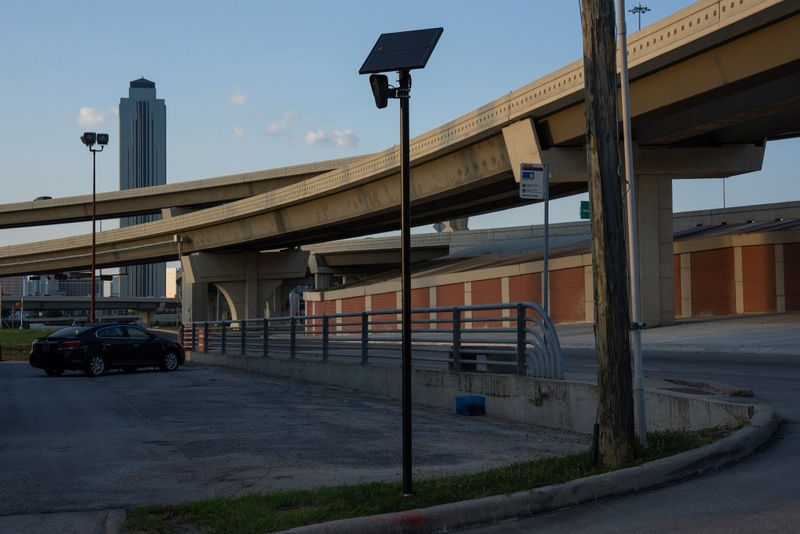
A Flock camera records drivers entering and exiting the southbound I-610 feeder road from a side street in Bellaire on Aug. 23, 2026. (Jon Shapley for The Texas Tribune)
Laredo, cut off from state funding for its Flock cameras, will ask voters for advice on whether to devote $1 million a year to keep 165 of the surveillance devices operating in city limits.
The Laredo City Council voted 7-2 Monday night to set a nonbinding referendum for May — delaying a decision that is coming due for cities, counties and law enforcement agencies that face a financial reckoning after Gov. Greg Abbott blocked state money from being spent on the roadside cameras.
“In my opinion as the head of this local government, with state funding paused, the circumstances have changed,” Laredo Mayor Victor Treviño said before the vote. “If continuing these Flock systems will require the local taxpayer to fund their entire system, I believe that 272,000 residents should have an opportunity to express their opinion.”
At least 14 cities and counties have shut off more than 900 Flock cameras since state funding was rescinded in late August, and more are scheduled to decide their next steps in the coming weeks. Larger cities like Houston and Dallas shuttered grant-funded cameras while leaving much of their networks in operation, while Plano, Robinson and Kendall County were among those that ended their Flock contracts entirely.
Complicating those decisions is a lack of information from the governor’s office about the duration of the funding pause and a desire from local law enforcement to keep the cameras they attribute to reductions in crime. In addition to the funding block, Abbott recently directed the Texas Department of Transportation to pause installation of license plate readers along state roads.
Flock cameras and other AI-enhanced automated license plate readers have come under fire from privacy advocates over their ability to scan all passing vehicles to build a database that can be accessed by law enforcement agencies from across the country. The cameras compile license plate numbers and other identifying information, including make, model, paint color, dents and bumper stickers.
Police say the information provides unprecedented ability to identify suspects, pinpoint stolen vehicles and locate missing persons. Critics fear the creation of a surveillance state and say the databases have been repeatedly abused by police conducting improper searches.
As of late August, there were an estimated 13,000 Flock cameras across Texas, according to DeFlock, an anti-surveillance watchdog that uses verified crowdsourcing to map the locations of Flock cameras.
Abbott’s office did not respond to a request for comment about guidance provided to local governments about how to proceed without state funding.
Schertz Assistant Police Chief Phillip Waller said the lack of information about the freeze is causing “major havoc” in smaller departments as local elected officials mull the long-term implications.
“I mean, depending on how big or how small the government entity is, having tens of thousands or hundreds of thousands of dollars of [automated license plate readers] not being reimbursed like we thought they were is a major hit to the budget,” Waller said.
Without information about when or if Abbott’s funding freeze will end, some local leaders have been hesitant to make decisions regarding the cameras while their current contract terms are still active.
In Addison, City Council members on Tuesday debated whether Abbott’s funding freeze was temporary or indefinite as they began weighing the loss of state support on the city’s $260,000 Flock contract. In Laredo, City Council member Tyler King cast doubt on the permanence of the funding block in Monday’s meeting.
“I personally believe it’s political, and I think on Nov. 4, if [Abbott is] reelected, that’ll come back, and the money will start flowing in again,” King said. “So if we make a decision based on that, then we’re going to be back in the same situation come Nov. 4 — the money’s back, what do we do now?”
Abbott withdrew state funds for the cameras in August as The Texas Tribune prepared to publish an investigation exploring how a small state agency had directed at least $30 million to help cities, counties and law enforcement agencies pay for more than 3,200 Flock cameras across Texas.
That support from the Motor Vehicle Crime Prevention Authority had been set to continue into 2027, with $10.9 million earmarked to help local agencies afford subscriptions for more than 2,600 Flock cameras, a Tribune review of approved grants found.
The vehicle authority, overseen by a governor-appointed board that includes Laredo’s police chief, Miguel Rodriguez, had completely covered Laredo’s installation costs for its 165 cameras, according to a police department spokesperson. Rodriguez has been a vocal advocate for placing the cameras across Texas and has commended their use in Laredo and elsewhere for allowing a new approach to detecting crime.
Like Laredo, League City southeast of Houston also will hold a nonbinding referendum on Flock cameras — a decision made mid-August, prior to Abbott’s funding freeze.
In addition to grappling with the loss of state money for Flock cameras, some local officials face a financial hit because vehicle authority grants are given as reimbursements.
Kyle, a small city south of Austin, has not received its 2026 grant for $205,000, $80,000 of which would help pay for 32 Flock cameras. Even so, the City Council voted 6-1 at a Sept. 5 meeting to continue Kyle’s Flock contract.
Mayor Yvonne Flores-Cale said they’ve had no issues with the devices.
“When we’re asked to remove something like Flock, it’s difficult, because what do we use instead of it?” Flores-Cale said. “It can’t just be like, ‘take it away and then we’re going to be a safer city,’ because we’ve never had a problem or a complaint or a misuse in our city.”
Like Kyle, Conroe and Carrollton have rejected calls to end their partnerships with Flock.
Even in cities and counties that are not immediately shifting their approach to Flock, the governor’s actions and widespread scrutiny have prompted police to provide presentations and explanations for how they use their cameras.
During the Schertz City Council meeting on Sept. 15, council members accepted the city’s latest $309,000 vehicle authority grant, with roughly $100,000 intended to be used for 41 Flock cameras before the funding freeze. Waller, the assistant police chief, also detailed how police were — and weren’t — using their cameras, including clarifying that vehicles, not people, are tracked.
Waller said in an interview after the presentation that misinformation about the cameras is rampant online, and he called automated license plate readers a helpful and natural improvement in policing.
“Technology advances and so does police work, and LPRs are just the next step in that advancement,” he said.
Some conversations prompted by the funding pause are the first time local elected officials have publicly discussed whether the cameras should be used. In 2024, when the Laredo City Council approved its first million-dollar installment for Flock cameras, it did so without public discussion — and did the same in January when it approved a $5 million, five-year contract.
Other cities that canceled their contracts, such as Leander and El Paso, had their police enter Flock agreements without city council involvement. The El Paso City Council responded with an ordinance requiring future contracts for license plate readers to be approved by the council.
Not all of the recent cancellations stemmed from funding concerns.
In Pflugerville and Hutto, political leaders ended Flock agreements after learning the extent to which other agencies could access their camera data. A records request from a Pflugerville resident found that hundreds of agencies across the United States had been using the city’s Flock data.
Several law enforcement agencies have begun cracking down on who can access vehicle data collected by their cameras after audits found that unauthorized departments — sometimes hundreds or thousands of them — had used their data. The Texas Department of Public Safety reined in its access significantly after a Tribune analysis found more than 2,800 agencies had repeatedly tapped into their network of more than 900 cameras without signing agreements the department said were mandatory.
Austin, TX