Delaware Supreme Court weighs voting rights for LLCs, trusts
Sep 24, 2026 | 6:00 am ET
Description
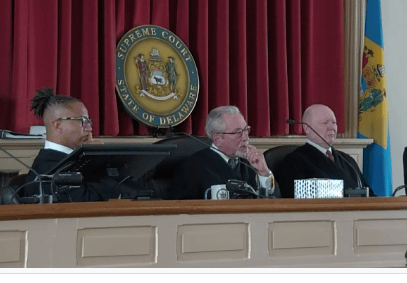
Photo courtesy of Spotlight Delaware
Why Should Delaware Care?
Since 2008, artificial entities such as corporations, limited liability companies and family trusts have been eligible to cast a ballot in Fenwick Island’s municipal elections. The American Civil Liberties Union of Delaware claims that allowance detracts from the power of human residents’ votes. Now, the Delaware Supreme Court may decide whether those voting rules will stand.
A pending legal challenge to whether artificial entities like family trusts and limited liability companies (LLCs) can vote in Fenwick Island’s municipal elections now awaits a ruling from the full Delaware Supreme Court.
During arguments heard on Wednesday morning in Dover, one Delaware Supreme Court justice questioned whether some property owners in the coastal resort town might actually be the ones disenfranchised by the American Civil Liberties Union (ACLU) of Delaware’s attempts to disallow artificial entities from casting ballots in local elections.
But ACLU attorney Andrew Bernstein argued in court Wednesday that artificial entities like corporations, LLCs and family trusts do not have the same natural rights — such as the right to vote — that human residents do.
By allowing entities a vote in Fenwick’s local annual elections, the total number of votes increases. In turn, that larger voting pool decreases the impact of a regular person’s vote, the ACLU argued.
“Here, Fenwick Island … changed the denominator,” he said.
The ACLU is appealing their case to the state Supreme Court, after a Delaware Superior Court judge ruled that non-human entities are allowed to vote in Fenwick’s local elections.
At the heart of the case is a question about Delawareans’ fundamental rights, said ACLU Executive Director Mike Brickner.
“What other fundamental rights could artificial entities get in the future?” he asked after arguments ended, noting that he believes the state’s highest court needs to weigh in on whether artificial entities have the right to vote in the First State.
Fenwick Island Mayor Natalie Magdeburger said revoking the ability of artificial entities to vote would work in the opposite way by not allowing people who own property through family trusts, for example, to vote for local rules or representatives. The majority of artificial entities currently eligible to vote in Fenwick are properties held in trusts, Magdeburger explained, not traditional corporations.
To her, what’s at stake is Fenwick Island’s identity as a multi-generational beach town.
“We have a lot of folks who have either inherited property or are planning their own end of life through trusts,” she said, noting that those people would no longer be able to vote if Fenwick’s election rules are deemed unconstitutional. “To me, that’s the real sad part about this argument.”
Solutions on deck
The case focuses on a 2008 amendment to Fenwick’s charter, which was approved by the Delaware General Assembly and co-sponsored by state Sen. Gerald Hocker (R-Ocean View).
The issue does not relate to state or federal elections.
Fenwick’s charter allows for artificial entities like LLCs and trusts to cast ballots in municipal elections through a representative power of attorney. Ballots are limited to one vote per person, or one vote per entity. For example, one Fenwick resident cannot vote on behalf of themselves and then again on behalf of their family trust that owns another vacation house.
It is one of five municipalities in the state that offer such extended voting rights.
Meanwhile, state lawmakers raising similar concerns about entities voting in local elections have already taken matters into their own hands.
The first leg of a state constitutional amendment — which requires a two-thirds supermajority approval of two consecutive terms of the Delaware General Assembly — that would ban artificial entities from voting in any Delaware elections has already passed.
“There’s no election between now and June 30,” said Chief Justice C.J. Seitz, questioning the urgency of ACLU’s pending appeal. “Why shouldn’t we stay this case?”
The defense team, led by Luke Mette of Brockstedt Mandalas Federico, asked the same, noting the solution could come from lawmakers after they return to Legislative Hall in January.
“This court should not be the lab for experimenting with new theories of vote dilution,” Mette said, noting that cases about conflicts between election rules and constitutional laws are usually linked to racial discrimination, gerrymandering or even bribery schemes.
But Bernstein, with the ACLU, said there is no guarantee state lawmakers will vote before Fenwick’s next election.
“It is not up to the General Assembly whether natural persons get full enjoyment of their constitutional rights,” Bernstein said. “This is not an academic or political question. It is a question of fundamental rights.”
Proving the right to represent
The ACLU also must convince the justices they have standing — a legal term for whether someone has enough at stake to file a lawsuit — in the first place. No specific Fenwick resident is named as a plaintiff in the complaint.
The ACLU cited potential fears of “reprisal or stigma” for locals who might publicly put their names on the complaint. He pointed to unnamed ACLU members, donors and supporters living in Fenwick as the Delawareans harmed by diluted voting power.
He said the ACLU’s stake in the claims is more “associational” through those members.
Magdeburger said in a phone interview after the hearing that there are just over 200 artificial entities in the town that are able to vote. Of those, she estimated that fewer than three dozen are corporations or LLCs. Of those, only about 10 are businesses in the business district. Artificial entities account for nearly a quarter of around 900 registered voters.
“Not one Fenwick Island resident made this complaint,” she said. “We don’t even have enough people to run in our elections.”
Last year’s election was canceled because there were no contested seats. The next election could be held as soon as August 2027.
“At the end of the day, all of their fears make no sense,” Magdeburger said, estimating that 80 percent of the town is residential. Fenwick’s charter actually prohibits a boardwalk from being built there, she said.
The justices are expected to issue a ruling within 90 days. It is possible they could also opt to stay the case through June 30, to allow the legislature time to vote on the pending constitutional amendment.
Dover