UL System schools share team-level revenue sharing budgets despite new state law
Sep 23, 2026 | 4:28 pm ET
Description
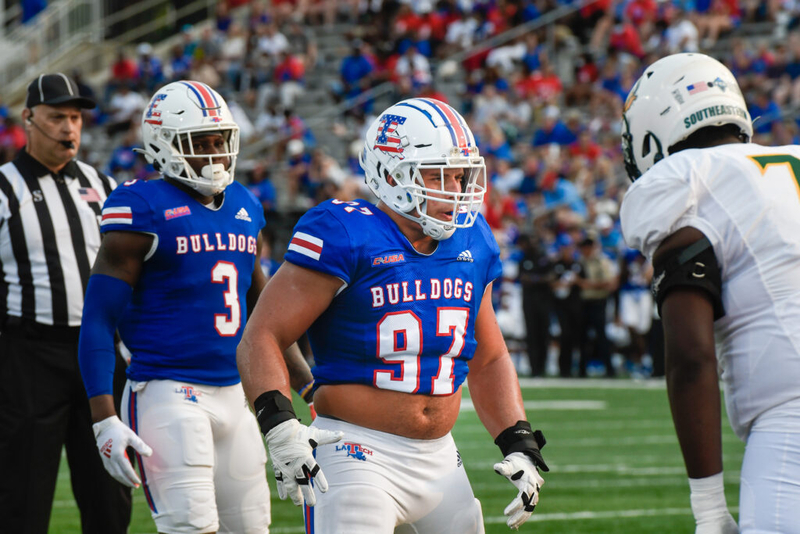
Louisiana Tech’s Trey Baldwin and Levi Bell play against Southeastern Louisiana University at Joe Aillet Stadium on Sept. 11, 2021. Tech won 45-42. (Photo by Emerald McIntyre/Louisiana Tech University)
Louisiana Tech University will spend nearly $2 million in public money to pay its student-athletes this year, while the University of Louisiana at Lafayette will devote $1.5 million to its sports teams.
Team-level payout details for four UL System sports programs, money for which comes from revenue generated on each campus, were accidentally included in documents posted online for last month’s University of Louisiana Board of Supervisors meeting.
Earlier this year, Louisiana lawmakers overwhelmingly passed Act 818 by Rep. Tehmi Chassion, D-Lafayette, which allows universities to shield how much they pay to individual athletes and each athletic team from public view. The law specifies that only the total spent on all teams must be disclosed.
The law applies to athletic departments’ self-generated revenue, which Division I schools are allowed to use to directly pay players for their name, image and likeness. It is separate from private NIL deals athletes make with sponsors that are protected from public scrutiny.
Louisiana law treats all self-generated revenue from state college campuses and other agencies as public money that requires legislative approval for how it is spent.
Despite the new law on revenue-sharing details, team-level information from the UL System schools was disclosed in documents posted online for the Aug. 27 UL Board of Supervisors meeting. At the time this report was published, the information was still available online.
Brandon DeCuir, an attorney who represents the UL System, said the information was disclosed in error. He said the information should not be used without authorization and asked the Illuminator to delete the documents, which are still posted on the system’s website.
Scott Sternberg, a First Amendment attorney who has represented the Illuminator, said journalists have a right to publish information they obtain legally.
“Documents that are made publicly available by the government are fair game, even if the government made a mistake,” Sternberg said. “It’s a long-held principle in the law that as long as [journalists] obtained it legally, [they] can report on the documents.”
Chassion’s law, which passed with the support of athletics officials from the UL System and LSU, nullified a lawsuit reporters from the Illuminator and other news outlets filed to find out how much public money LSU was paying to student athletes.
The UL board meeting documents show that of the schools participating in revenue sharing, only Grambling State University did not disclose team-level data. Grambling’s total amount budgeted for the current academic year is $460,000.
McNeese State, Nicholls State and the University of Louisiana at Monroe will not use public money to pay players. ULM spokesman Adam McDonald said its athletic program’s private NIL budget was approximately $2 million, which meant it did not need to rely on public money for its athletes.
Louisiana Tech reported budgeting $1.98 million to pay players, of which $1.2 million will be used for football, nearly $500,000 for men’s basketball, $200,000 for baseball and $86,000 for all women’s sports.
Northwestern State’s $750,000 will be spread out, with $300,000 for football, $350,000 for men’s basketball and $100,000 for all women’s sports.
The University of Louisiana at Lafayette budgeted $1.5 million for revenue sharing, of which $591,895 is for football, $647,500 for men’s basketball, $120,600 for baseball and $157,354 for all women’s sports.
Southeastern’s revenue sharing was erroneously reported in the wrong budget category in the UL board meeting documents. School spokesman Mike Rivault clarified in a written statement that its budget for paying players is $454,000, with $404,500 for men’s basketball and the rest for all women’s sports.
Baton Rouge, LA