Kansas lawmaker cries foul over voter registration gift cards, asks Kobach to investigate
Sep 23, 2026 | 9:30 am ET
Description
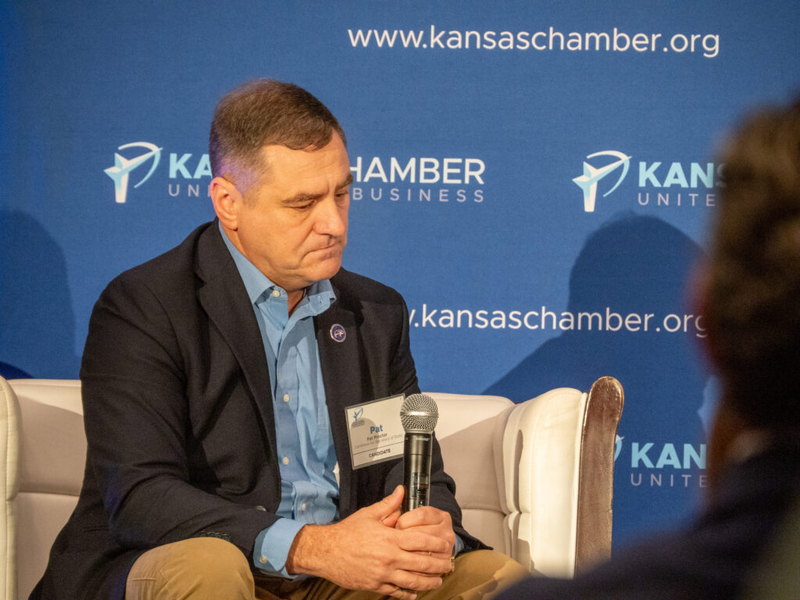
Rep. Pat Proctor, shown here at a candidate forum on Aug. 27, 2026, made a complaint to the attorney general about a League of Women Voters group in Leavenworth that gave high school students $5 Starbucks gift cards if they would register to vote. Although Proctor said he wants the group investigated, he asked that students who were "unwitting" participants not be investigated. (Photo by Anna Kaminski/Kansas Reflector)
TOPEKA — A Kansas legislator is demanding an investigation into a League of Women Voters chapter that gave $5 gift cards to high school students who registered to vote, a move he said violates election laws.
Rep. Pat Proctor, a Leavenworth Republican who is running for secretary of state and is chairman of the House Elections Committee, asked Attorney General Kris Kobach to investigate the group, which in May held voter registration drives at Lansing and Leavenworth high schools.
In a Facebook post with photos, the League of Women Voters of Leavenworth County showed students registering to vote. The post included a photo with a sign on the table that read: “Register to vote get a $5 Starbucks gift card.”
Photos also showed students holding up the gift cards.
Federal law makes it illegal for anyone to pay, offer to pay or accept payment for registering to vote, and the crime is punishable by up to five years in prison and a $10,000 fine, Proctor said in a news release.
“I have, for many years, heard reports of this organization engaging in activities that call into question its supposed nonpartisan status and could well jeopardize its tax-exempt status,” Proctor said. “But this activity is not just rank partisanship; it’s illegal.”
While Proctor asked that the children who were “unwittingly involved” not be investigated or prosecuted, it is also illegal to accept payment for voting or registering to vote.
Marlene Merrill, president of Kansas League of Women Voters, said she had no comment. The group has reached out to its national organization to discuss the situation.
The Kansas attorney general’s office has not been in touch with the League of Women Voters yet about the issue, she said. Attorney General Kris Kobach’s spokeswoman did not reply when asked to comment on whether the situation would be investigated.
Brendan Fischer, director of strategic investigations at the Campaign Legal Center, a nonpartisan legal organization focused on democracy, said federal law prohibits paying anyone to register to vote or for their vote.
“Given the breadth of the law, well-intentioned groups seeking to encourage civic participation can accidentally cross a legal line,” he said.
In 2008, for example, Ben & Jerry’s planned to give free ice cream to anyone with an “I voted” sticker, Fischer said. Because doing so would have provided something of value in exchange for voting, the company made free ice cream available to everyone on election day, he said.
“The details of the offer matter a lot,” Fischer said. “A business may give everyone free ice cream on Election Day, but it may not condition the free ice cream on someone registering or voting. The law also does not prohibit civic groups or others from offering assistance to prospective voters.”
That law, however, is “unlikely” to prohibit candidates from making promises to deliver economic benefits to voters if they win an election, Fischer said.
President Donald Trump recently promised $5,000 to every voter if the Republicans win in the midterm elections.
“As the Supreme Court noted in a 1982 case, ‘there are constitutional limits on the State’s power to prohibit candidates from making promises in the course of an election campaign,’ provided that the benefits are achieved through the normal processes of government rather than a private arrangement,” Fischer said.
Proctor posted his letter about the League of Women Voters on his Facebook campaign page and Rep. Kirk Haskins, D-Topeka, noted in a comment that Proctor could be violating campaign law.
“FYI- Pat, ironically, it appears you may be violating Kansas campaign laws by posting your letter on state produced/designed letterhead on your campaign influencing FB page,” Haskins wrote. “K.S.A. 25-4169a. The statute specifically bars using state ‘machinery, equipment and supplies’ or public resources to influence an election.”
When reached for comment, Proctor said he had nothing to say before any questions could be asked.
Haskins called Proctor’s posting in violation of campaign law a “minor misstep,” in a message to Kansas Reflector.
“However, it deserves more than a cursory glance,” he said. “Public officials do have a duty to address matters of public interest. However, this action of Rep. Proctor is indicative of a glaring political culture of selective attention and bias.”
Proctor highlighted the grassroots voter registration effort while ignoring Trump’s $5,000 proposal, which Haskins interpreted as a cash bribe for votes.
Haskins called the double standard something that “damages public trust in our elected officials and ultimately our democracy.”
Topeka, KS