2 years into K-12 voucher program, SC leaders don’t know how students are performing
Sep 21, 2026 | 6:37 pm ET
Description
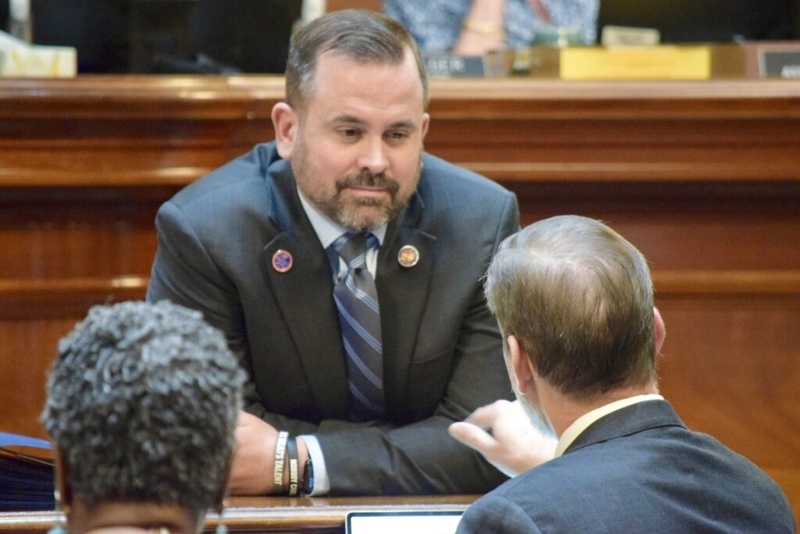
Rep. Neal Collins, R-Easley, pictured the House floor, Wednesday, May 6, 2026, said legislators need better data to decide whether to fund school vouchers in coming years. (Photo by Jessica Holdman/SC Daily Gazette)
COLUMBIA — As the third year of a program that gives state money to K-12 students for educational needs, including private school tuition, begins, state leaders don’t know how those students are doing academically.
Under state law, students receiving the roughly $7,500 scholarships to spend on private school tuition, tutoring and other educational needs must take an end-of-year test. Legislators added that requirement to the program, known as the Education Scholarship Trust Fund, to track student performance and make sure the money helped students improve, they said during legislative debates.
But only about one in 10 of the 2,880 students who received funds during the program’s inaugural year reported usable test results, according to a report the Education Oversight Committee heard Monday.
That number wasn’t enough for the agency to present data or draw meaningful conclusions about student performance, executive director Dana Yow told a subcommittee of legislators, educators and business leaders Monday.
SC senators request investigation into use of K-12 vouchers for homeschooling
The lack of testing data means any conclusions likely wouldn’t represent the student population as a whole, Yow said.
On top of the lack of test results, the agency couldn’t measure how scores changed, since the Department of Education didn’t give any data on how students performed the year before. Nor did the department provide demographic information, which the agency uses to account for other factors in a student’s life, or graduation data, which is required by law.
“Before the program’s effect on student learning can be appropriately reported, the data describing that learning must be more complete, more accurate and more transparent,” the report reads.
The Department of Education attributed the gaps in data to growing pains.
In 2024, after the school year started, the state Supreme Court struck down a portion of the program that allowed the money to go toward private school tuition as unconstitutional. That hobbled a program just trying to find its legs, said Meka Childs, director of education choice for the Department of Education.
Legislators reinstated that portion of the program last year, routing the money instead through a trustee tasked with distributing the funds.
As the agency began collecting testing data, officials ran into technical snafus, including rounding up test results directly from parents, who often handwrote their responses, she said.
Those sorts of issues are expected during the first year of a program, said Rep. Shannon Erickson, who leads the House education committee.
“I kind of would like us to think of this first year that we are discussing right now as building a ship in the ocean while it’s floating and a hurricane hits,” the Beaufort Republican said. “That’s really what happened.”
The oversight agency received testing data for the 2025-2026 school year Sept. 12. Agency leaders plan to present that data and what they can use of the 2024-2025 test results during the committee’s December meeting, Yow said.
By the numbers
Nearly 800 students receiving state funds submitted test scores to the state agency.
That’s out of roughly 1,440 students who finished the 2024-2025 school year in the program, which at the time offered $6,000 for up to 5,000 students.
That school year started with around 2,880 students, but roughly half withdrew before the end of the year. Some left after the state Supreme Court’s decision ended the use of funds for private school tuition, though private donors stepped in to fund tuition for most of those students, allowing them to use the money for other purposes. Around 1,000 students were removed from the program for failing to switch schools as the law required.
Up to 1,000 ineligible SC students booted from voucher program, report finds
Other students and parents left because they decided the program wasn’t for them, Childs said. She didn’t give numbers for how many students fell in each category.
Out of the nearly 800 test results the oversight agency received, most were unusable for data analysis, according to the report.
Students in kindergarten through second grade submitted about a fifth of the tests, which the oversight agency didn’t use because students in those grades are exempt from the testing requirement.
The agency chalked about 50 of the tests up to errors, since they were dated outside of the 2024-2025 school year.
About a third of the tests, 273 of the total, fell outside the agency’s parameters for various reasons. State law requires tests to have approval from the department, fall in line with state standards and include research showing how they compare to other tests.
In some cases, students took a test designed for a grade level other than the one they were in, which would violate the requirements of state standards. Others took tests the department didn’t approve. Some took tests that had department approval but didn’t align with South Carolina’s standards.
The oversight agency doesn’t report data that applies to fewer than 20 students because smaller sample sizes could make it possible to track down specific students, causing the numbers to dwindle further.
After tossing most of the data, the agency decided the results left created “a sample too limited and too unlikely to represent all participants to serve as a reliable basis for conclusions about student outcomes,” the report reads.
The oversight agency didn’t receive test results for nearly 630 students.
Most weren’t required to submit a test. Of those, 446 were in kindergarten through second grade, and six had a documented disability, another exemption from the testing rule. Those students are required to submit separate coursework to prove they’re taking classes.
The agency removed 42 children from the program for the next year because they didn’t submit testing data. Another 102 were seniors in high school, meaning they were supposed to submit test results but had no consequences if they didn’t, since they aged out of the program the next year anyway, according to the oversight committee.
The department is working with 19 families who submitted testing data but had some sort of technical issue, according to the report.
‘A failure’
Inaccurate test results can hurt students, said Melissa Pender, a member of the committee and executive director of schools for Beaufort County School District.
If a child who took an unapproved test dropped out of the program and went back to public school, teachers can use their previous test results to gauge how well that student is performing in a certain subject, she said.
“Having a state-aligned assessment that a school can use when they come back in is very valuable for a school,” Pender said.
SC Senate spending plan would disallow K-12 vouchers for homeschoolers
Testing requirements go beyond the test itself, Pender said. Research also suggests ideal timelines for children to take assessments, when they are at the peak retention for information they learned.
Testing too early or too late in the year could skew results. Although the Department of Education encourages schools to give tests within the same window as public school districts, the law has no requirement about when they have to take them.
Without test results, legislators have no way to make sure the program is working, said Rep. Neal Collins, a member of the oversight committee and a frequent critic of the voucher program.
The vouchers were initially pitched as a way of helping low-income students stuck in failing schools get access to resources their parents couldn’t otherwise afford.
This year, the money can go to students whose parents make up to 500% of the federal poverty level, or $165,000 for a family of four.
Legislators have spent more than $170 million on the program. They have to know that money is going toward actually improving outcomes for students, Collins said.
When a student fails to comply with the program’s rules, including failing to submit test results, removing them from the program isn’t enough, Collins said. Since test results typically come at the end of the year, parents have already spent thousands of taxpayer dollars the state can’t get back, he said.
“We need proof up front,” the Easley Republican said. “Show us that your voucher works. Then we’ll fund you. Don’t fund and then all bets are off.”
With the entire first year of testing data unusable, legislators essentially spent that money without any idea whether it actually helped students improve, he said.
“I think it’s a failure,” Collins said.
What comes next
Legislators need to know exactly how students performed, and they need to know as quickly as possible, Collins said.
State agencies start submitting their requests for state funding in September, and legislators begin to assemble their annual budget in January. That includes any spots in the program the Department of Education wants legislators to fund beyond the floor of 15,000 students.
“I need the data, I need the accountability, to see if it’s worth investing in,” Collins said.
He asked for the education department to give results as soon as the school year ends and for the Education Oversight Committee to analyze the data right away.
The data is difficult to analyze and understand, Yow said. In 2024-2025, students submitted results from 23 different tests, and agency staff have to go through and figure out how they compare.
When legislators revived the law last year to reinstate the private school tuition portion, they also expanded the testing options families can use, Yow said.
SC students booted from K-12 voucher program spent $64K. The problem didn’t repeat, report says
“That’s too much, when we’re talking about a very small subset of students,” Yow said. “We can’t get our arms around that.”
The Department of Education also needs longer to collect the data than it does with traditional public schools because the results are coming from public schools, private schools and, in some cases, parents, Childs said.
“While I understand the desire to have everything immediately, the reality is, it does take time to pull the data in,” Childs said.
The oversight committee recommended the Department of Education start delivering test results on a regular schedule, similar to when the department releases public school testing data.
The oversight agency also asked that the department digitize all of its results, avoiding the difficulty of analyzing handwritten submissions, and that it collect all the required data, including graduation data and students’ testing data for the prior year.
The education department is in the process of making some of those changes, including standardizing systems and setting deadlines for the data, Childs said.
“We do have to bear in mind that this is a new program and we are building out those systems and we are much better than we were and will continue to strengthen,” she said.
Columbia