Departing congressman says voter choices and Trump’s ‘lost focus’ contribute to DC’s troubles
Sep 21, 2026 | 6:36 pm ET
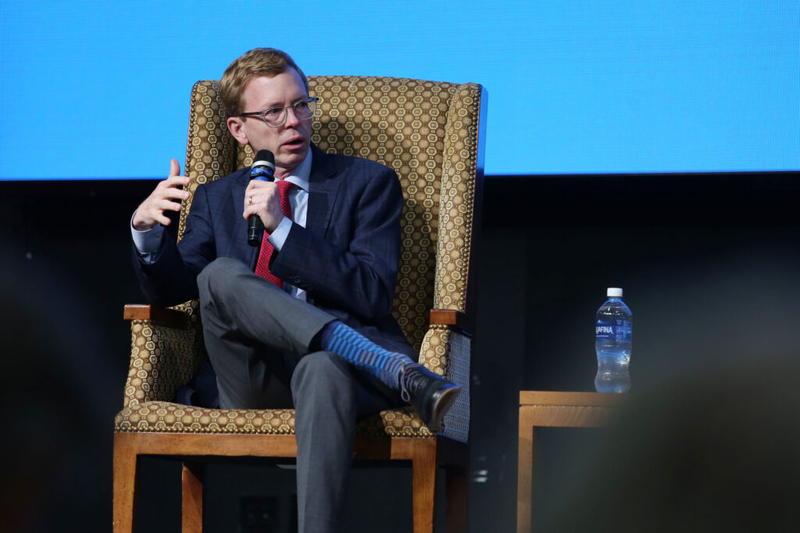
Description
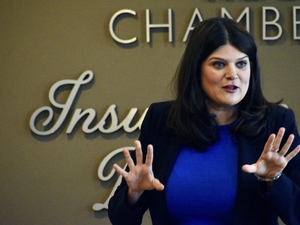
U.S. Rep. Dusty Johnson, R-South Dakota, speaks to members of the Downtown Sioux Falls Rotary Club on Sept. 21, 2026. (Photo by Makenzie Huber/South Dakota Searchlight)
SIOUX FALLS — Partisan squabbles are keeping Congress from effecting change, and President Donald Trump has made it worse when he has “lost focus,” said South Dakota Republican U.S. Rep. Dusty Johnson, who added that he finds many of Trump’s personal characteristics “lacking.”
Johnson, who will leave office in January, aired his frustrations about national politics and celebrated his staff and some colleagues at a Sioux Falls Downtown Rotary Club meeting Monday. During a question-and-answer session, he reflected on his eight years in Congress.
“I won’t miss the circus, but I’ll miss the clowns,” Johnson said.
Q&A: Dusty Johnson analyzes his defeat and future, saying ‘I want to lead a life of consequence’
Afterward, Johnson told reporters he believes the Republican Party is “well positioned” on national policy and is “going to get some much needed wins” by January, before a new Congress convenes. Beyond that, it’s more complicated.
The central problem, Johnson said, is voters choosing to vote for “somebody they think is fighting rather than for somebody who is getting things done.”
“If the voters don’t start voting for thoughtful problem solvers a little more often, then I think we’re going to continue to find it hard to get things done quite as often as we should in D.C.,” Johnson said.
He said the anger and frustration in politics at all levels will eventually shift and the “fever will break,” but that’s “clearly not where we’re at today.”
Johnson chose not to run for reelection to the U.S. House and lost his bid for South Dakota governor in the June Republican primary. He previously served as a member of the state Public Utilities Commission and as chief of staff for former Gov. Dennis Daugaard.
Johnson did not share specific plans Monday about his future.
“I want my next 20 years to be as impactful as my last 20 years,” he said.
The following Q&A is excerpted from the Rotary meeting and has been edited for length and clarity. Questions came from a Rotary moderator and a Rotary member.
Q: You’re heading into the final months of your eighth year as South Dakota’s lone representative. What was it like coming into the office as a freshman representative and what did you learn in those first few years?
A: I think I was a little surprised. I had run in no small part because I just thought there were too many jerks in politics, and, of course, there are, although the ratio is a lot lower than I expected. In the end, I sort of felt naive. I had done what most people do, which is assume that the 10 or 15 members of the United States House that you can name — your Marjorie Taylor Greenes or your Alexandria Ocasio-Cortezes — are representative of the whole. And they’re really not.
So the big surprise for me was how many decent human beings, really successful inventors or nonprofit executives or four-star generals, successful educators, nurses, just really great human beings are there.
I’m not going to try to convince you that we do a good job, for reasons I still don’t entirely comprehend. The whole is less than the sum of our parts, but the inputs, the human beings, I was surprised by how decent most of them are.
Q: How have things evolved or how has your approach to tackling issues evolved?
A: I try to be an optimist, but I don’t want to just whisper sweet nothings in your ear. I think things are markedly worse in D.C. than when I arrived eight years ago. I don’t blame me, but I do think the tribalism is much higher. I think the populist rage and angst is much higher.
All of the incentives in the system reward bad behavior and so most members, of course, they’re good people, so they do want to serve, they want to make the right decisions. They also want to survive. But I think they understand that, walking through the field of public policy, there are almost an inexplicably large number of landmines that can just end a career on any given day because you say this about data centers, or you say that about January 6th, or you say this about vaccines or that about Lake Ontario. I think it creates that survival versus serve dichotomy.
I think that there’s more tension there than there would have been five years ago and 10 years ago. I think it is a very, very difficult time to serve.
More of my colleagues in the House have lost their primaries for Senate, for governor — not to pick any scabs — or their own House race than at any point that I can recollect. Two dozen of them, which is really unusual.
Normally if you’re running for the U.S. House, for your own job or higher office, you’re very well positioned. People generally know you, you generally have a campaign team, you know how to raise money, you’ve got some accomplishments to run on. Now, service of that kind is a pretty substantial albatross around someone’s neck.
Fewer and fewer of my colleagues are excited about running, and I think fewer and fewer really decent people are running for the first time. Now, the problem for all of this is that we’re getting a barely functional government with great inputs. If we get only mediocre inputs, I’m concerned that we will not even meet the functional standards.
Q: What’s the Dusty spin on that?
A: I still think there’s tremendous optimism in the American private sector. We’re going to cure cancer and we’re going to cure Type 1 diabetes and we are figuring out how to do a better job of housing people in an increasingly inflationary environment. Outside of D.C., there’s a lot of reason for optimism.
I think city governments in this state are generally run pretty well. Most local governments in this state choose progress over drama, and I think that’s true for our state government as well. Always be hesitant when someone wants to centralize more power in Washington, as, unfortunately, more and more in my party seem to want to do. We’re the party of federalism and yet we sometimes like big government conservatism. Be wary about centralizing more power into the less functional level of government.
Q: You’ve experienced three different administrations while you’ve been in Congress. What was different between the three?
A: I would focus on the commonalities between those three, and that is when the administration was focused it was pretty effective and it got good things done — regardless of whether you’re talking about Trump 1.0, Biden or Trump 2.0.
I think we do get into trouble when there’s a lack of focus, and I try to tell the president and his team that, “If we’re talking about the border, middle class tax cuts, a return to common sense and some of the social issues where most Americans believe the pendulum has swung too far, that’s where we’re going to be able to build. If we are fighting about the reflecting pool and renaming Lake Ontario, we’ve lost focus. I think that can make it more difficult for your party to do well in November, sir.”
Any of those three administrations, when they lost focus and discipline, our country was poorly served.
Q: You’ve been a close adviser to Speaker Mike Johnson over the past several years. Tell us about how you were tapped for that role and what it’s been like to help lead him as he became a new speaker.
A: It really started with Speaker Kevin McCarthy. I went to D.C. and I thought that the lane I was going to carve out was being the dorky little policy guy, which of course I am, but I really was going to be a committee leader not in title but that people knew that if they wanted to understand Title I programs and how they interact with crop insurance or county averages they’d say, “Go to Dusty. He understands the issue.”
I was lucky enough to be in the right time and the right place to give the right people counsel. McCarthy said, “Hey, I’ve got to have you in some of these rooms. We’re negotiating the Fiscal Responsibility Act with a Democratic Senate and a Democratic president. We don’t want to default on debt, we do need to spend less money, we do need to reform welfare. I need you in the room as part of the negotiating team behind the scenes.”
That was like being a backup quarterback. You never know when you’re going to get the call, but you go out and understand the playbook and assignments, and you make sure you hit people, run the routes, then you’re going to get an opportunity to help the team again.
When McCarthy was thrown out of office, the natural inclination for Mike Johnson is to get rid of the old team because they’ve just been fired. Mike and I had a pre-existing personal relationship and I was held over in Mike’s cabinet. I’m sure everybody here has very legitimate criticisms of Mike Johnson, but I have to tell you it would not be easy to govern in an incredibly dysfunctional time with an incredibly dysfunctional U.S. House. The fact that we haven’t defaulted on the debts that we have, I would say the U.S. House has been somewhat more functional than people had any right to expect, and I think Mike Johnson is a huge part of that.
Q: How do you assess the personal character of President Trump?
A: I find many of his personal characteristics lacking. Particularly, as I talked about, the lack of focus can be problematic for our country. That being said, I do think that we’re so tribal in this nation anymore. While some are too ready to celebrate his every act, some are too willing to denigrate his every act. I think securing the southern border — that kind of clarity of conviction and willingness to get it done, I think, is the kind of bold leadership that caused his supporters to continue to view him favorably.
Clearly, he is too quick to criticize others, particularly with personal insults. I think he doesn’t value our allies and friendships abroad as much as I do, and I don’t think he values some of these institutional norms, which I think are part of the American success story.

Pierre, SD