RI judicial selection panel to weigh campaign contribution disclosures to applicants
Sep 21, 2026 | 3:36 pm ET
Description
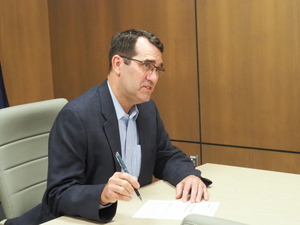
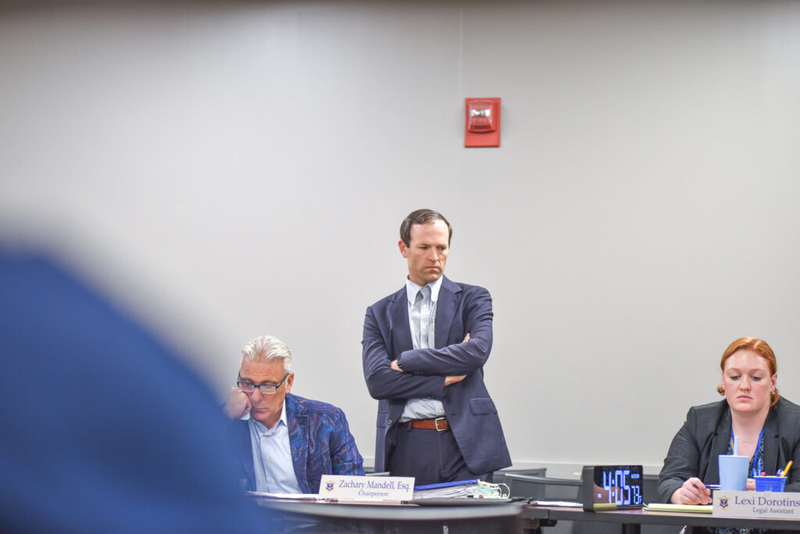
Zachary Mandell, chairman of the Rhode Island Judicial Nominating Commission, prepares to begin the panel's meeting on Tuesday, July 28, 2026. (Photo by Christopher Shea/Rhode Island Current)
The panel tasked with selecting Rhode Island’s judges on Tuesday will consider whether its members must disclose campaign contributions to judicial applicants and recuse themselves from considering those candidates.
That question before the Judicial Nominating Commission comes from a petition filed Aug. 21 by H. Philip West Jr., the former executive director of Common Cause Rhode Island, after revelations that four commissioners had donated to former House Speaker K. Joseph Shekarchi’s campaign account months before he applied for a seat on the state Supreme Court.
“Any contributions at all, I think should be disclosed,” West said in an interview Monday. “You’re talking about a judgeship — a life tenure without review at a very high salary.”
West’s proposal would require commissioners to disclose campaign contributions, expenditures or other covered transfers made to support or oppose a judicial applicant during the previous 10 years. Commissioners who had made any contributions would then have to recuse themselves from discussing, voting on or otherwise considering the applicant.
Commissioners are scheduled to discuss and vote on West’s petition after announcing which candidates they intend to interview for the vacant chief judge position at Rhode Island District Court, a seat left open by Judge Jeanne LaFazia’s retirement in June.
Zachary Mandell, chairperson of the Judicial Nominating Commission, did not immediately respond to request for comment.
The state’s Code of Ethics does not consider campaign contributions when determining whether a conflict of interest exists. West said that makes it “hard to press” an ethics complaint based on donations alone, which is why he wants a clearer standard for the all-volunteer commission tasked with recommending who gets to fill a judicial vacancy.
John Marion, Common Cause Rhode Island’s current executive director, called West’s proposal a straightforward way to address concerns from good government advocates and some lawmakers about former General Assembly members seeking judicial appointments.
Marion said Shekarchi’s application brought the issue into sharper focus because he was still serving in the General Assembly and still has an active campaign account with over $4.7 million in the bank.
After seven commissioners voted to advance Shekarchi’s application along with four others, GoLocalProv reported that four of the seven commissioners who voted to advance his application, including the panel’s chairman, had collectively contributed more than $30,000 to Shekarchi’s campaign account since he first ran for office in 2012.
“People who’ve been out of the legislature for a while were somewhat removed from politics, but in some instances still had campaign accounts,” Marion said. “It’s been a problem, a growing problem, but then Shekarchi really put the spotlight on it because of his position.”
Ultimately, Gov. Dan McKee selected Superior Court Judge Luis Matos to fill the vacancy on Rhode Island’s highest court.
“The system worked, but it was close,” West said.
Shekarchi’s challenge to the appointment process is still pending before the Rhode Island Supreme Court following a legal dispute between the former House speaker and the state’s Ethics Commission over whether his judicial application violated the state’s “revolving door” provision.
Marion commended West for pushing the issue and said the proposal could be a first step toward broader changes to the judicial appointment process, some of which may require action by the General Assembly.
Lawmakers this year considered legislation that would have required the Judicial Nominating Commission to conduct a “blind review” of applications before interviews or public hearings. But the bills stalled at the committee level, which did not surprise advocates like West.
“When there’s an attempt at reform, there’s a pushback,” he said.

Providence, RI