Florida bar exam passage rate drops by more than 3%
Sep 18, 2026 | 3:41 pm ET
Description
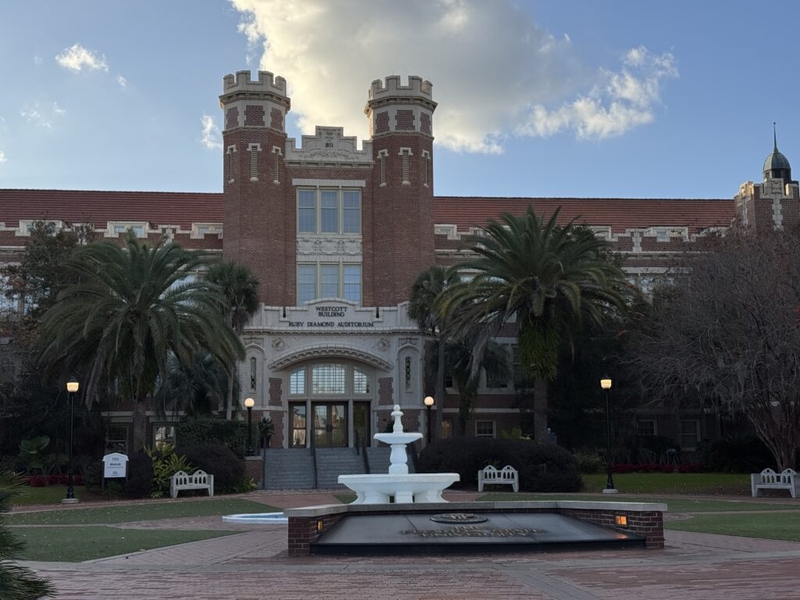
The Westcott Building and fountain at Florida State University on Dec. 31, 2024. (Photo by Jay Waagmeester/Florida Phoenix)
Those pursuing admission to the Florida Bar were less successful this year than last.
The summer 2026 exam was taken by 2,250 first-timers. Of that cohort, 75.2% passed, or 1,693. That passage rate represents a decrease from summer 2025, when 78.4% of test-takers passed. During summer 2024, 76% of test-takers passed.
The number of test takers in 2026 rose from 2025, when 2,152 took the test for the first time.
The highest passage rates among law schools in the state this year were Florida State University (91.8%), the University of Florida (90.9%), Ave Maria School of Law (89.8%), Florida International University (87.3%), and the University of Miami (84.9%).
The lowest passage-rate schools were Cooley Law School (39% of 23 test-takers), Barry University (59.9%), Jacksonville University (68.8%), Nova Southeastern University (73.4%), Florida A&M University (79.7%), and St. Thomas University (79.8%).
Among accredited schools, 80.4% of test-takers passed.
“We are tremendously proud of our graduates for achieving the highest first-time bar passage rate in Florida,” FSU College of Law Dean Erin O’Hara O’Connor said in a Friday news release.
“This extraordinary result reflects the talent, discipline and determination of our students, as well as the commitment of our faculty and staff to their success. Our graduates worked incredibly hard to reach this milestone, and we are excited to see all that they will accomplish as they begin their legal careers.”
The Florida Board of Bar Examiners, an administrative board of the Florida Supreme Court, administers the test.
Earlier this year, the Florida Supreme Court agreed that students from schools accredited by organizations other than the American Bar Association could sit for the exam. A Supreme Court workgroup questioned the ABA’s “accreditation standards on racial and ethnic diversity in law schools and about the ABA’s active political engagement.”
Florida Supreme Court ends three-decade reliance on ABA, handing win to DeSantis
The Supreme Court determined that “it is not in Floridians’ best interest for the ABA to be the sole gatekeeper deciding which law schools’ graduates are eligible to sit” for the exam.
“The ABA is a very, very partisan activist organization, and you have a right to be that, but you should not then be the arbiter of legal education,” Gov. Ron DeSantis said in January.
However, this month the ABA voted to eliminate its requirement that college pledge to diversity in recruiting and admissions to obtain accreditation. The vote was an effort to maintain its status as an accreditor with the U.S. Department of Education.
Tallahassee, FL