Environmental groups argue transmission corridor failing to meet conservation standards
Sep 18, 2026 | 5:47 am ET
Description
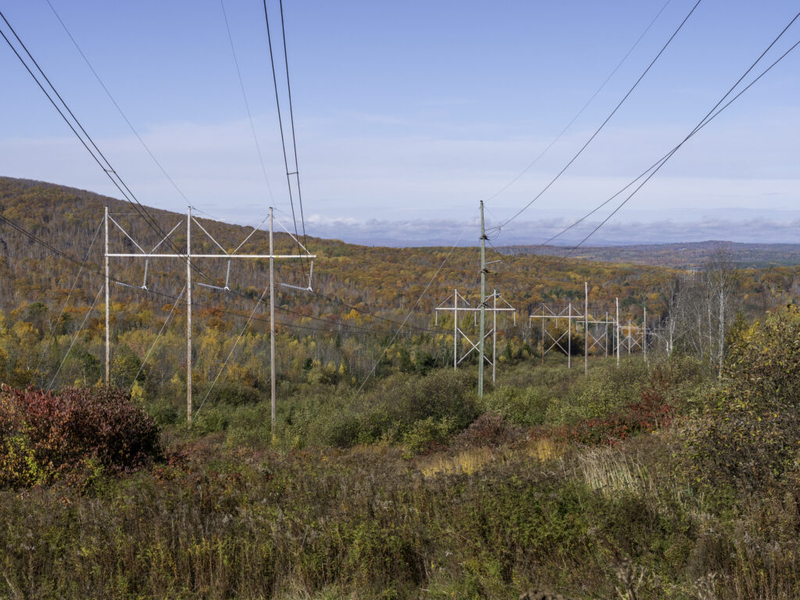
The $1.65 million iNew England Clean Energy Connect project owned by Central Maine Power parent company Iberdrola carries hydroelectric power from Quebec to several New England states.
(Photo of an unnamed transmission line in Maine by BWFolsom/ Getty Images)
Despite more than four hours of discussion on the conservation requirements for the long-embattled New England Clean Energy Connect project, the state environmental board held off on making a final ruling on the issue.
Instead, the Board of Environmental Protection on Thursday directed department staff to review its proposed order and add additional analysis before it is revisited.
Last year, the Maine Department of Environmental Protection approved the project’s conservation plan as part of the construction of 53 miles of new transmission line through western Maine. The $1.65 million interconnection project owned by Central Maine Power parent company Iberdrola carries hydroelectric power from Quebec to several New England states.
The citizen-led Board of Environmental Protection, an independent body that oversees the enforcement of environmental laws, met to consider an appeal of the department’s decision, filed by the Appalachian Mountain Club, Maine Audubon, Natural Resources Council of Maine and Trout Unlimited.
David Kallin, who represents the groups, said the conservation plan “categorically fails” to meet the standards set by the board, calling it a “shell game on multiple levels.”
The groups argue that the conservation area set aside by NECEC doesn’t meet the board’s earlier standards, and instead should be less fragmented, with more old-growth forest.
“The board must recognize that this is a bad plan that does not meet the words, let alone the intent, of the habitat fragmentation mitigation that you’ve already ordered,” Kallin said.
But Lisa Gilbreath, attorney for NECEC LLC, said the conservation groups were the ones that demanded the area be protected.
“The record is stuffed with testimony and filings by appellants that directly contradict this appeal,” she said. “To put it in polite terms, it really doesn’t pass the straight face test.”
Kallin argued that the area in NECEC’s easement is mostly made up of juvenile forest and will need several decades of growth to be considered mature — while the damage done by the corridor has already happened.
“There are lots of options that could have been brought forward, where actual mature forest exists on the ground today, not a half century from today, and where those could have been protected in some meaningful way,” Kallin said.
But Gilbreath countered that the easement was deliberately selected as a high conservation value area, and the groups have not identified another section of land that would be a better option.
“By their definition, it needs to be entirely unfragmented, can’t be near Route 201, it can’t be near any other fragmenting feature,” she said. “They haven’t pointed to one piece of property that would satisfy it.”
She argued that the land does have sufficient mature forest, and the groups were “making demands that simply are not required,” adding that NECEC selected the conservation easement as close to the corridor as possible because conservation groups, and then the board, required that it be near the area impacted by the project.
Kallin also pointed to comments submitted by several state agencies that specified that the definition of a mature forest in the conservation plan should not be considered precedent for future projects.
“Throughout all of this time, (NECEC) has claimed that the state agencies were holding them to task to compensate for the fragmentation impacts of this project, but Maine’s natural resource agencies are waving a warning flag for you,” Kallin said. “There’s no getting around the fact that any decision made on this project will be a precedent.”
Gilbreath said that will not be the case.
“There’s no precedent here,” she said. “The department knows, the board knows, every single project is treated differently. Every single order is different based on specifics of that project.”

Augusta, ME