ICE agent in Jan. 14 Minneapolis shooting makes first appearance in Minnesota state court
Sep 17, 2026 | 7:21 pm ET
Description
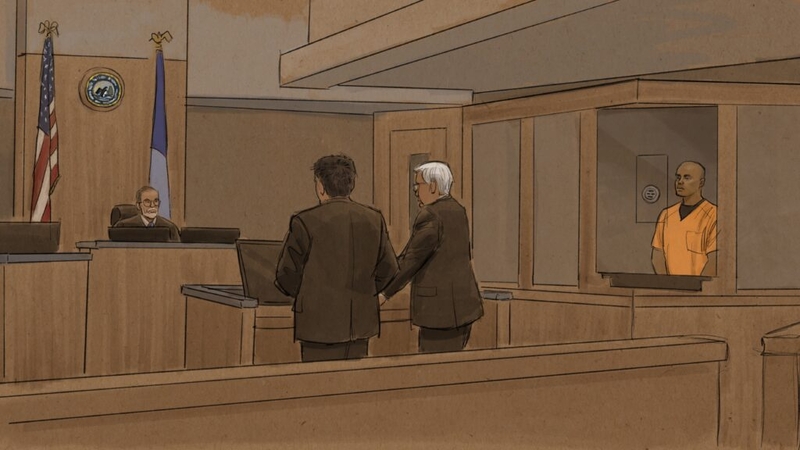
Christian Castro, an ICE agent charged with shooting and injuring Julio Cesar Sosa-Celis and then lying about the circumstances surrounding the shooting, stands for his first hearing Thursday, September 17, 2026. (Court sketch by Cedric Hohnstadt)
U.S. Immigration and Customs Enforcement agent Christian Castro, who is accused of unjustifiably shooting Julio Cesar Sosa-Celis through the closed door of a north Minneapolis home in January, made his first appearance in Hennepin County District Court Thursday.
Minnesota prosecutors fought for months to get Castro into court, unsuccessfully suing Texas Gov. Greg Abbott for blocking Castro’s extradition from Texas to Minnesota.
This week marks eight months into a winding saga that began on Jan. 14 and has involved four legal cases, including federal charges against the shooting victim and his roommate that were later dropped after prosecutors discovered Castro had lied about the incident; the extradition battle between Texas and Minnesota; and federal charges against Castro, who will make a federal court appearance Friday.
ICE agent Christian Castro turns himself in on federal charges
Hennepin County District Judge Paul R. Scoggin set bail at $200,000 if Castro agrees to not possess firearms, not contact witnesses and to be electronically monitored. Scoggin set unconditional bail at $400,000.
Castro also signed a waiver of extradition — an agreement to be extradited without a formal hearing in the future — and agreed to surrender his passport to state authorities immediately if he gets it back from federal authorities, who took his passport under federal legal proceedings happening simultaneously.
Castro appeared behind a glass partition in an orange uniform and handcuffs, his brows occasionally furrowed as he listened. He said only two words, after Scoggin asked him if he understood the requirement to surrender his passport: “100% sir.”
Minnesota prosecutors have said that Castro made 394 jail calls to a woman in Mexico, during which he expressed his intention to marry her and buy a house in Mexico to retire. County prosecutor Joshua Larson had asked for higher bail amounts at $350,000 and $500,000 respectively. He argued that Castro was a flight risk, citing the difficulty of extraditing Castro from Texas and Castro’s phone calls to the woman in Mexico.
Larson also said that Castro failed to turn himself into Minnesota Bureau of Criminal Apprehension headquarters as promised Wednesday, leading to BCA agents arresting Castro on the street in downtown Minneapolis.
“This did not strike me as an indication that this defendant is a man of follow-through,” Larson said.
Daniel Gerdts, Castro’s lawyer, offered a contradicting narrative: The BCA had agreed to take Castro into custody at Gerdts’ office but instead arrested Castro as he and his wife were looking for a place to park. After the court appearance, Gerdts said that the BCA’s arrest seemed like “political theater.”
Gerdts advocated for a $50,000 bail, arguing that Castro would have fled already if he wanted to, and that Castro would struggle to make a $200,000 bail. Gerdts also claimed that Castro, despite refusing to consent to extradition for 90 days, was “disappointed” in his then-legal counsel when he was in jail and would have preferred to be extradited to Minnesota than spend “all that time in jail” in Texas.
Confusion and misinformation surrounding the facts of what happened have plagued the case since it began.
On Jan. 14, during the peak of Operation Metro Surge, Castro engaged in a car chase with Sosa-Celis’s roommate, Alfredo Aljorna, ending at Sosa-Celis’s and Aljorna’s home in north Minneapolis. Castro and his fellow ICE agent had mistaken Aljorna for another Latino man, according to an FBI affidavit. Aljorna exited his car and slipped as he tried to get inside his house, at which point Castro attempted to arrest Aljorna. Sosa-Celis tried to help Aljorna, leading to an 11-second scuffle between the three. After both men escaped and ran inside, Castro’s shot passed through the front door and hit Sosa-Celis in the leg before coming to a stop in the wall of a child’s bedroom.
In an interview with FBI agents, Castro accused Sosa-Celis and Aljorna of assaulting him with a broom and a snow shovel in a three-minute fight before Castro opened fire, leading to assault charges against the two men that were dropped after surveillance footage proved Castro’s statements false.
The shooting took place between the Jan. 7 killing of Renee Good and the Jan. 24 killing of Alex Pretti by federal agents, both of which had ample witnesses and bystander footage. The details of the north Minneapolis shooting were far more shrouded, until aspects of that night were revealed over the course of several months.
In May, Minnesota prosecutors charged Castro with four counts of second-degree assault as well as one count of falsely reporting a crime, setting off the effort to extradite Castro from Texas, during which Abbott declined to sign off on extradition papers and Castro was released from a Texas jail.
Castro finally turned himself in to federal authorities in early September after a federal grand jury indicted him with six charges of making false statements related to the shooting, stemming from six specific lies he told FBI investigators after the shooting. An assistant U.S. attorney in Minnesota had been pursuing hefty civil rights charges against Castro, but was instructed by Justice Department officials in Washington, D.C. to downgrade the charges. The attorney, Matthew Evans, was fired, CBS News reported, citing four unnamed sources familiar with the matter.
Castro appeared in a federal court in Texas, and is set to appear in federal district court in St. Paul Friday morning. He drove up from Texas this week.
With Castro finally in state custody and having signed the waiver of extradition, Minnesota Attorney General Keith Ellison said Thursday that his office has dropped the lawsuit against Abbott.

Saint Paul, MN