Arkansas will bolster services for kids with disabilities after public outcry over long waitlist
Sep 15, 2026 | 1:09 pm ET
Description
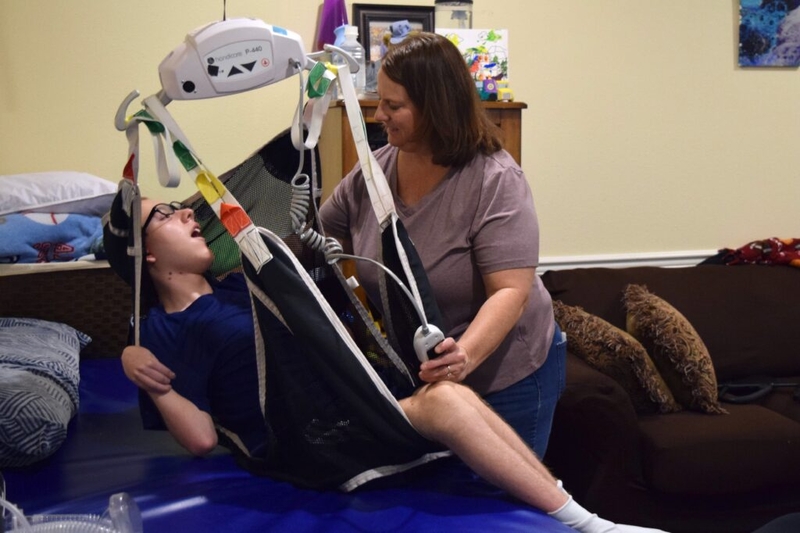
Susan Roberts uses a device hanging from their ceiling to help lift her 16-year-old son, TJ, into his bed on July 29, 2026. The device is covered by a Medicaid waiver for people with disabilities that need supportive living services. (Photo by Antoinette Grajeda/Arkansas Advocate)
Arkansas will provide additional support to children with disabilities who have been waiting for services, Gov. Sarah Huckabee Sanders said Tuesday, in response to growing demands from families for a special legislative session to address the issue.
Sanders announced that the Department of Human Services will provide supportive living services to families on the waiting list for the Community and Employment Services Medicaid waiver. The department will also work on “additional long-term solutions for these families,” the Republican governor said in a news release.
More than 2,400 Arkansas families are waiting for health insurance coverage that will help them meet their children’s complex medical and non-medical needs.
“This will go a long way toward addressing the number one concern we hear from families about the CES waitlist,” Sanders said. “As we work to get this change in place, DHS is also convening relevant stakeholders and policymakers to create additional long-term solutions for these families.”
The move comes after families have taken to social media to highlight the waitlist and obstacles in receiving needed services, with posts that have been shared thousands of times.
The parents include Paige McCammon, who posted a Facebook video of her son Turner’s seizures on Sunday as part of the ongoing effort to bring Arkansas leaders’ attention to children with disabilities. Turner has severe epilepsy and a neurodegenerative condition.
“It has become easier to catch a seizure on video than it is not to, and that is a terrifying thing to be able to say about your 2-year-old,” McCammon wrote Saturday in another post.
Waitlist, policy changes stir worries among families of Arkansans with disabilities
Disabled Arkansans on the waitlist receive health insurance via the Provider-Led Arkansas Shared Savings Entity program, also known as PASSE, a managed-care Medicaid program the state implemented in 2018. As of Sept. 1, the four participating insurance companies cover 46,779 Arkansans, including those on the waiver, Department of Human Services spokesperson Gavin Lesnick said.
Families on the waitlist can receive most of the services available to people on the waiver, but one of the few exceptions and the one most requested is supportive living services, or affordable in-home care for people with disabilities.
The PASSEs should start providing supportive living services to families on the waitlist by January at the latest, and the state will incorporate the change into its request for the federal government to renew the waiver next year, according to the news release.
The changes will cost $17 million, and Sanders will meet with lawmakers to discuss short-term and long-term funding, the release states.
McCammon expressed her gratitude in a Tuesday Facebook post.
“We still have work to do,” she wrote. “But Arkansas, look at what happened when enough people decided this mattered and refused to be quiet about it.”
Online advocacy
Some Arkansans, including Brintlee Cherry, included their numbers on the waitlist in their Facebook posts asking Sanders for help. Cherry’s daughter Eden is the 1,900th person waiting for services, and their insurance policy denied a request for a special needs stroller to keep Eden from running off in public, Cherry wrote on Facebook Sept. 3.
“Caregivers are physically and emotionally exhausted. People are crying out, and it feels like no one is listening,” said Cherry, who posted photos of the bruises she gets from trying to keep Eden with her. “But the squeaky wheel is about to get oiled. We are our children’s voices.”
Shelby Brazeal’s teenage son is the 1,935th person on the waitlist, she posted Sept. 4, and he needs waiver services so he can live independently after high school and so at least one parent won’t have to stop working and care for him full-time.
“This isn’t about politics,” Brazeal wrote. “Just the greater good for those who cannot advocate or fully care for themselves.”
An online petition to gather support for a special session had 2,960 signatures as of Tuesday.
The effort ramped up in late August and early September after McCammon said Sanders called her and her husband in response to their advocacy. At the time, Turner was receiving care at Arkansas Children’s Hospital, and the Capitol was visible from his room.
Sanders told the McCammons that they and other families would likely have to wait until the Legislature’s regular session in January for officials to address the waitlist, but “she is looking into what can be done in the meantime,” McCammon wrote on Facebook Aug. 26.
A maximum of 8,233 Arkansans can receive supportive services from the waiver, and many families spend years on the waitlist. TJ Roberts, a 16-year-old from Bella Vista, was on the waitlist for 11 years and has been on the waiver since 2021. One of the supportive living services he’s received is a ceiling track in his family’s house that lifts him in and out of his wheelchair.
Susan Roberts, TJ’s mother, told the Advocate that she spreads awareness of the waiver program and encourages eligible families to apply because it isn’t widely known when it’s not receiving media attention.
“If it doesn’t directly impact you, you don’t tend to pay attention to it, but [now] I really think it’s putting us in a place where we have to talk about it,” said Little Rock Democratic state Rep. Denise Ennett, whose 18-year-old son is on the waiver.
Several Arkansas families plan to hold a news conference at the Capitol at 4 p.m. Wednesday to call further attention to the waitlist and their children’s needs. McCammon said Tuesday that the rally will go on as planned after Sanders announced impending new services for people on the waitlist.
We still have work to do, but Arkansas, look at what happened when enough people decided this mattered and refused to be quiet about it.
Past efforts to help
In 2021, then-Gov. Asa Hutchinson directed $37.6 million toward disability support services in an effort to clear the waitlist, which had more than 3,000 people on it. All of those people received services by 2025, including Ennett’s son, who had been on the waitlist for eight years.
Besides Ennett, lawmakers expressing support for the families on the waitlist include Republican Rep. Rick Beck, who represents the McCammons in Morrilton, and Little Rock Democratic Rep. Ashley Hudson, who has also called for a special session.
“We should use a responsible portion of the surplus to fund additional waiver slots, and we should develop a long-term plan to make sure we don’t continue creating long waitlists for these vital services,” Hudson wrote on Facebook.
Arkansas ended the 2026 fiscal year June 30 with a $655 million budget surplus, nearly $300 million more than the previous year. The state has about $4 billion in reserves.
Before Hutchinson took executive action in 2021, the Legislature passed Act 1033 of 2019 directing the Department of Human Services to clear the waitlist, said Democratic Rep. Denise Garner, who was serving her first term in 2019.
Garner, who is now running for Fayetteville’s open state Senate seat, suggested in a Facebook post that Arkansas could fund some non-medical support services, such as respite and assistive technology, while people wait for full coverage.
“The goal shouldn’t only be to make the waiting list smaller,” Garner wrote. “The goal should be to make the waiting unnecessary.”
Garner also noted that services for children with complex medical needs require multiple solutions: state funding, a federal funding match, qualified healthcare professionals and a robust workforce in addition to open waiver slots.
The current workforce largely consists of parents like McCammon, who said she often misses work to care for Turner, and Roberts, who left a full-time job to care for TJ after he was born with cerebral palsy. The PASSE covering TJ’s healthcare pays Roberts $11 per hour, a recent decrease from $14 per hour.
Libertarian Colt Shelby, who is challenging Sanders in the governor’s race, has also called for the state to direct funding to clear the waitlist.
“If we’re not taking care of our most vulnerable children, we are failing as a state,” Shelby posted on Facebook.
State Sen. Fred Love, Sanders’ Democratic challenger, has promised to make children’s healthcare more accessible. As of Tuesday morning, Love had not responded to a request for comment about the waitlist and Sanders’ announcement.
Little Rock