Arctic climate report set for publication despite loss of federal support
Sep 15, 2026 | 9:45 am ET
Description
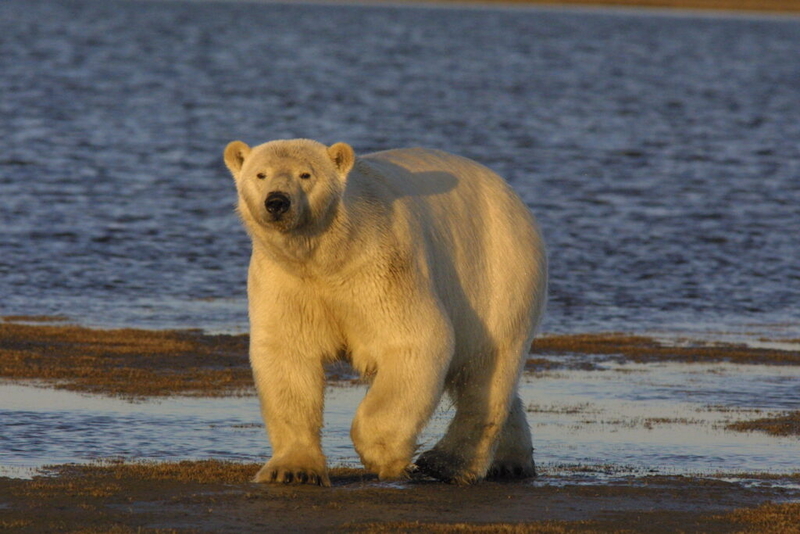
A polar bear walks onshore in Alaska on Sept. 6, 2019. This year's Arctic Report Card, to be issued under new management after the Trump administration pulled federal support, is set to include a chapter updating the status of polar bear populations. (Photo provided by the U.S. Fish and Wildlife Service)
The Arctic Report Card, the annual peer-reviewed analysis of climate in the circumpolar region, will continue even without federal government support, scientists announced.
The American Geophysical Union, an organization representing tens of thousands of Earth and space scientists, announced last week that it has taken over as manager of the Arctic Report Card after the Trump administration pulled support last month.
The National Oceanic and Atmospheric Administration was, until this summer, the agency that coordinated and published the annual report since the inaugural edition in 2006.
But the Trump administration has slashed funding for climate science work at NOAA and other federal agencies, and Trump himself has repeatedly referred to climate change as a “hoax.”
The annual Arctic Report Card is now one of several NOAA climate-related programs which the Trump administration has eliminated or reduced.
The report provides status updates for permafrost thaw, sea ice extent, air temperatures, wildlife patterns, tundra vegetation and other subjects. It places a heavy emphasis on Alaska. Researchers from UAF and other Alaska universities are prominent among the chapter authors, and in recent years the report has included analysis from Indigenous Alaska scientists and community members.
Under AGU oversight, the Arctic Report Card’s editorial team remains intact, with continued leadership by researchers from the University of Alaska Fairbanks and the University of Colorado. Rick Thoman of UAF’s Alaska Center for Climate Change Preparedness remains one of the three main editors. The other two are from the University of Colorado’s Cooperative Institute for Research in Environmental Science, which includes the National Snow and Ice Data Center.
In a statement, one of the Colorado-based lead editors said the Arctic Report Card’s survival was a victory against censorship of climate science.
“Beyond the importance of sharing this key science, the fact that we can pull together and ensure the Arctic Report Card goes forward is a sign that science won’t be stopped or silenced,” Matthew Druckenmiller, a senior NSIDC scientist, said in the statement. “When we come together, we have a powerful platform for robust observational evidence to inform global decisions – we are counting on that same spirit of support to help us close the remaining funding gap and secure the report card’s future.”
This year and beyond
The AGU will issue the 2026 Arctic Report Card at its annual conference in December, the same event at which NOAA issued past report cards.
Thoman noted that much of the work was already completed before NOAA announced its withdrawal from the project, so changes might not be obvious.
“I suspect 2026 will have a look and feel very similar to what we’ve done in the past,” he said.
This year’s report will include, along with the usual updates on ice, air temperature, ocean and tundra conditions, some special chapters of interest to Alaska, Thoman said.
One chapter will examine Indigenous wildfire management practices, and another chapter will examine wildfire patterns more broadly, he said. There will be a polar bear update, he said. And a chapter led by UAF geophysicist Andy Mahoney will examine changes in shorefast ice, the land-attached type of ice that is important to Arctic coastal communities.
Beyond this year, the shape of future Arctic Report Cards “is really not thought out,” Thoman said.
Some operation changes are already underway.
The editors and authors are no longer using archived data, images or other information from climate.gov, a NOAA climate information website that the Trump administration took down last year. Instead, they are using an alternative nonprofit site called climate.us.
That site was established and is maintained in part by some of the same NOAA scientists and staffers who had worked on climate.gov but lost their agency jobs. “They know what they’re doing,” Thoman said.
The editors will be turning to an international source, the Arctic Monitoring and Assessment Programme of the eight-nation Arctic Council, for assistance with peer reviews. There might be similar outreach on other tasks, Thoman said. “There could be more robust international collaboration,” he said.
Trump administration policies on climate change
The end to NOAA support for the Arctic Report Card comes amid similar cuts.
Last year, for example, NOAA pulled its support for the National Snow and Ice Data Center’s satellite-based sea ice tracing program. The Colorado-based center switched to more reliance on satellite data from the Japan Aerospace Exploration Agency, that nation’s counterpart to NASA.
Trump administration officials have expressed particular animus toward NOAA.
The Heritage Foundation’s Project 2025, a blueprint for a second Trump administration, recommended breaking up NOAA. The agency’s six science-focused divisions, which include the National Marine Fisheries Service and the National Weather Service, “form a colossal operation that has become one of the main drivers of the climate change alarm industry and, as such, is harmful to future U.S. prosperity,” Project 2025 said.
Russell Vought, the lead author of Project 2025, now heads Trump’s Office of Management and Budget. He is seeking to dismantle the 66-year-old National Center for Atmospheric Research, a university-managed institution in Colorado that partners with NOAA. That effort has been blocked by legal challenges.
Juneau