Majority of Coloradans dislike AI, new survey finds
Sep 14, 2026 | 5:09 pm ET
Description
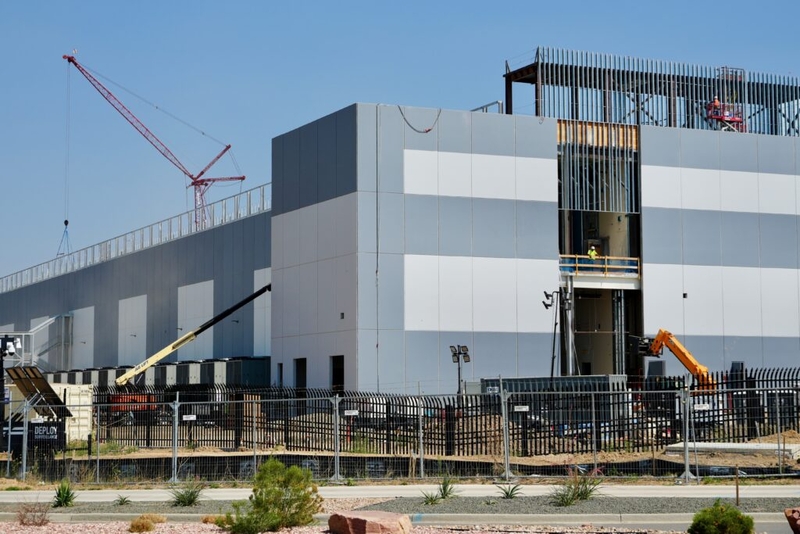
Construction on a data center expansion at the QTS site in Aurora is pictured last month. (Photo by Chase Woodruff/Colorado Newsline)
Two-thirds of Coloradans have an unfavorable opinion of artificial intelligence, with younger people the most strongly opposed to it, as global AI leaders call for a development slowdown and push for safety controls.
A newly-released survey found that 81% of people between 18 and 44 years old do not like AI, compared to 55% of people between 45 and 64 years old and 49% of people over the age of 65. Sixty percent said they had used AI tools in the previous year.
The survey was released over the weekend by Magellan Strategies, a nonpartisan research firm based in Broomfield. It was not paid for or developed by an outside organization, and the survey was conducted with nearly 1,400 registered voters between Aug. 26 and Sept. 2. The margin of error is 2.63%.
Women are more unfavorable toward the technology, with 74% holding that attitude compared to 58% of men. Republicans are more friendly toward AI, with 48% saying they have a favorable view versus 25% of unaffiliated voters and 20% of Democrats. And favorability towards AI increases with income, landing at nearly an even split among people who make at least $200,000 per year.
“It is a massive, terrifying economic ticking time bomb,” wrote one Adams County woman.
Local governments in Colorado enact moratoriums on data center development
The survey asked for agreement or disagreement with statements and allowed for open-ended responses.
“I think generative AI is completely useless and discourages critical thought, research, and learning in general in every age group,” a Boulder man wrote.
But another Pueblo man wrote that AI “has great potential to advance society, if used correctly.”
Those against AI wrote about the environmental costs of the large data centers that power AI, concerns over declining skills and reliance on AI, job loss, lack of trust for companies like Facebook and Google creating AI software, and belief that many AI-powered systems produce incorrect results. Respondents who have a favorable view of the technology, however, cited a more efficient workflow, working beyond their personal training level, and staying ahead of countries like China in such a large technological advancement.
“I learn more by exploring topics I wouldn’t normally look at. I am more productive with my time. And if we don’t lead with AI someone else will. I would rather be at the front instead of behind,” wrote one woman from Arapahoe County.
I think generative AI is completely useless and discourages critical thought, research, and learning in general in every age group.
Release of the survey immediately follows a shakeup in attitudes of global leaders on AI. Over the weekend, Anthropic CEO Dario Amodei published an essay in which he asserted that AI was advancing too fast for researchers to safely monitor. Within hours, OpenAI CEO Sam Altman, Google DeepMind co-founder Demis Hassabis and Elon Musk all publicly agreed that the world needs to prioritize safety over AI growth. Meanwhile, President Donald Trump continues to reject calls for government regulations on rapidly-developing AI and views the United States and China as competitors in a race to master the technology.
Coloradans do not generally like those big tech leaders at the forefront of AI advancement, with 91% unfavorable toward Meta CEO Mark Zuckerberg, 82% unfavorable toward Amazon founder Jeff Bezos and 61% unfavorable toward Altman.
Dislike of data centers
Colorado lawmakers passed a broad AI law in 2024 aimed at curbing discrimination when AI is used to make decisions like loan acceptance and hiring choices, but after a tumultuous couple years among business groups and consumer protection advocates, the General Assembly replaced the law this year with a more narrow version. The Legislature also punted a decision this year on how to regulate, or incentivize, data centers. That led to local governments across the state to take the lead on enacting moratoriums on data center development, though some municipalities are welcoming them.
Fifty-five percent of survey respondents support data center construction bans and 26% think there should be new zoning regulations specific to those projects.
But general opposition to data centers was broad among respondents, and grew when a hypothetical data center was closer to their home. Seventy-five percent oppose data centers anywhere in the state, and 86% oppose it in their neighborhood. Many of those opponents gave similar reasons: that data centers use too much water and power when the state is facing a drought and capacity crisis. There is widespread agreement that data centers will drive up electricity costs for nearby neighborhoods.
While 83% and 82% of people think data centers use too much power and water, respectively, just 16% agreed that the benefits to the local economy outweigh the potential impact.
“AI is going to add a huge demand to the electric and water systems in Colorado. We better be 1,000% sure we have a plan for how to handle those demands that is environmentally sound. Colorado is already suffering through a drought and record heat,” wrote an Arapahoe County woman.
Majorities of people also think AI will result in job loss for future generations and do not trust local governments and school districts to use AI. The most positive impact, respondents said, could be on medicine, with 40% saying AI could be beneficial. On the flip side, 74% said AI will have a negative impact on social media and 73% said it will negatively affect elections.

Denver, CO