Woonsocket vows to close its sewage incinerator. For now, a new company holds promise.
Sep 14, 2026 | 3:49 pm ET
Description
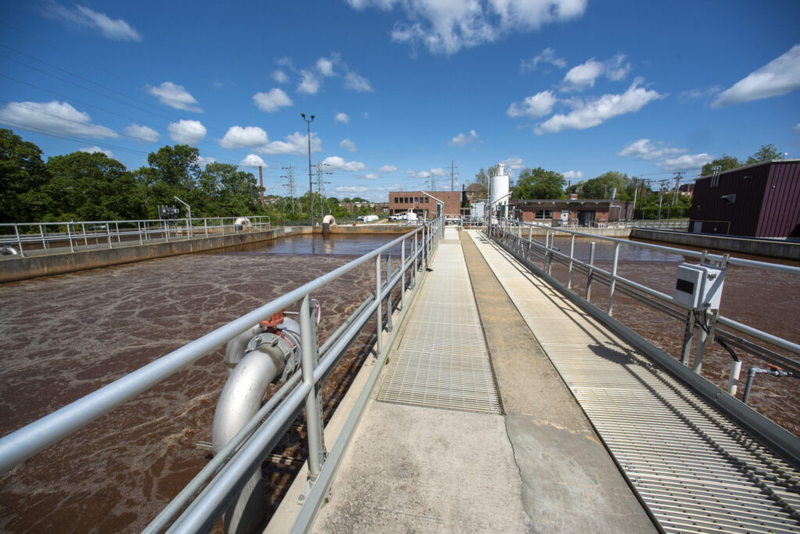
The Woonsocket Wastewater Treatment facility is poised for new management under an agreement between the city and Veolia North America. (Photo by Michael Salerno/Rhode Island Current)
A new private contractor already well known in Rhode Island is on track to temporarily take over Woonsocket’s sewage treatment plant while city officials look for a long-term solution for the regionally vital but locally unwelcome incinerator.
A resolution and accompanying draft contract on the Woonsocket City Council’s Monday night agenda call for a six-month agreement with Veolia North America to run the 16-acre Cumberland Hill Road sewage plant overlooking the Blackstone River. The contract covers all aspects of the wastewater treatment services and general oversight the accompanying sludge incineration arm.
Veolia would replace Texas-based Jacobs Engineering Group, which is cutting ties with the city 14 years into its 20-year contract over a late payment dispute. The six-month agreement with Veolia, with up to six one-month extensions, calls for a $251,250 monthly payment for 15 full-time Veolia employees and repair costs. There is also a one-time $270,000 startup and transition fee, according to the agreement.
The contractor change comes as city officials continue their quest to shutter the controversial sludge-burning service, fed up with the odor, truck traffic and operational and legal woes piling up after 50 years of treating dried sewage for many of their municipal neighbors.
The Cranston Wastewater Treatment Facility, also operated by Veolia, is the only other treatment plant in Rhode Island with an incinerator. The Boston-based company also provides water and wastewater treatment services for East Providence, South Kingstown, Narragansett, Jamestown, Newport and Providence, making it the obvious choice to step in for Jacobs, said Council President Dan Gendron, who is sponsoring the resolution
“The closing of the incinerator, in my mind, is absolutely the biggest factor of all this,” said Gendron, who is running in the nonpartisan city mayoral race against Mayor Chris Beauchamp. “That is absolutely a goal for the city.”
But an earlier plan to shutter the incinerator and sell off the wastewater treatment arm of the plant to the quasi-public Narragansett Bay Commission is no longer on the table. Negotiations fell off sometime this summer, felled by controversy over a separate project for a high-heat sludge processing plant in North Kingstown’s Quonset Business Park. Narragansett Bay Commission was planning to use the proposed Quonset pyrolysis plant to treat its wastewater byproducts, including from Woonsocket, but the Quonset project is now on hold amid community backlash, a pair of lawsuits, and a soon-to-begin legislative study panel.
“When that rug was pulled out from under NBC, so too was the ability to unconditionally shut down our incinerator,” Gendron said.
The closing of the incinerator, in my mind, is absolutely the biggest factor of all this. That is absolutely a goal for the city.
A spokesperson for Narragansett Bay Commission did not respond to requests for comment Monday.
Meanwhile, a years-old payment dispute with Jacobs had reached its limit.
Jacobs claims the city broke its contract by failing to make several of its monthly service payments on time in 2024, using the alleged breach of contract to justify severing the agreement entirely. The 20-year contract, signed in 2012, would have kept the wastewater operator in Woonsocket until 2032.
Jacobs, which also runs Westerly’s sewage plant, did not respond to multiple requests for comment on Monday.
The city acknowledges it failed to make at least two of the monthly payments within the mandated 90-day time frame due to what city solicitor Michael Lepizzera called a “clerical error.” But Lepizzera does not agree that the city’s late payments — rectified as soon as Jacobs notified city officials in December 2024 — constitute a breach of contract.
“The whole point of that clause was to make sure someone is not held hostage, that our financial problem does not become their financial problem,” Lepizzera said in an interview on Monday. “We had the money. That’s not the issue.”
Running out the clock
Lepizzera claims that Jacobs intentionally waited out the late payment window because the company wanted out of the contract. Two 2023 lawsuits filed by state regulators and residents over environmental pollution and odor, respectively, along with the very public city position to shutter the plant, made it financially and legally unappealing for Jacobs to continue operations in Woonsocket, Lepizzera said.
Jacobs still hasn’t left, maintaining a 13-person crew running 24/7 operations and submitting mandated monthly odor reports to the city as recently as Aug. 14. But the company indicated they are “winding down,” and will be on their way out soon, Lepizzera said.
The date of Jacobs’ departure was not immediately available.
“We have an obligation to make sure that the plant is being operated,” Lepizzera said. The wastewater arm treats 10 million gallons of sewage a day, from its host city as well as for North Smithfield and Bellingham and Blackstone, Massachusetts.
Gendron acknowledged it will be more expensive for the city to bring on Veolia than if it had retained Jacobs, which receives around $250,000 a month under the escalating payment framework laid out in its 2012 contract.
The city’s approved fiscal 2027 budget featured higher sewer fees to cover its expected payments to Veolia, with a $556 annual charge for city residents compared with roughly $440 the year before, Gendron said. The city’s independent wastewater treatment fund is expected to generate $13.5 million in revenue in fiscal 202, nearly $4 million more than the $9.6 million balance as of June 30, according to city budget documents.
The incinerator burns the dried sewage byproduct from these municipalities, along with another 30+ municipal and commercial customers that pay to have their sludge trucked to Woonsocket from across southern New England. Synagro, based in Baltimore, oversees the sludge operations, but Jacobs acted as Synagro’s supervisor and was the designated backup if Synagro breaks or ends its contract.
Sophia Salis, a spokesperson for Veolia in Rhode Island, acknowledged requests for comment but could not provide details immediately on the company’s interest in the work.
The Woonsocket City Council meets at City Hall at 7 p.m. Its meeting will also be streamed in the city YouTube page.
This story will be updated.
Providence, RI