Alabama Democrats have had a few good weeks. But political gravity is tough.
Sep 14, 2026 | 5:59 am ET
Description
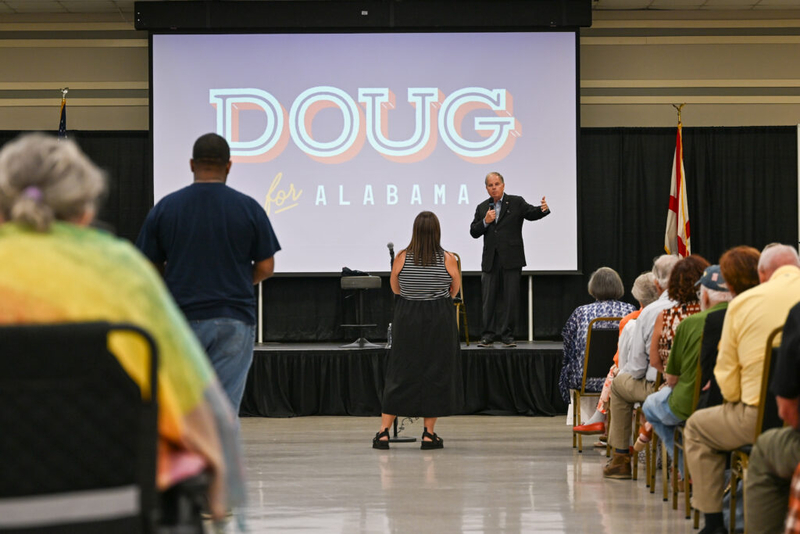
Doug Jones speaking at a veteran's town hall in Anniston, Alabama, on Sept. 9, 2026. (Anna Barrett/Alabama Reflector)
I still think the GOP will prevail in Alabama’s state elections.
The state’s demographics and political structure favor Republicans. Alabama Democrats have enthusiasm, but they had that in 2018, too, and they gained nothing.
But over the past few weeks, my thinking has changed. From “Republicans are going to win” to “these are the GOP’s races to lose.” And that’s mostly because of the gubernatorial contest.
Democratic nominee Doug Jones has waged an energetic campaign, staying on the offensive, staying on message and drawing crowds to town halls around the state. This could be expected in Birmingham or Montgomery. It’s worth noticing when more than 300 people see Jones on a weeknight in a county where President Donald Trump won 72% of the vote two years ago.
Republican nominee U.S. Sen. Tommy Tuberville has all the advantages the state gives his party, and it seems clear he’ll need them. The national environment isn’t helpful, but Tuberville’s campaign has been clumsy. The U.S. senator made an early choice to present himself as inevitable, which may have been one reason he denounced concerns about data centers and their critics in a July speech to the Alabama Sheriffs Association. A candidate who thinks he has to persuade voters doesn’t take that approach to an issue cutting across normal Alabama divides. It handed Jones an opening he was quick to exploit.
In fact, what’s been striking over the last six weeks is how Jones has gotten Tuberville to play on his turf. When Tuberville called Social Security a scam — another unforced error — Jones accused Tuberville of threatening state employee retirement. That put Tuberville and his allies on the defensive for a few days.
Even Tuberville’s first post-Labor Day spot calling for the abolition of the grocery tax feels like the Republican nominee making an abrupt move to ground more congenial to Democrats. As of Friday, his campaign site didn’t explicitly list the proposal among his priorities. Those remain attacks on DEI, immigrants and transgender Americans that Tuberville would clearly prefer to be discussing.
Still, there’s a political gravity in the state. And three factors should pull this race toward the GOP.
The major one is straight-ticket voting. No Democrat in 16 years has won a statewide race with more than one contest on the ballot. Jones defeated former Alabama Chief Justice Roy Moore for U.S. Senate in 2017 in part by being the only other option in a special election.
In Alabama, two-thirds of all ballots cast are straight ticket, and almost two-thirds of those go to Republicans. That gives the GOP a lot of room for error. Republicans are going to cling tight to that advantage: Tuberville’s first spot attacked “Democrats,” a sign they want this to be a contest between parties, not individuals.
Then there’s fundraising. Jones is holding his own, as are a handful of other statewide Democratic candidates. Jones may not overtake Tuberville — who had almost four times Jones’ cash on Sept. 1 — but his real goal is to keep pace with the Republican nominee. Tuberville hadn’t opened the spigots as of early September. When he does, he could reframe the race.
Outside incumbents and safe seat races, fundraising by Democratic legislative candidates has been underwhelming. There’s a warning sign for the party in Senate District 2 in metro Huntsville, a target for Democrats: nominee Rudolph Drake, who faces Republican nominee John Roberts and his $400,000 war chest, raised a little more than $200 in August.
Finally, there’s the institutional factor. Republicans by and large are nominating candidates known to voters, activists and local officials. Democrats, as a minority party, have many first-time candidates who lack established constituencies or experience with campaigning.
So I’m not expecting a revolution in November.
Democrats do have a more favorable environment than in the past. Trump is broadly unpopular in Alabama, and Republican candidates may have to decide whether they want to embrace a president popular with their base or tone it down for the general electorate. One poll released last month found that the president appeared to be underwater in Tuscaloosa and Lee counties, two college cities that are must-wins for Democrats. His numbers in fast-growing Shelby and Limestone counties are just above water. Tuberville, hopelessly devoted to Trump over the last six years, did not mention the president in that first post-Labor Day spot.
If Tuberville stops giving openings to Democrats and hammers the GOP’s advantages, straight-ticket voting will do its magic. If Jones can keep the race on his turf, things could get interesting. The next round of campaign finance reports in early October should tell us where things stand.
But there’s still a lot for Democrats to overcome. As has been the case for the last 12 years, the party is trying to win an election and build an organization at the same time. That’s difficult against a seasoned and well-funded opposition.
Yet they haven’t been put away. That’s not something I could say four years ago. And even a little uncertainty in some of these races should give Democrats some hope.
Montgomery