Lawyers argue over South Dakota’s notification letters to voters registered as federal-only
Sep 11, 2026 | 7:12 pm ET
Description
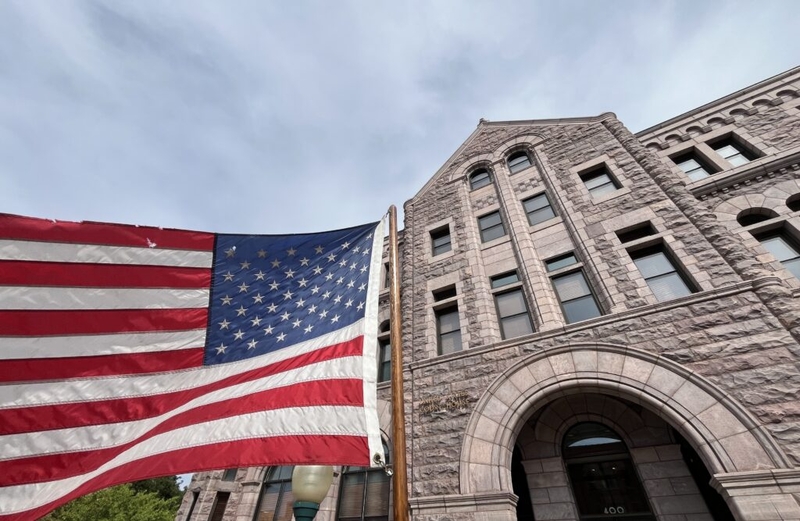
An American flag waves outside of the U.S. Courthouse in Sioux Falls, South Dakota, on Sept. 11, 2026. (Photo by Makenzie Huber/South Dakota Searchlight)
SIOUX FALLS — A federal judge will decide whether South Dakota’s secretary of state is violating the U.S. Constitution with allegedly misleading letters to voters registered as federal-only, and by allegedly failing to tell them how to change their status.
Judge Eric Schulte heard oral arguments Friday and said he expects to release a decision next week.
The case deals with how the state’s chief elections officer is implementing legislation approved by lawmakers and signed into law by Republican Gov. Larry Rhoden in March.
The law requires new voter registrations to include proof of citizenship, which can include a birth certificate, passport, driver’s license, non-driver’s identification card or tribal identification card, or “any other type of acceptable documentary evidence of citizenship” permitted under federal law. Photocopies are acceptable for any documents except driver’s licenses or state or tribal identification.
People who don’t provide those documents are registered but receive a “federal-only” ballot, which lists only candidates for federal offices such as the president and Congress, but not state or local offices.
State of South Dakota faces lawsuit over proof-of-citizenship voter registration law
A separate provision, passed in 2025 and implemented in January, requires voters registering or requesting an absentee ballot with only a mail-forwarding service or post office box as their address to receive federal-only ballots unless they can provide a physical address and prove 30 days of state residency.
The lawsuit asks a judge to force the state to:
- Accept photocopies of driver’s licenses, tribal IDs and nondriver IDs for voter registration.
- Rescind guidance requiring in-person registration for people who use such IDs as proof of citizenship.
- Make sure registrants designated as federal-only are offered accurate explanations as to why they’ve been denied access to state and local ballots.
- Offer voters registered as federal-only an opportunity to challenge the designation.
Schulte heard arguments Friday specifically about the notification letters sent to voters registered as federal-only.
The lawsuit was filed by the League of Women Voters — a nonpartisan, nonprofit group that conducts registration drives, provides voter education and lobbies on voting rights issues — and by a Sioux Falls resident, Jaysen Hill. They’re suing South Dakota Secretary of State Monae Johnson and the state Board of Elections.
The Secretary of State’s Office writes letters sent to new voters by county auditors informing them of their federal-only status. But those letters cite only the mail-forwarding address issue as the reason — even for voters whose status stems from failing to provide citizenship documentation, Campaign Legal Center attorney William Hancock argued on behalf of the League.
That makes the letters inaccurate and misleading, Hancock argued, and violates the due process rights guaranteed by the 14th Amendment, which he said requires the government to give people accurate information about actions that affect them and a way to respond.
The letters have forced the League to scale back voter registration drives because volunteers can’t reliably explain to new voters why they might be designated federal-only or how to fix it, Hancock said. The organization has also spent time and money investigating individual voters’ federal-only status.
Members of the League’s South Dakota chapter argued before the state’s Board of Elections for rule changes earlier this summer that would have addressed the issues raised in their lawsuit. The board voted them down 5-2, ruling that the League lacked legal standing to propose them.
Hancock said one “simple fix” would include the Secretary of State’s Office writing new notification letters specific to the reason for designating a voter as federal-only, including for citizenship cases, and listing how voters can remedy their status and the deadline to do so.
Hancock told the court that the Secretary of State’s Office is aware the letters are imperfect and intends to fix them — but not until after the Nov. 3 general election.
Lawyers representing the state argued the League lacks standing because its claims are not specific enough to the organization and its members. Attorney Drew Driesen also cited a county-specific letter that highlighted aspects of the law that applied to Hill’s situation. Hancock argued the county letter was insufficient to correct the misleading information in the secretary of state’s letter.
Driesen also said the plaintiffs should have sued county auditors rather than the secretary of state because the statewide office has “very little control” over whether its guidance is followed — and because auditors, not the secretary of state, register voters.
Hancock argued that the auditors do not control the contents of the state’s notification letters — the secretary of state does.
- September 15, 20264:41 pmThis story has been updated with a correction. The original story included an incorrect affiliation for attorney William Hancock.

Pierre, SD