Mixed-status immigrant households expected to lose benefits under new public charge rule
Sep 11, 2026 | 2:43 pm ET
Description
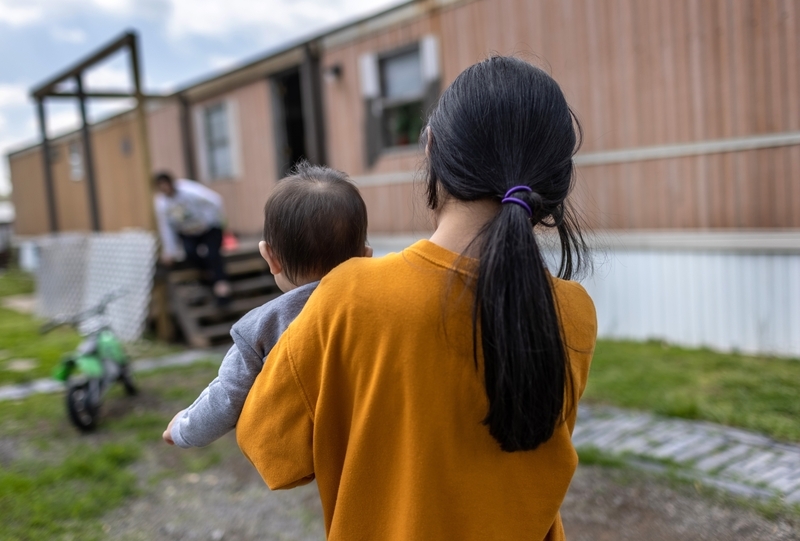
A 10-year-old Honduran immigrant who came into the United States as an unaccompanied minor carries her baby cousin in 2021 in Indiana. A new federal rule expands public charge considerations in immigrants’ applications for lawful permanent residency, a policy that could contribute to more than a million people disenrolling from public benefits. (Photo by John Moore/Getty Images)
New rules going into effect next week allow immigrants’ enrollment in safety net resources to be taken into account for lawful immigration status applications, the latest in the Trump administration’s immigration overhaul.
The rules will have wide implications for mixed-status households, as people without lawful status may forgo enrollment in public benefits for their U.S. citizen kids and other dependents out of fear.
The new U.S. Citizenship and Immigration Services (USCIS) guidance goes into effect Sept. 18 and affects people applying for a green card, certain visas or admission into the United States. It rescinds the Biden administration’s 2022 public charge regulations, which restricted immigration officers from considering immigrants’ use of non-cash public benefits, including many benefits for low-income families such as Medicaid, housing programs and food stamps.
Trump administration will make green card hopefuls return to home countries before applying
When an immigration officer determines a person could become dependent on government benefits, that “public charge” is a ground for inadmissibility under federal law.
Trump’s new policy broadens immigration officers’ discretion, allowing them to consider enrollment in non-cash public benefits as public charge. That includes Medicaid, Children’s Health Insurance Program (CHIP) and the Supplemental Nutrition Assistance Program, the country’s largest food assistance program.
Those subject to public charge consideration are immigrants seeking adjustment of immigration status to lawful permanent residency, and includes those who are spouses, siblings, parents and children of U.S. citizens; widowers and widows; foreign medical school graduates; U.S. armed forces personnel; certain workers such as those with advanced degrees, and others.
USCIS specifies certain immigrant groups and classifications that are not subject to public charge. Those include asylees, refugees, Afghani and Iraqi interpreters or such nationals who worked for the U.S. government, people seeking temporary protected status, human trafficking victims, self-petitioners under the Violence Against Women Act, Indigenous people born in Canada who aren’t U.S. citizens, among other groups.
Health research group KFF this summer estimated that between 1.4 million and 4.1 million Medicaid and CHIP enrollees living in a household with a noncitizen could disenroll due to the public charge rule or another immigration-related fear.
Last November, the U.S. Department of Homeland Security acknowledged this, saying that the rule would affect U.S. citizens in mixed-status households. The agency said that federal and state spending could be reduced by almost $9 billion annually “due to disenrollment or forgone enrollment in public benefits programs by members of households that include aliens who may be receiving public benefits.”
It also acknowledged “downstream and upstream” effects for states and their economies.
“For example, the rule might result in reduced revenues for healthcare providers, such as hospitals and nonprofits, participating in Medicaid, companies that manufacture medical supplies or pharmaceuticals, grocery retailers participating in SNAP, agricultural producers who grow foods that are eligible for purchase using SNAP benefits, or landlords participating in federally funded housing programs,” the agency wrote in its proposed guidance.
Immigration activity is taking a toll on children’s health, doctors say
Previous studies found that under the first Trump administration’s public charge rules, families were less likely to apply for food assistance or seek healthcare, a point emphasized by the American Academy of Pediatrics this week.
“When a child is hungry, it can affect every aspect of their development and lead to chronic conditions like heart disease and diabetes, even into adulthood,” said Dr. Sural Shah, chair of the American Academy of Pediatrics’ Council on Immigrant Child and Family Health, during a news conference Thursday.
“Without accessing WIC, babies and young children will miss out on critical nutrition supports that are important for brain development in the first 1,000 days of life. Medicaid and CHIP are lifeline programs.”
In an executive order he signed a month after his inauguration, President Donald Trump wrote that his administration would “uphold the rule of law, defend against the waste of hard-earned taxpayer resources, and protect benefits for American citizens in need, including individuals with disabilities and veterans.”
Health clinicians say immigration activity has been leading to fear and isolation among families, causing delayed care and illnesses to advance among children. They also say those with disabilities and complex needs will be among those hit hardest.
The Autism Self Advocacy Network, for example, said immigrants with disabilities will be disproportionately affected, as they tend to use public benefits more than other immigrants.
Stateline reporter Nada Hassanein can be reached at [email protected].