Trump pulled the plug on EVs. Georgia EV makers are adapting and forging ahead
Sep 10, 2026 | 3:01 pm ET
Description
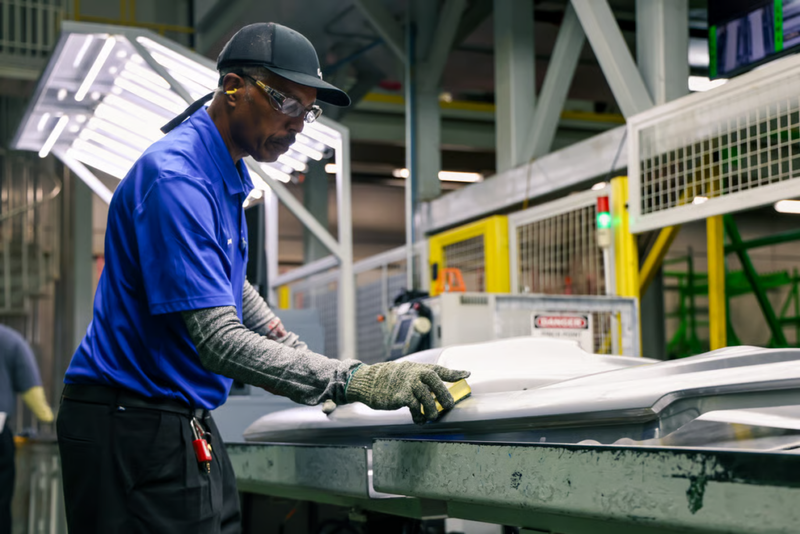
A factory worker at Kia's plant in West Point, Ga., which now makes electric vehicles and hybrids along with gas-powered cars.
This coverage is made possible through a partnership between WABE and Grist, a nonprofit environmental media organization.
A year ago this month, federal immigration agents raided an electric vehicle battery plant in coastal Georgia and arrested more than 400 people, most of them South Korean workers there to help get the new factory off the ground.
It was a grim moment in what has been a challenging year-and-a-half for the industry in Georgia. But the EV makers are still forging ahead, even if that means making some adjustments.
For years, Georgia Gov. Brian Kemp has been working to make the state a welcoming home for clean-energy manufacturing, including EVs, solar panels and batteries. Georgia went all out with tax breaks and a worker training program to attract EV and battery makers — and it’s worked.
Georgia-based bus manufacturer Blue Bird started selling electric buses commercially in 2018 and built an expanded factory for electric buses in 2023. In 2022, Hyundai built a plant near Savannah that it said would be dedicated to making EVs. In 2024, Kia started making EVs at its West Point plant. And in 2025, Rivian broke ground on its manufacturing plant near Atlanta. The Hyundai and Rivian operations are two of the biggest economic development projects in Georgia history. The state has also worked to attract other parts of the EV and clean energy manufacturing sector, including battery makers and recyclers and solar panel companies.
Under the second Trump administration, the economic outlook for these companies has been destabilized. In addition to ending federal EV tax credits for car buyers, the Trump administration has imposed tariffs on battery packs, charger hardware and other components; loosened rules around emissions from gas-powered cars; and ended the Biden administration’s push to make government vehicle fleets electric.
Factories adjust
At Kia’s plant in West Point, a long and constantly varied line of vehicles moves steadily forward on the assembly line, step by step gaining all the trimmings that turn metal shells into driveable cars.
This plant functions more like a short-order cook than a traditional assembly line. Instead of producing big, uniform batches, Kia has designed the plant to manufacture cars according to unique specifications — each one a different model, color or trim. There are gas-powered, hybrid and electric cars rolling off the line here. Kia says it has done this to make more of the cars people most want to buy at any given moment.
Right now, that means hybrids.
“What we’ve seen is a transition back away from maybe full EV vehicle building to this kind of a middle-of-the-road opportunity,” said factory CEO Stuart Countess.
“When it comes to electric vehicles, Georgia politics remains utterly confused.”
Electric cars are still the future, he said. But for several reasons, including price and charging access, consumers just aren’t there yet. Changes to federal policy are a major factor, too.
“We had a tax incentive credit that did go away,” Countess said. “Sales were really moving in the right direction, but once it went away, it became a much different environment.”
Just as Kia has ramped up hybrid production, its sister company Hyundai has added hybrid production to the lineup produced at its massive plant near Savannah, which was originally built to make EVs.
“It’s kind of a messy period we’re in right now,” said Stephanie Valdez-Streaty, director of industry insights at Cox Automotive. “But I think the manufacturers are adjusting.”
At the same time, battery makers throughout the state have started shifting to producing storage batteries for electricity storage in addition to ones made to power vehicles.
“The state continues to have a lot riding on the success of both the electric vehicle but also the battery market,” said Stan Cross of the Southern Alliance for Clean Energy, or SACE.
Georgia leads the region in EV and battery manufacturing, but the growth has stumbled, with layoffs at SK Battery earlier this year. More than $4 billion in investment has been canceled or scaled back in the last year across the Southeast, according to SACE – though that’s dwarfed by the nearly $74 billion in manufacturing investment that’s moving ahead.
Making vs. buying EVs
One open question, Cross said, is whether Georgians will buy the hybrids and EVs being made in the state. Despite actively pursuing EV manufacturing, Georgia doesn’t have incentives to encourage EV adoption like some other states. In fact, there’s an extra registration fee designed to make up for lost gas taxes.
“When it comes to electric vehicles, Georgia politics remains utterly confused,” Cross said.
Private investment continues, though, including in charging infrastructure — a key missing piece for many car buyers considering going electric.
Kia and Hyundai are part of a charging consortium called IONNA that has installed several charging stations around the state, including one at the Kia factory site in West Point. Electric utilities are investing more in vehicle charging too. Across the region, EV-related investment by utilities increased by 14% this year, according to SACE.
“Though we’re not seeing a lot of activity on the legislative side, we do see potential on the regulatory side and really are encouraging Georgia Power to step up and help kind of fill the void that policymakers in the state are creating,” Cross said.
Valdez-Streaty believes that, over time, making EVs in Georgia will likely lead to more people in Georgia buying them.
“It’s like that familiarity, right?” she said. “People have jobs at those companies and familiarity with those products.”
Though shaky for the last 18 months or so, she said the EV market is starting to stabilize — and the auto industry is still going electric, it’s just taking a little longer.
Atlanta, GA