More Housing Without Kicking Anyone Out? It’s Possible, Apparently
Sep 10, 2026 | 6:01 am ET
Description
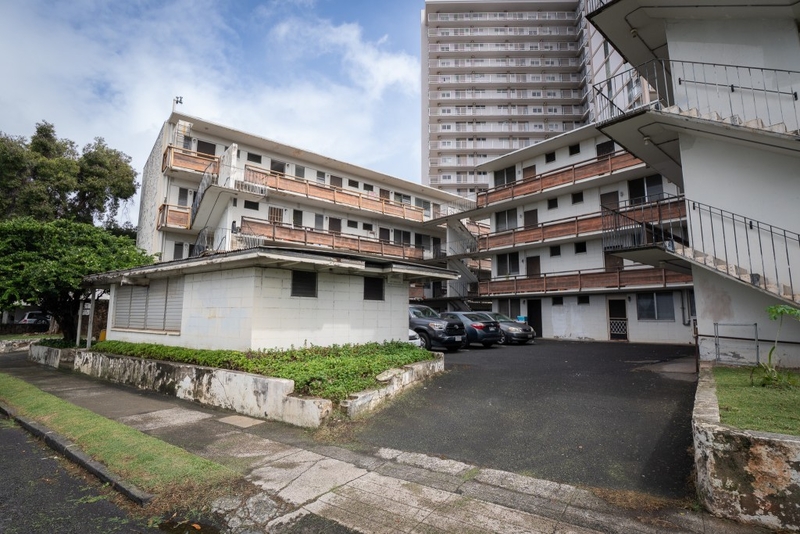
Photo courtesy of Honolulu Civil Beat
Pouron Malekkazeronian was heartbroken when she got a notice from the new owner of the Mōʻiliʻili apartment building where she’s lived for 20 years: She and her neighbors had 45 days to vacate so he could redevelop the property.
It looked like a repeat of what’s played out in other parts of Honolulu, where older, walk-up apartment buildings have been converted into new, bigger properties that existing tenants — often on month-to-month leases with limited protections against rent increases — can’t afford.
That’s not what happened. Instead, the new owner is trying to work out a way to let the current residents stay.
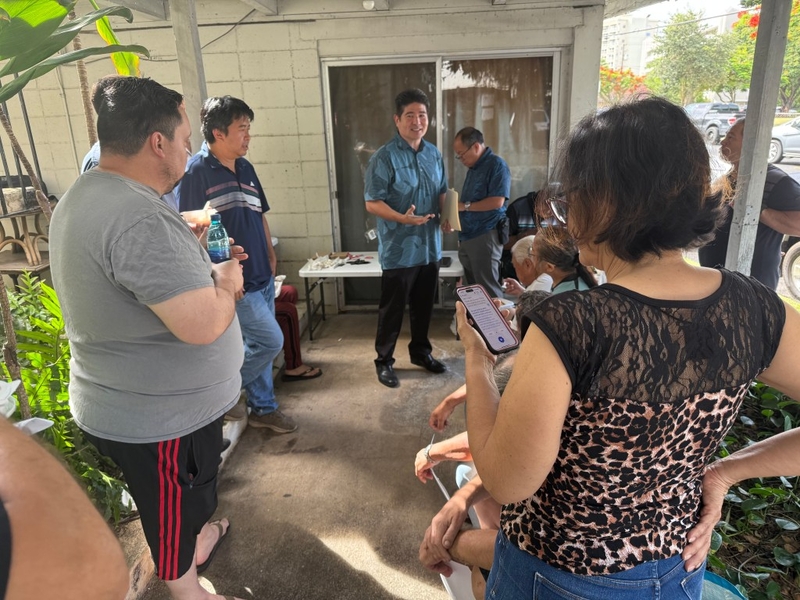
"If he runs for mayor,” Malekkazeronian now says of new owner, Ryan Tanaka, “I’m the first person who’ll give him my vote."
As it turns out, Tanaka is taking an approach far different from what’s happening elsewhere in Honolulu. Instead of a wholesale redevelopment, Tanaka’s Kai HI Advisors LLC is planning to renovate the 39-unit building to attract new renters and improve cash flow, while preserving below-market rents for current tenants like Malekkazeronian, whose apartments won’t be overhauled.
Whether his project can be a model for other developers remains to be seen. Most state and local affordable housing policies incentivize developers to build new properties to rent at below-market rates. The problem is that, even with government incentives to sweeten the pot, building costs are so high that developers find it hard to build deeply affordable rentals without losing money. Tanaka is confident his plan will pencil out at the Hawaiian Holiday Apartment complex.
"The first 10 tenants that I talked with, they would prefer to stay in their unit and just pay a higher rent, a small adjustment, but that would allow me to at least cover the mortgage," Tanaka said in an interview. "Those economics worked for me, and it worked for them … So it was a win-win."
That’s good news for Malekkazeronian and other tenants who thought they were going to be tossed out in mass to find new homes amid Honolulu’s tight housing market. It also means an exterior facelift for the 65-year-old building, which has clearly seen better days, and about 15-20 now-vacant units being brought back onto the market.
Malekkazeronian, a 67-year-old retired hair stylist, was satisfied with the trade-offs that went with living at the Hawaiʻian Holiday under the previous owner: low rents in exchange for a building slouching into squalor. But she says what Tanaka is doing now is good for everybody.
"Some people say it’s a haunted place," Malekkazeronian said, referring to the building’s rundown exterior. "I always say, ‘No, it’s got good energy.’ That’s why I want to stay here until I die."
Housing Policies Promote Gentrification
Hawaiʻi’s state and local land-use laws encourage redeveloping older, lower-cost housing stock into new homes that in many instances existing tenants can’t afford. Under the laws, developers can obtain rights to build more units than zoning laws normally would allow on their properties if the developers set aside certain percentages of the new units as "affordable housing." That increases the supply of much-needed housing, but because of what’s deemed affordable in Hawai‘i, existing residents often get pushed out to make way for higher-income people able to buy or rent the new homes at higher prices.
In Honolulu, for example, a land-use ordinance known as Bill 7 lets developers build bigger and higher than zoning laws would normally allow if they agree to rent at least 80% of the new units as affordable—which the city defines as what someone earning 100% of the area median income could pay —for at least 15 years. Developers building under a state affordable housing statute, 201-H, can be exempted from numerous state and county land-use laws, including limits on the number of units they can build, if they price at least half of the units at up to 140% of the area median income.
The issue with these policies is that the area median income, which is set by the U.S. Department of Housing and Urban Development, isn’t really based on what people actually make. Instead, it’s based largely on prevailing rents.
The result is a studio in one of Honolulu’s Bill 7 projects can be rented for up to $2,696 per month and still be considered affordable housing. Under the state law a studio can be rented for up to $3,773 a month.
Developer’s Different Approach
Tanaka, whose company acquired the 39-unit lowrise building for $6.3 million in June, is taking a different approach. He thought he would need to do a complete renovation. Instead, he’s simply going to fix up vacant units and leave occupied ones as they are. He plans to rent refurbished studios for $1,700 — still far lower than the state and city’s "affordable" price.
For existing tenants, whose units won’t be renovated, Tanaka has offered rents of $1,100 per month for studios and $1,300 for one-bedroom units starting in November, with another increase of $150 per month starting in November 2027 and no increase in the third year. Tenants also can pay another $100 per month for an assigned parking spot.
Tanaka’s plan marks an about-face since July, when Tanaka’s property manager notified tenants they had 45 days to vacate their homes.
It wasn’t much help when the manager extended the deadline to 120 days, said Sharon Shobu, a tenant who found a place nearby that she can buy under a rent-to-own deal. As panic set in among residents, some people were talking about buying vans to live in, she said.
Others, like Luis Irizarry, experienced what many Oʻahu residents do when hunting for a new place to live: Landlords listing properties for rent simply didn’t call him back.
"The housing situation is crazy," Irizarry said.
For some of the elderly tenants who have been living in the building for decades, it would have been "a death sentence," says Aaron Blakeslee, an automobile mechanic who’s been living at the property for four years.
"They’d be living on the street or in their cars," he said.
Tanaka’s notice that tenants would have to vacate the buildings caused an uproar. One long-time tenant, retired teacher John Mussack, organized tenants against Tanaka by getting them to sign a letter pushing back against the notice. Eventually, Tanaka says he was able to tour the property’s units and craft an alternative plan.
Turnaround Over Breakfast Bentos
Tanaka had good reason to think the property needed a complete overhaul when his company purchased it. The property had been built in 1961 by Jimmy Wong, a prominent developer known among other things for building Puck’s Alley on land owned by Kamehameha Schools on University Avenue and the now-defunct Paradise Park exotic bird attraction in the back of Mānoa Valley.
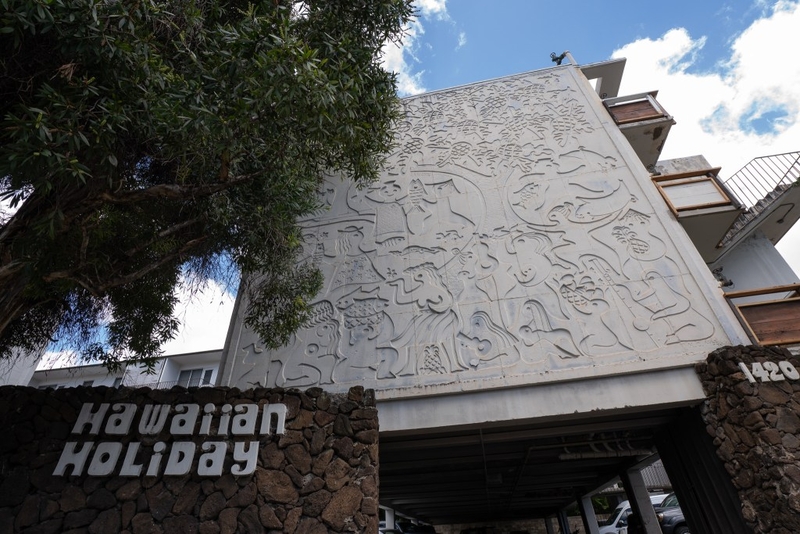
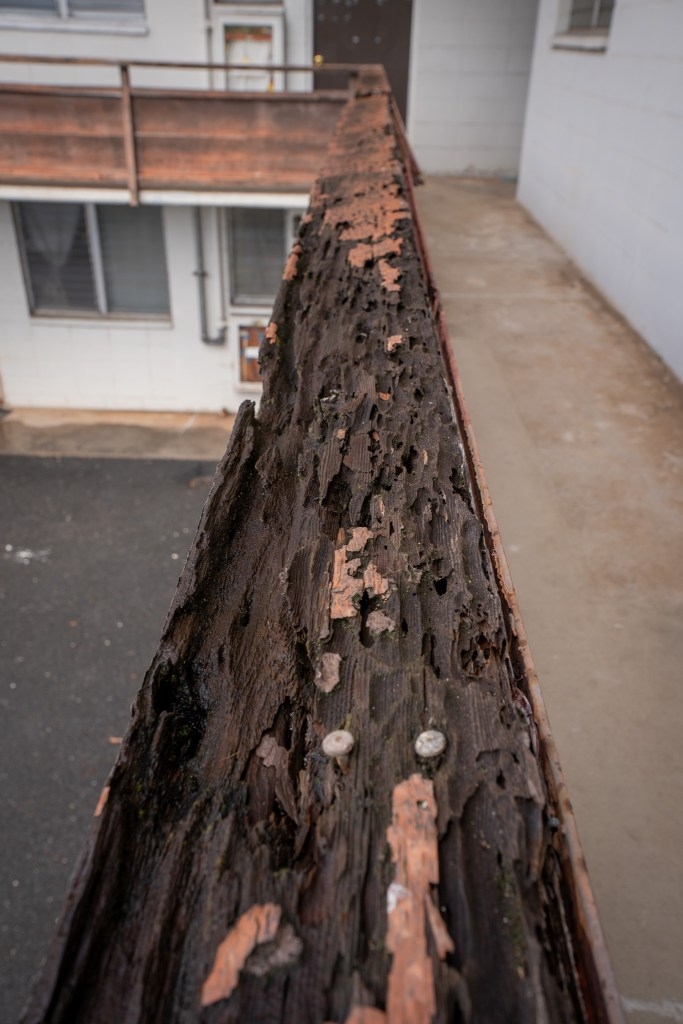
The apartment property still has remnants from its 1960s heyday, including the building’s name spelled out in retro tiki-style lettering on a lava rock wall and a massive bas-relief mural on its façade by the accomplished artist Hon Chew Hee, known for murals at Hilo Medical Center and the Hawai‘i State Art Museum. But by the time Tanaka bought it, the apartment complex had fallen into disrepair. The railing on the outdoor walkways was rotting, and in some cases, plumbing fixtures in apartments were failing, Blakeslee said.
For tenants, the benefit was that rents stayed low: In the 20 years she was there, Malekkazeronian says, rent for her studio increased by only $210, from $690 to $900.
The downside, the property’s agent, Christina Dwight, said in her listing advertisement, was that "All systems need replacing, and all interiors need to be upgraded." The Wong family was selling the building "as-is." Tanaka says he wasn’t able to tour the property’s apartments before he bought it; he could only rely on the agent’s word that the entire property consisting of two buildings needed to be redone.
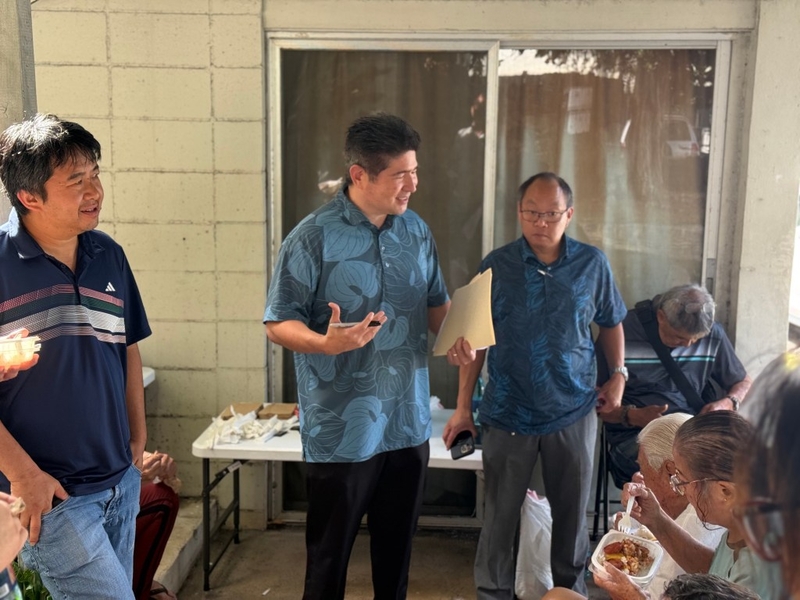
On a Saturday morning in July, Tanaka shared his idea with roughly a dozen tenants in an outdoor covered common space along Wilder Avenue. Over breakfast bentos, Tanaka apologized for the stress the notices to vacate had caused them and explained he had believed what he had been told: that the entire property would need a makeover.
"I was informed I would have to replace everything for health and safety," he said. "That’s what I thought."
Instead, Tanaka said, when he toured the individual apartments and talked to residents, he learned many people wanted to stay and that the units were safe for them to live in.
Tanaka outlined the rent plan, which he later put in writing in letters to tenants, but also said he would try to work with people on fixed incomes case by case if they couldn’t afford his proposed rents. Tanaka also apologized for the noise workers were causing as they replaced cabinets and redid floors. He asked the tenants to bear with the noise for the next few months.
Among those moved by Tanaka’s talk were Shobu, Malekkazeronian, Irizarry and long-time resident Charles Graham.
"He has a heart," Shobu said. "I’ve never seen an owner who would do this."
"It’s a godsend," Graham said.
Rents Still Will Increase
Still, not everyone is completely pleased with Tanaka’s plan. Blakeslee’s rent, for instance, will go from $900 per month to $1,300 for a one-bedroom — a 44% increase that he said is hard to swallow when his apartment won’t change. His stove, he says, has only two working burners, and the plumbing is a mess. The $100 monthly parking fee adds another new cost.
Parking is now free, provided on an unregulated first-come, first-served basis. This leads to some people having two or three cars there, while others have to find parking in the neighborhood. Blakeslee said having an assigned parking stall would solve that problem, but it adds up to a hefty cost increase.
"It’s just the initial jump," Blakeslee said.
Tanaka said he welcomes input from the tenants. "I feel like it's my responsibility to understand where they're coming from, and to make the adjustments necessary," Tanaka said. "It could be that I'm missing something."
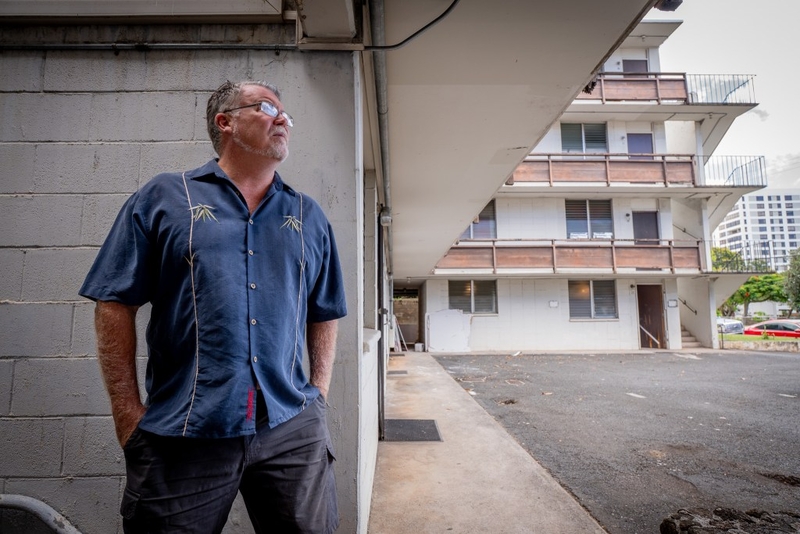
Mussack has been more outspoken. He’s written complaints to the Hawaiʻi Department of Commerce and Consumer Affairs and Honolulu Department of Planning and Permitting, to no avail. DPP spokesman Davis Pitner declined to comment specifically about work at Hawaiian Holiday. But he provided a list of the sorts of non-structural repairs for which a building permit isn’t needed, supporting Tanaka’s assertion that the repairs he’s doing don’t need a building permit.
Mussack declined to say how many of his original supporters are still on his side. While some believe his protests helped move Tanaka to change his plan, others are frustrated that Mussack is continuing to push back against a landlord who they now believe is one of the good guys.
Irizarry said Mussack’s complaints are misplaced.
"He really should be mad about the previous owners," Irizarry said. "They didn’t do anything for us."
The office of the complex’s previous owner, Hawaiian Holiday Apartments Inc., appears to have been vacated. The office was closed when Civil Beat visited the office twice during recent workdays. Darryl Wong, the company’s executive vice president, secretary, treasurer and agent, did not respond to a request for comment.
A 'Hard Model'
Tanaka says his approach isn’t for everyone.
"It's a hard model," he said.
Home builders face economic headwinds that have made construction expensive. The price of materials has surged since 2019, he said. And interest rates went from near all-time lows to current levels. All of that "changes the affordability on the back end."
Tanaka did not share details of his mortgage, budget, balance sheet, projected cash flow statements or other documents showing the math behind his plan. But generally, he said, if he can save money by not completely renovating all of the units, he won’t have to borrow as much, which means he won’t have to charge high rents to cover his mortgage.
Some tenants have lived in the building for decades, he said, and he wants them to be able to stay there the rest of their lives, if they want.
"The more I learn about this community," he said, "the more I fall in love with it."

Honolulu, HI