Health officials, auditors at odds over millions in Medicaid payments to inmates
Sep 10, 2026 | 5:00 am ET
Description
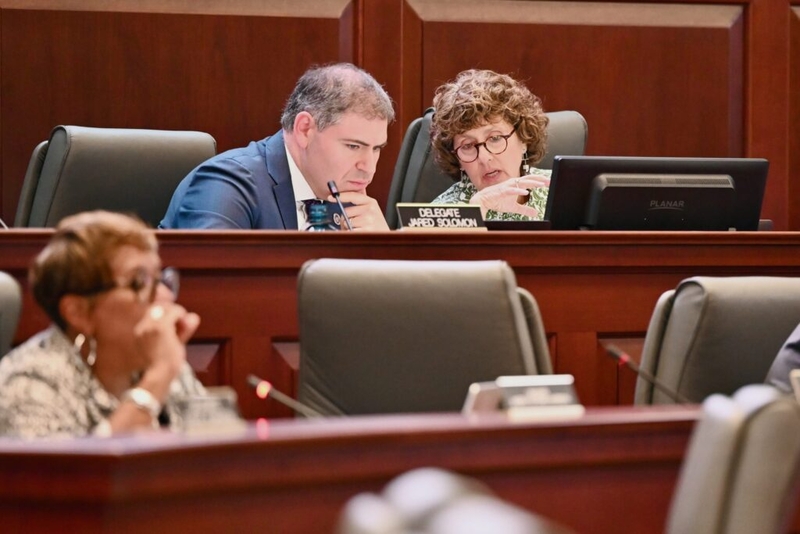
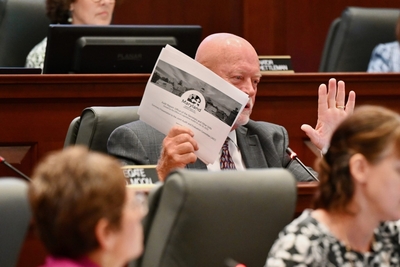
Del. Jared Solomon (D-Montgomery) and Sen. Shelly Hettleman (D-Baltimore County), co-chairs of the Joint Audit and Evaluation Committee, confer during a 2025 hearing. The committee Wednesday reviewed several agencies audits that found repeat problems from previous audits. (File photo by Bryan P. Sears/Maryland Matters)
Lawmakers were left frustrated and confused Wednesday after a 2.5-hour discussion with state auditors and health officials turned into a debate over whether millions in Medicaid payments made on behalf of incarcerated individuals were proper.
Health Department officials said 75% of the $6.4 million in payments identified in a May report by the Office of Legislative Audits were actually allowable payments for inmates who had been hospitalized – a detail that was not made clear to auditors until after their report was finished. They stood by the audit, which repeated some problems found in previous audits of the department.
Lawmakers like Del. Steven J. Arentz (R-Upper Shore) voiced frustration that there were still so many repeat challenges within the health department that take up time and taxpayer dollars to address.
“We have some failures within our departments. We’re seeing a number of these repeat audit findings,” he said. “I’m just asking from an overall auditor’s side of it and a delegate who’s trying to watch taxpayer dollars … are we lacking somewhere in this chain of command?
“From the secretary down to the department heads all the way down,” Arentz said. “What can we do to help you do this job better, so we don’t have to have you here in four more years?”
He asked that of Health Secretary Meena Seshamani and Deputy Secretary Perrie Briskin, who appeared before the Joint Audit and Evaluation Committee Wednesday to discuss how the department was responding to 12 findings in the audit of the Medical Care Programs Administration.
Auditors: Maryland Medicaid agency may have paid for care for inmates, dead people
State auditors said that the MCPA, which oversees Medicaid payments, lacked “effective processes” to identify millions in questionable payments made to dead or incarcerated people, and did not process changes to care plans in a timely manner, possibly delaying care for vulnerable patients, among other concerns.
Several of those findings from the May report were identified in a previous audit, including payments for claims on behalf of incarcerated individuals for whom Medicaid coverage is suspended except in specific circumstances. The audit covered the period from April 1, 2022, to March 31, 2025 – prior to Seshamani’s arrival.
Chief among the problems were $6.4 million in Medicaid payments on behalf of 2,397 recipients who were incarcerated. Auditors said the department did not have adequate systems in place to ensure the payments were proper.
But Briskin testified Wednesday that 75% of those payments were actually for “allowable inpatient hospital stays.” She said the department was still working with the Office of the Inspector General to investigate the remaining 25% of those cases, and will recoup any incidences of improper payment.
But state auditor Brian Tanen said that information was not brought to OLA during the auditing process and it “doesn’t discount the findings” in the report.
“The audit goes on for many, many months. Throughout that process, we have numerous conversations, and they have an opportunity to respond – both to preliminary findings and ultimately a report,” Tanen said. “But when they bring up something months later, after the audit is done … if they did an investigation as to the details that we’re talking about subsequent to the audit – commendable, I applaud the effort. It doesn’t discount the findings.”
Sen. Clarence K. Lam (D-Anne Arundel and Howard) said the responses between state auditors and the department were “very confusing.”
“You’re saying that the inpatient notations are in your database, but when OLA went through, they’re contending they didn’t see that, so they’re flagging these as all inappropriate payments,” Lam said to the health officials. “You’re saying that, after the fact, after they’ve left and completed their audit … you’re saying, ‘By the way, 75% of these were inpatient.’”
Briskin said there may have been errors in communication that led to the discrepancy.
“I think there are lessons for us here in how we are communicating with OLA,” Briskin said. “Because if this were the case, we should have been able to communicate during the auditing process that, ‘Actually what you’re looking at is actually allowable and is not worth your precious time and our precious time.’”
She added that one of the long-term goals within the department is to add more system alerts that can flag when a Medicaid payment is going out to someone who may not be eligible, such as someone who is newly incarcerated or recently died.
There were other disagreements Wednesday. Seshamani and Briskin questioned whether data on incarcerated individuals that state auditors got from the Department of Public Safety and Correctional Services aligned with information at the health department.
“What we believed happened is that DPSCS provided OLA with a much larger, broader list of individuals that we as Medicaid would say, ‘This is too broad, we have to verify this too.’” Briskin said. “We just think their dataset was broader and encompassed more fields.”
Seshamani and Briskin said that since the audit came out, half of its findings have been addressed and fixes for the rest will be in place by 2027. Seshamani said the audit provides an “opportunity” to improve operations at the department.
“It provides a wonderful opportunity for us to say, ‘Where are the things that have been identified that we can improve?’” she said. “It is the priority of the department to be good stewards of the taxpayer dollar and to make sure that we are providing services to Marylanders.”
Arentz appreciated the response but wasn’t satisfied.
“I don’t mean this disrespectfully, we probably heard that in the last audit,” he said.
Arentz said he hoped that the improvements made by the health department this time will put an end to some of those repeat audit findings, because “the loss of revenue, the loss of dollars, the loss of job time and the people we have working for us – it’s not getting the job done effectively.”
“We had to go back and spend taxpayer dollars to re-identify these things,” he said. “I think these guys (auditors) are asking legitimate questions of legitimate people, and I’m not getting legitimate answers.”
Annapolis, MD