As gap between CEO and worker pay yawns, employers do little to defend the most vulnerable
Sep 10, 2026 | 3:55 am ET
Description
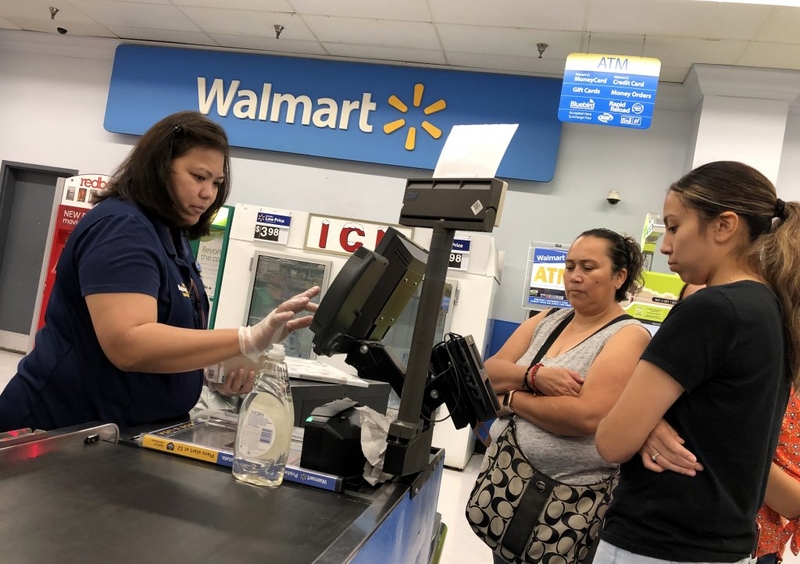
Customers look on as a Walmart cashier rings up their purchases at a Walmart store. Photo by Justin Sullivan/Getty Images.
When congressional Republicans in 2025 passed President Donald Trump’s One Big Beautiful Act, industry groups representing low-wage employers praised the tax cuts that made their CEOs even richer.
They were virtually silent on deep cuts to safety-net programs on which thousands of their employees depend. Nor did they do much to stand up against aggressive tactics federal agents used against their foreign-born employees, many of whom were in the country legally.
Those are the main assertions of the Institute for Policy Studies’ Executive Excess 2026 report.
“Our main finding: (corporations) have overwhelmingly focused on tax cuts and other policies that primarily benefit CEOs and other wealthy individuals while turning a blind eye to government actions that threaten the economic and personal security of low-wage workers,” the report said.
It was the Institute’s 32nd annual look at the “Low Wage 100,” that is, 100 of S&P 500 corporations with the lowest median pay.
Until this year, the reports have looked primarily at the huge and growing disparity between the compensation of top executives and their employees.
This year’s report showed that those trends continue.
“Average CEO compensation within the Low-Wage 100 hit $17.5 million in 2025,” the report said. “The group’s average median worker pay sat at just $36,571 last year.”
That means that on average, a CEO in the group made as much as 614 workers in 2025. That was up from 574 in 2019, according to the report.
In one measure of how historically unequal the American workplace has become, in 1965, “the CEO-worker pay ratio at major U.S. corporations averaged just 25 to 1,” the report said.
One big way CEOs pad their own pockets is through stock buybacks.
Instead of using cash to reinvest in employees, facilities or research, they buy up huge blocks of stock, thereby inflating the value of each share — “and, in the process, pump up the value of the stock-based compensation that makes up about 80% of corporate CEO compensation,” the report said.
Between 2019 and 2025, the Institute for Policy Studies’ “Low Wage 100” companies spent $718 billion on such buybacks, the report stated. Much of the money was freed up by huge corporate tax cuts that were part of Trump’s signature legislation from his first term.
The Institute for Policy Studies report says that industry groups representing the Low Wage 100 were enthusiastic about renewal of the tax cuts as part of the One Big Beautiful Bill Act passed last summer by congressional Republicans and signed by Trump.
They’ve been almost silent, however, about the fact that the same law cut nearly $1 trillion from Medicaid and $186 billion from federal food assistance over a decade. The cuts would seem to harm the businesses’ own interests since many of them sell food and most pay so poorly that they have thousands of employees who qualify for the low-income programs.
The Business Roundtable, the National Restaurant Association, the International Franchise Association, the American Hotel and Lodging Association, and the National Retail Federation are industry groups that lobby for the Low Wage 100. They all applauded the Big Beautiful Bill’s tax cuts, the report said.
But when it comes to the safety-net programs, among the lobby groups, “only the National Retail Federation even mentioned the cuts — and only did so to praise them for ‘reducing waste and fraud,'” the report said.
“In reality, cases of fraud are rare, and the massive spending cuts in the law will greatly exceed the costs of routine administrative errors,” researchers stated. “We could find no evidence of any Low Wage 100 executives raising concerns about these painful safety net cuts.”
The Government Accountability Office in June updated a report on employees in select states who received benefits from Medicaid and the Supplemental Nutrition Assistance Program in 2025.
It found that 2,800 employees of Cincinnati-based Kroger received Medicaid in six states, and 3,300 received Supplemental Nutrition Assistance Program (SNAP) benefits in nine states. A spokeswoman didn’t immediately respond when asked whether the company had made any public statements or worked behind the scenes to stop the safety-net cuts.
Another grocery giant, Walmart, had 16,000 on Medicaid in six states, and 15,500 on SNAP in the nine states the GAO surveyed. It also didn’t immediately respond when asked whether it opposed the cuts and whether it did anything to stop them.
The Institute for Policy Studies report also called out the corporations for doing little to protect immigrant workers even though they’re heavily dependent upon them.
“The 5.7 million immigrants who perform low-wage jobs in the United States make up about 22% of the country’s low-wage workers (defined as earning less than two-thirds of U.S. median income), according to Urban Institute analysis of census data,” it said.
Last winter, masked ICE agents in Minneapolis committed a series of violent acts, including shooting and killing two U.S. citizens. They also arrested 3,600 others, two thirds of whom had no criminal records.
The report said the corporate response to the mayhem was slow and weak. Researchers acknowledged that CEOs for Minnesota-based companies Target, Best Buy, and Ecolab “eventually” issued an open letter calling for “immediate de-escalation.”
“But they did not directly condemn ICE for fatally shooting protestors or for arresting their employees, many of them U.S. citizens or legal visa holders,” the report stated. “Months later, when the Trump administration requested an additional $70 billion in funding for ICE and Customs and Border Protection, Low Wage 100 CEOs raised no objections.”
The Institute for Policy Studies suggested reforms to narrow the gap between low-wage workers and their CEOs, including taxing companies with “excessively paid” CEOs, taxing and restricting stock buybacks, and cutting corporate contracts and subsidies to companies that pay their CEOs significantly more than their regular employees.
Columbus, OH