Iowa farmers argue Hinson’s Save Our Bacon act would hurt small producers
Sep 09, 2026 | 7:01 pm ET
Description
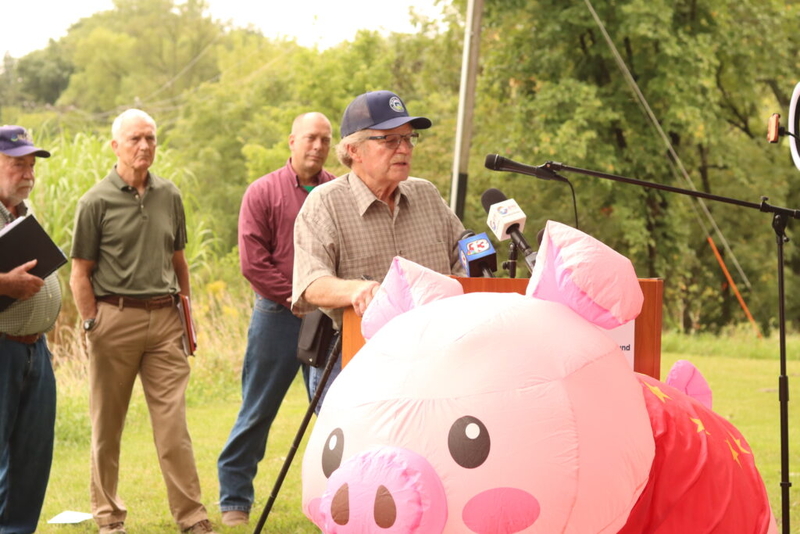
John Gilbert speaks at a farm in Elkhart, Iowa Sept. 9, 2026 in opposition to the Save Our Bacon Act. Behind him is Chris Petersen, left, John Norris, center, and Tony Thompson, right. (Photo by Cami Koons/Iowa Capital Dispatch)
ELKHART — Some Iowa producers argued Wednesday that the federally proposed Save Our Bacon Act will harm farmers by taking away diversified markets and by sending a message to consumers that they are not entitled to a choice in what they eat.
The Save Our Bacon Act is a bill introduced by U.S. Rep. Ashley Hinson, who is running for U.S. Senate, to block individual states from enforcing conditions on livestock products sold across state lines.
The bill seeks to protect livestock producers from a “patchwork” of state laws, like California’s Proposition 12, that stipulates the growing conditions of certain livestock, including hogs.
While proponents of the bill argue it keeps other states from telling producers how to raise their animals, opponents of the bill say it protects the industrialized agriculture model and punishes farmers who have innovated their operations to sell into diversified markets.
Aaron Lehman, president of Iowa Farmers Union, spoke at a news conference Wednesday and said instead of the Save Our Bacon Act, lawmakers should be focusing on “real, structural” changes to agriculture that will help struggling farmers, like mandatory country of origin labeling, the enforcement of antitrust laws, support for local meat processing and to greater connections between producers and consumers.
“We know how to make meaningful changes to help Iowa livestock farmers,” Lehman said. “We just need the political will to demand that they be put in place. The Save Our Bacon Act won’t get it done.”
Proposition 12 in California originally passed in 2018, but was not fully implemented until 2024, following a U.S. Supreme Court decision that upheld the state’s law that requires, among other things, that certain pork products sold in the state come from hogs that were given at least 24 square feet of usable floorspace.
A spokesperson for Hinson said Iowa farmers “overwhelmingly oppose” Proposition 12.
“Ashley Hinson has listened to them and led the fight against anti-ag activists trying to tell Iowa farmers how to raise their livestock,” the spokesperson said in a statement.
The Save Our Bacon Act was adopted in the House-passed farm bill but was not part of the Senate version, which is still in committee.
Pork producers in the state, and nationally, have said the added costs of complying with Proposition 12 would negatively impact the next generation of hog producers, and they argue it makes pork products — including bacon — cost more at the grocery store.
Opponents of Save Our Bacon, however, argue that producers don’t have to sell their proteins to California if they don’t want to comply with the state’s law.
Tony Thompson, a farmer and candidate for the Iowa Senate, said the bill would prevent markets from rewarding farmers who “do something different.”
He argued that while big producers are competitive by producing more product, faster and cheaper, smaller producers are competitive by being innovative with stewardship practices and quality standards.
“Small family farms aren’t going to win a race against multinational, vertically integrated corporations on producing the cheapest pound of protein,” Thompson said. “Frankly, I don’t want them to, because when lowest cost becomes the only goal, everything else starts to look like a cost to be eliminated.”
The Save Our Bacon Act has garnered support from Iowa Pork Producers Association, Iowa Farm Bureau Federation and other agricultural interest groups from around the country. Iowa Farm Bureau’s political action committee has also endorsed Hinson in the U.S. Senate race against Democrat Josh Turek who has said he opposes the Save Our Bacon Act.
John Gilbert, a Hardin County farmer who said dairy and hogs have been the “linchpins” in his operation, said the Save Our Bacon Act would “punish” producers who have invested in operational upgrades to be compliant with the California law.
A spokesperson for the Hinson campaign argued the bill would give farmers and consumers a choice in producing or purchasing protein that met certain standards. Without the bill, they argued, farmers are forced to comply with the regulation.
Gilbert said he was also concerned that the bill would “negate” other state laws, including some in Iowa, that work to protect the livestock industry from importing animals with diseases.
A legislative analysis from Harvard Law School identified 13 Iowa laws that would be potentially impacted by the Save Our Bacon Act.
Gilbert said the most “egregious and insulting” element of the Save Our Bacon Act is the message it sends to consumers.
“People like you and me, it’s telling people you don’t have a right … you’re not entitled to have a say in what you eat,” Gilbert said.
Producers and lawmakers have been fighting on the issue — spurred by Proposition 12 — for several years. Prior to the Save Our Bacon Act, lawmakers in Congress tried to pass the Ending Agricultural Trade Suppression Act, or EATS act, to similarly stop states from enacting such laws.
Lehman said the topic is an issue in this election because “farmers are hurting” and the Save Our Bacon Act would “make problems for farmers even worse.”
“It is essential that we address corporate consolidation in agriculture,” Lehman said. “Farmers receive less than 15 cents out of every food dollar spent in our country. This is the reason that even when farmers struggle to make a living, consumers are still paying higher and higher prices at the grocery store.”
Des Moines, IA