A heart of stone: Barton County couple revive 126-year-old barn with help of state grant
Sep 09, 2026 | 12:44 pm ET
Description
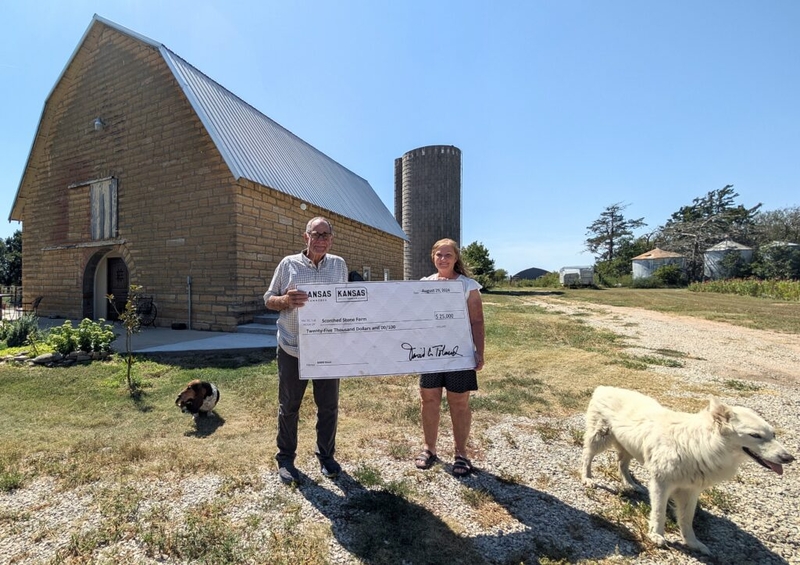
Jim and Katie Homolka display the oversized $25,000 check they received for participating in the Kansas Department of Commerce’s Tourism Office Barn Adaptation and Restoration Needs grant program. The funds help with the restoration of their limestone barn built in 1900 in northeastern Barton County. (Dale Hogg for Kansas Reflector)
BARTON COUNTY — It was a parched, sunbaked afternoon in the rolling hills of rural northeastern Barton County.
The wind whistled through the scrubby trees and rustled the waving grass.
With few modern-day landmarks around, the scene resembled the time in 1900 when James L. Homolka and his brother Joseph Homolka used brawn, skill and determination to chisel a massive barn out of the native golden limestone.
Despite a fire in 1930, that barn still stands as James L.’s grandson Jim and his wife, Katie, breathe new life and purpose into it. The couple received one of six barn restoration grants from the Kansas Department of Commerce’s Tourism Office to complete its resuscitation with eyes on developing an events space.
“It’s been a lot,” Katie said of the passion project, noting they added a lot of personal investment in the project. “We put a lot of heart into it.”
Kansas introduced the Barn Adaptation and Restoration Needs — or BARN — grant as a one-time program in 2024, doling out $100,000, said commerce spokesman Patrick Lowry.
He said the program was “well-received” but that “there are no immediate plans to revive the grant.” It was closed because of a lack of future funding, he said.
According to state tourism officials, the program launched in May 2024 to support and expand Kansas agritourism by converting underutilized or vacant historic barns into new business venues. Designed to rescue agricultural structures from demolition or collapse, the program aimed to drive rural economic growth while creating new travel destinations for visitors.
In September 2024, state officials announced the grant recipients, who collectively provided more than $200,000 in matching funds to support the restoration work.
In addition to the Homolkas’ farm, other recipients included Sunshine Whiskey and Ranch in Osage County, which received the maximum award of $25,000; Cattle Cartel Merchandise in Russell County, awarded $22,000; Wendlin Vines in Leavenworth County, awarded $15,000; the Barn at Richmond in Anderson County, awarded $9,000; and Red’s Corn Maze and Pumpkin Patch in Logan County, awarded $4,000.
Looking at their property and all of its possibilities, Kate said it is a shame the program wasn’t renewed to help similar sites.
“It’s very sad that a lot of history is going to be lost,” she said.
Bringing it back to life
Back 126 years ago, those brothers thought they might as well do something with the limestone since the ubiquitous rock made doing just about every farming task darn tough in the age of horse-drawn implements and hand tools.
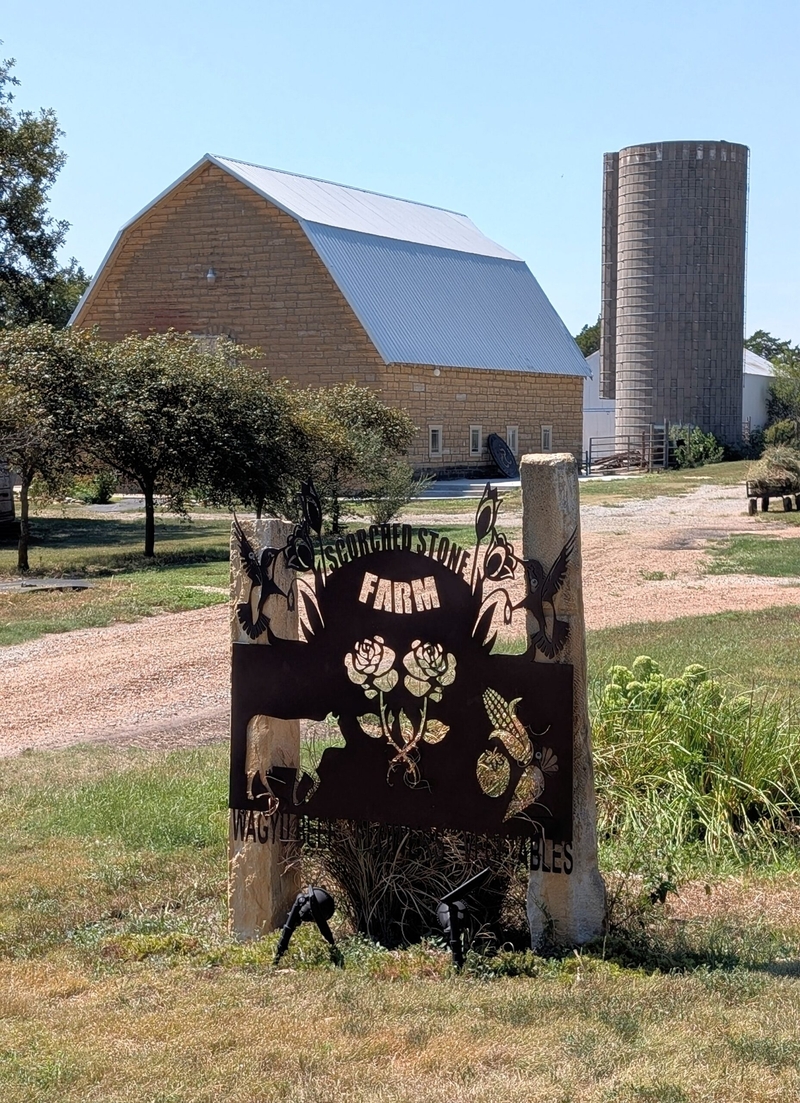
Their will was as hard as that stone, and that hewn barn rose from the plains — until the fire in 1930, caused by farmhands carelessly smoking during wheat harvest, gutted the wooden interior.
Jim and Katie, who now own the property, last month celebrated the resurrected barn on what is now known as Scorched Stone Farm, a name derived from those blazes that left reddish scars on the still-solid walls.
The couple received the grant in August 2024 and had two years to finish the work. The $25,000 was one of six projects statewide sharing the $100,000 awarded.
“We had already spent a lot of money out there,” Katie said. “This allowed us to finish it. Preserving that history is important to us.”
These were matching grants, so the Homolkas had to put up $25,000 of their money for the renovation effort.
The Homolkas have lived on the family homeplace since 1985, inheriting it in 2002. But the family has roots on the land since it homesteaded there in the latter half of the 19th century.
The wooden interior was rebuilt after the fires as the barn remained in service. But the Homolkas envisioned a different future for the historic structure.
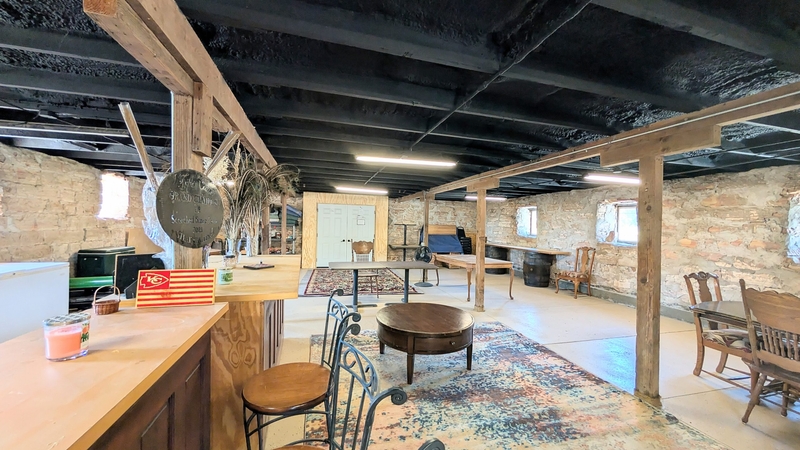
They removed the grain and feed bins and the livestock stalls. And they replaced the dirt floor with concrete, added insulation, relocated the staircase to the loft and upgraded the electricity to the building. Installing air conditioning and renovating the loft remain on the list.
The exterior walls of the barn and house are more than two feet thick. There are two layers of one-foot limestone blocks with a layer of crushed limestone in between.
Although providing some insulating properties, Jim said those walls offer only some relief from the hot Kansas summers and the cold Kansas winters.
More than just a barn
The Homolka brothers also built a limestone house on the homestead, which, after some modifications, is home to the Homolkas, a smokehouse, a cellar and other outbuildings, all of which stand to this day.
But it remains a working farm.
“I came in and there was a calf laying there (on the new floor) all of a sudden,” Katie said. “That was my son Josh doing that.”
Josh Homolka left coaching football at Northern Illinois University to help farm when his dad fell while working cattle and impaled himself on a fence post. Although Jim continues to farm some, his son runs the operation.
Josh raises award-winning Wagyu beef on the 1,000-acre property, while continuing his love of coaching as the head football coach at Ellsworth High School.
But the barn is for more than bovines.
In 2018, Katie, a retired teacher, started raising wildflowers, which now add colorful exclamation points around the golden stone buildings. She and her daughter-in-law Jessica hold flower-decorating workshops and make floral arrangements for weddings.
How they did it
In turn-of-the-century Kansas, particularly across this mostly treeless central Post Rock region that straddles Barton, Ellsworth, Russell and Rush counties, harvesting limestone for barns, homes and fence posts depended almost entirely on manual labor, Jim said. Quarrying occurred mainly during late fall and winter, when farm chores subsided and internal moisture made the stone easier to manipulate.
Jim said his grandad and grandad’s brother quarried the stone on their property and hauled it to the building site with horses and a buckboard wagon. He still has that wagon.
“They had all the tools,” Jim said. “But we lost them in the fire.”
Workers began by clearing topsoil and dirt from exposed ledges using horse-drawn scrapers, shovels and pickaxes to uncover the limestone seam, a layer roughly 8 to 12 inches thick. Using handheld star drills or hand-cranked augers, they drilled a straight line of holes along the ledge. The holes were filled with water and the winter freeze caused the blocks to break free.
Once fractured, workers pried the slabs free with long iron crowbars. The freshly cut limestone contained ground moisture known as quarry sap, leaving the rock soft enough to shape with chisels, stone axes and handsaws.
Exposed to sun and air, the sap evaporated, allowing calcium carbonate within the stone to harden into a durable, weather-resistant finish.
What’s next
On this late-summer afternoon, the sun baked the storied structure. But, the wind whistling through the open doors provided some relief.
Standing in the remodeled space, the Homolkas are content with the progress, but there is still a restlessness. They see so much more potential.
“We are looking at possibly expanding the barn into more of an event space,” Katie said.
While they have hosted a couple of small events, anything more formal is down the road.

Topeka, KS