New Mexico’s plan to reduce wildfire risk currently ‘nowhere near enough’
Sep 09, 2026 | 11:52 am ET
Description
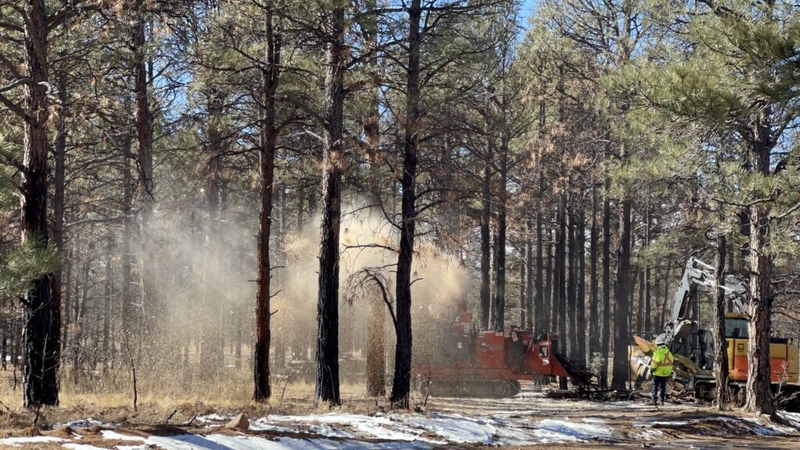
State Forester Laura McCarthy on Sept. 8, 2026, previewed legislation for New Mexico lawmakers to help mitigate the state's wildfire risk. Above: Crews work on mulching burned trees in the Hermits Peak-Calf Canyon Fire burn scar on Feb. 1, 2023. (Patrick Lohmann/Source NM)
New Mexico’s top forest administrator on Tuesday warned legislators that the state is behind on wildfire risk reduction goals, and provided six possible bills ahead of the next legislative session that could improve planned targets.
The state’s Forest Action Plan aims to treat 125,000 acres a year by thinning and prescribed burns to meet a 1.7 million acres decade-long target to improve forest health and wildfire resilience.
In the past year, however, only 22,000 acres were treated, State Forester Laura McCarthy told state lawmakers during an Economic and Rural Development and Policy Committee meeting in Las Cruces, making New Mexico “way below where we need to be.”
The poor treatment rates, according to McCarthy, stem from forest landowners and contractors lacking the necessary capital for tree thinning. Landowners need money to pay tree thinning contractors upfront before being reimbursed through federal and state programs. The contractors need the money to buy the machinery and equipment.
The state also lacks sufficient workforce for tree thinning and burns, and has high transportation costs to move the wood, McCarthy added.
McCarthy, flanked by ecological economists and investors, put forth a six-point plan to address the poor risk reduction rates while also promoting a “biomass economy.”
In order to address these issues, McCarthy and ecological economists outlined legislation they hope lawmakers will consider in next year’s session.
Those bills would: provide loan guarantees to landowners and contractors; finance companies building biomass infrastructure; create cooperative wood yards; grant funding for biomass research; create procurement preferences for state construction and purchasing; and establish a data initiative to update statewide wildfire risk analysis and mapping.
State Rep. Anita Gonzales (D-Las Vegas) noted that the proposed solutions did not address workforce shortages that hinder wildfire risk-reduction efforts.
The presenters said that they’ve been relying on the Wildfire Resilience Training Center at Luna Community College to train the future wildfire workforce, but that they “don’t want to get people trained and then not have jobs for them.” They added that another bill to build up the workforce would be necessary.
“We’re not going to get there overnight,” McCarthy said. “If we can only get from 12,000 acres a year to 22,000 in the seven years that I’ve been State forester, that tells me we need a different approach.”
Santa Fe, NM