Upstate New York’s Biggest Cities Are Building for Bikes
Sep 09, 2026 | 4:00 am ET
Description
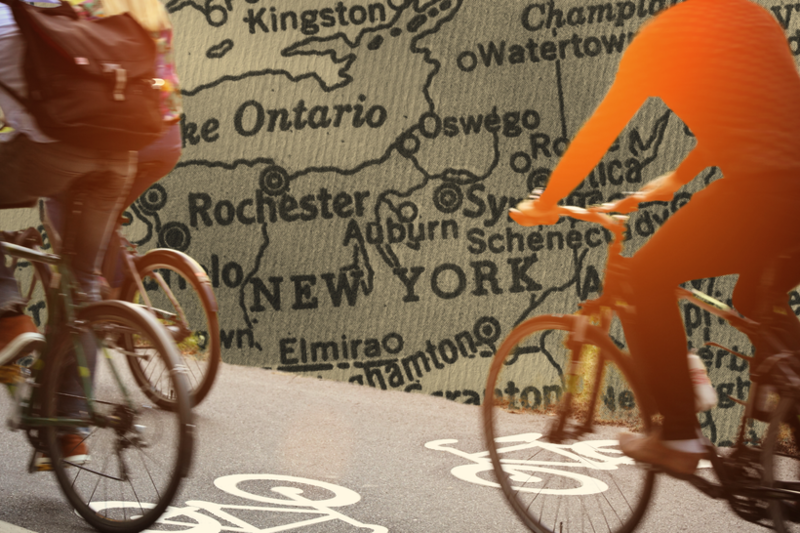
Photo courtesy of New York Focus
New York’s biggest upstate cities are making room for bikes.
Buffalo, Rochester, Syracuse, and Albany — three of which are headed by progressive mayors elected last November — are reshaping their streets to make cycling less dangerous and more practical. In the past two years, three of the cities joined Vision Zero, a campaign that aims to reduce and eventually eliminate traffic deaths. And in the past few years, all four cities dramatically increased the pace of bike infrastructure projects, a New York Focus analysis of announcements on their government websites found.
A large part of the state’s plan to reduce emissions relies on drastically cutting down on car usage. Bikes, including e-bikes, can be an attractive alternative to cars — if residents feel safe enough to ride them.
The early days of the Covid pandemic sparked renewed interest in two-wheelers across the country. Bike sales boomed across the state as people looked for ways to get some exercise while socially distancing. Yet many newfound cyclists soon discovered the lack of safe places to ride around their cities, and crashes involving bikers have ticked up in the years since.
While redesigning streets and building permanent safety improvements can be a yearslong process, advocates are optimistic that the wheels are in motion for safer streets.
“For those four cities, it’s absolutely a high-water mark,” said Jon Orcutt, advocacy director at the cycling education nonprofit Bike New York and former policy director at the New York City Department of Transportation.
“There was almost no conversation going back five or 10 years ago, or it was still at that advocacy-led stage instead of government-led. Advocacy is great, but it doesn’t get you infrastructure. You need government to lead on this stuff.”
Buffalo
Under recently elected Mayor Sean Ryan, an avid cyclist, Buffalo has begun redesigning public spaces and improving bike lanes. Bike advocates hailed Ryan’s appointment of Justin Booth, former leader of the advocacy organization GObike Buffalo, as the city’s parking commissioner, a key role in streets and transportation policy.
“It makes a big difference to have somebody who’s really watching what’s going on in city hall and inside the agencies, while offering a perspective that’s different from what’s traditionally existed inside government,” Orcutt said.
In late July, Ryan announced a plan to transform Niagara Square, the area in front of Buffalo City Hall, from an unwieldy roundabout into a bike-accessible public space. And in May, his administration broke ground on a $70 million overhaul of a stretch of the city’s Main Street after years of planning — including significant improvements for bikers.
“There will be dedicated protected bike lanes at the sidewalk level, which will be a first for the City of Buffalo,” Booth told New York Focus.
“There’s going to be a lot more stuff coming down the line,” Booth added.
Not everyone in Buffalo is thrilled with the bike-friendly agenda. After Booth warned police not to park their squad cars in the square illegally, the city’s police union called for his dismissal, according to the Investigative Post. The union’s vice president reportedly took issue with GObike Buffalo’s “anti-vehicle agenda” and association with “radical groups,” including Buffalo World Naked Bike Ride, an organization that runs an annual clothing-optional protest against car dependency.
But recent years have seen more grassroots excitement for cycling in Buffalo. One sign of the changing tide: “bike buses” — a mode of transit sweeping across the state, in which groups of parents defensively bike around their children as they head to and from school — have become very popular in the city.
“These bike buses are the revolution that our city and region, as well as the country, is going through,” said Kevin Heffernan, interim executive director of GObike Buffalo, which helps coordinate the groups. “Once these children get hooked on biking to school, and it’s their favorite day of the week, they’re not just gonna be like, ‘I grew out of it now.’”
Rochester
Seventy-five miles east of the Queen City, Rochester became one of the first upstate cities to join Vision Zero.
Mayor Malik Evans committed in 2024 to the program, which involves identifying streets with the most injuries and deaths and using the data to implement strategies like road diets, protected bike lanes, and lower speed limits. (New York City embarked on the initiative in 2014.)
As part of its Vision Zero plan, Rochester is working on a host of safety measures, including lowering the speed limit on residential streets from 30 to 25 miles per hour. The city is also considering reintroducing cameras — after removing them a decade ago — to crack down on drivers who violate speed limits and run red lights.
The city received $24 million in 2024 from the federal Department of Transportation for its Safe Streets and Roads for All program, which is building protected bike lanes and seeking ways to better maintain roadways in the winter. That’s no small feat, given Rochester is one of the snowiest cities in the country.
The federal grant money has helped the city fund several major bike safety improvement projects, such as an effort to accelerate a planned 63-mile “bike spine” network of connected bike lanes.
Darin Ramsay, a transportation specialist for the Rochester government, said the city is upgrading or planning improvements for many streets in the network, such as North Clinton Avenue, Lexington Avenue, Chili Avenue, and parts of East Main Street, Culver Road, University Avenue, and Genesee Street.
“The direction of bike infrastructure has been overall very positive,” said Cody Donahue, co-executive director of the transportation and cycling advocacy group Reconnect Rochester. “We’re building more. We’re connecting more.”
Syracuse
Syracuse signed onto Vision Zero late last year under former Mayor Ben Walsh, leaving the plan’s implementation to the newly elected Mayor Sharon Owens, who served as Walsh’s second-in-command.
In February, Owens appointed a Vision Zero coordinator and created a new city position, a transportation and mobility director, to centralize street safety and cycling efforts.
Syracuse first released a bike plan in 2012, but the city completed only a small portion of the envisioned network. Now, the city is starting to make steady progress, according to Alex Lawson, a member of Syracuse’s Moving People Transportation Coalition, a transportation-focused community group.
“There’s been real progress over the last 10 years,” said Lawson. “Syracuse didn’t used to have any dedicated bike infrastructure, but a few major projects have created the start of what you’d need for a citywide network.”
This year, the city is making over 100 city blocks safer for cyclists through a mix of painted bike lanes, pavement markings, and traffic-calming measures. Also, as part of the ongoing removal of I-81’s downtown section, the state government is building dedicated bike lanes along the route of the defunct highway.
Lawson pointed to James Street as an illustrative example of how Syracuse has changed. A few years ago, after a driver hit a friend of Lawson’s while biking on the street, the friend decided to stop biking and bought a car to get around instead. Incensed, Lawson reached out to the mayor’s office about James Street’s danger to bikers.
“They were sympathetic,” Lawson said about the city employee who responded to him. “But then they pointed to their ‘bike suitability map’ — which rates every street’s suitability for biking based on traffic data — and told me James Street just isn’t very safe to bike on, so maybe I should suggest an alternative route to my friend.”
Lawson said he was delighted to hear that the city government is working on a plan to improve the street.
“I’m glad to see the shift from ‘don’t bike on that road’ to ‘how do we make it safer,’” he said.
Albany
The state’s capital has seen new biking improvements, too.
Albany’s bike advocates have a street safety ally in Mayor Dorcey Applyrs, who took office at the start of the year. Applyrs successfully pushed to lower the residential speed limit to 25 mph as a city councilmember. Last year, she wrote an opinion piece advocating for cameras and road-calming infrastructure to rein in speeding drivers, especially in school zones.
Albany joined Vision Zero in 2024 under former Mayor Kathy Sheehan as part of the broader Capital Region Vision Zero plan, which includes nearby cities such as Troy. (Sheehan, who served from 2014 to 2025, supported several bike safety measures during her tenure.)
The county government has joined in on the push for cycling safety. In March, the Albany County Legislature enacted a law requiring drivers to give a three-foot berth to bikers when passing them. In May, the county legislature pledged its support to implementing the region’s Vision Zero plan.
Local bike boosters are optimistic about Albany’s progress. James Rath, the executive director of Capital Streets, an organization that advocates for safer streets, highlighted improvements to Washington Park and the addition of a shared-use path on the new Livingston Avenue Bridge under construction. The new route will span the Hudson River, connecting the Empire State Trail and the Albany Skyway to neighboring Rensselaer.
“That’s going to be a crucial connection for people crossing the Hudson to get to Rensselaer,” said Rath.
Founded three years ago, Capital Streets is learning a lot from its more experienced counterparts in other upstate cities.
“GOBike Buffalo has really inspired us, and we’ve been working closely with Reconnect Rochester over the past three years,” Rath said. “It’s helpful to learn from one another, share successes and lessons learned, and also just have solidarity that there’s a movement for this across New York State.”
Albany sits at the eastern terminus of the original Erie Canal and its Erie Canalway Trail. According to Rath, many commuters bike on the trails surrounding the city, weaving their way through the constellation of municipalities around the capital.
The Erie Canalway Trail
Stretching more than 350 miles from the Hudson River to Lake Erie, the Erie Canal wends its way across the Empire State. Opening in 1825, the canal became a lifeblood of American trade, playing a pivotal role in the development of Albany, Syracuse, Rochester, and Buffalo.
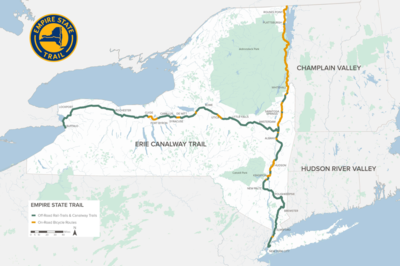
Today, though the Erie Canal is no longer the quintessential commercial artery of its golden days, the waterway still connects New York’s major upstate cities. In late 2020, the state completed the 750-mile Empire State Trail network, a long segment of which runs along the original canal’s path. The trail now sees nearly 10 million visits a year.
In addition to making streets more accessible to bikes, Albany, Syracuse, Rochester, and Buffalo have promoted their proximity to the trail, which has proven to be a boon for tourism and a hit among hardcore bikers.
“The Canalway Trail and the Empire State Trail is the spine across the state,” Ben Walsh, director of the New York State Canal Corporation and former Syracuse mayor, told New York Focus. “We’re seeing communities all along it build upon it. Really, it’s about connecting the dots.”
For example, Buffalo is building a new waterfront recreation space “which will be a significant connection among the Empire State Trail,” according to Booth.
Paul Steely White, the executive director of Parks & Trails New York, a nonprofit that seeks to improve access to outdoor recreation, said many parts of the trail could also be improved to avoid crossing over roadways.
“There’s a couple hundred miles of those [gaps] in the Empire State Trail alone that need to be bridged,” he said.
The trail also provides a controlled environment for less experienced bikers, White said.
“We used to have a word for bicyclists who would go to the street grid from the greenway: greenway graduates,” he said. “We’re seeking to create that same sort of safety experience on the street.”
Albany