From climate change to the economy to healthcare, NH voters seek solutions with their ballots
Sep 08, 2026 | 9:52 pm ET
Description
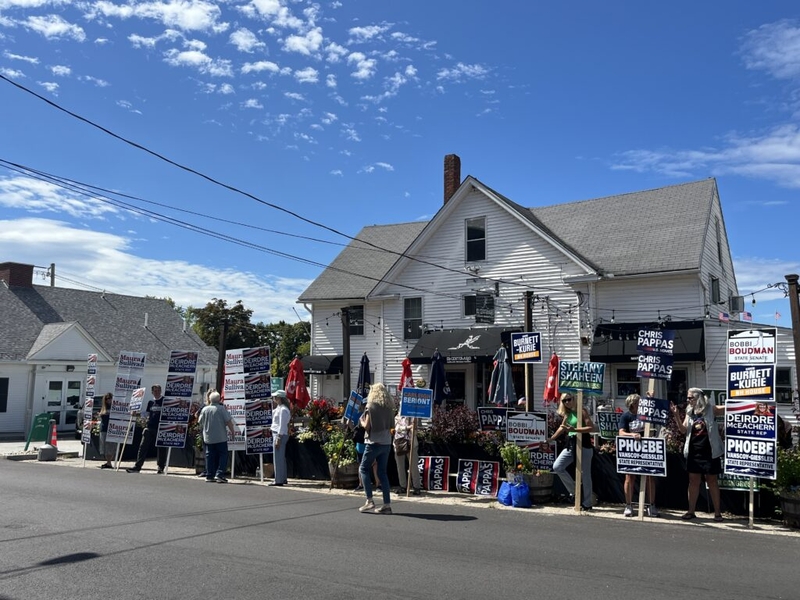
Supporters hold signs for their preferred candidate in Wolfeboro during the Sept. 8, 2026, primary election. (Photo by William Skipworth/New Hampshire Bulletin)
Scott Thompson, a retired mechanic from Epsom, usually doesn’t vote in midterm elections, but after a GOP candidate for state representative showed up at his door he decided to make plans to vote on Tuesday.
“Josh Shapiro Jr. actually came to my house on a 98-degree day to talk to me,” Thompson, 59, said as he left the polls. “He made an effort more than I’d seen anybody else. I normally only vote in the presidential elections, but I thought: He’s going to make an effort; I’ll make an effort. So I looked at his website to see what he stood for.”
After agreeing with his stances, Thompson decided that Shapiro earned his vote. As a Republican, he also voted for John Sununu for U.S. Senate and Gov. Kelly Ayotte for reelection.
Thompson was among those who showed up at the polls throughout New Hampshire Tuesday to vote in primary elections. Bulletin reporters fanned out across the state to hear from voters about what motivated them to come out, how different candidates earned their votes, and how they feel about the state of democracy in the Granite State.
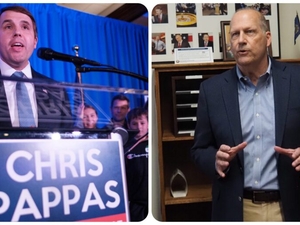
In Concord, Susan Burkhardt voted in the Democratic congressional races but was torn between the progressives she agreed with more on policy and the centrists she felt had better chances in the general election. In the end, she picked one of each: She chose newcomer progressive Karishma Manzur over establishment centrist Chris Pappas for Senate, but incumbent U.S. Rep. Maggie Goodlander over her progressive challenger, Paige Beauchemin.
“Pappas has never been my favorite,” she said.
Burkhardt believes Pappas, who currently represents the eastern half of the state in the U.S. House of Representatives but is asking voters for a promotion to the Senate, is “pretty conservative for a Democrat.”
At the top of the list for reasons Burkhardt voted against Pappas was his support for Israel. Pappas has long supported military aid to the Middle Eastern country. However, as Americans nationwide have soured on Israel amid its multi-front wars and an increasing number of independent experts concluding its military is committing genocide against the Palestinian people, he’s moderated his stance. At AIPAC’s 2026 Congressional Summit in February, Pappas enthusiastically called himself “a strong supporter of the bipartisan U.S.-Israel relationship, which is a cornerstone of our national security policy,” but in July, he voted “present” — neither for nor against — on a measure that would’ve restricted weapons sales to Israel. He told the Bulletin he wanted “a reset with respect to the U.S. policy toward Israel.”
Burkhardt is unsure whether Manzur could win in November, but “it’s at least a message to the Democratic establishment here in New Hampshire, which is pretty stuck, that people are looking for something else.”
In the 1st Congressional District, Burkhardt wanted to vote for Beauchemin, currently a state representative from Nashua, but was worried she would lose in a general election to a Republican, which she felt would be the worst outcome.
Downballot, Burkhardt voted for Jason Quinno, a young candidate for state representative who knocked on her door.
“(We) could use some youth,” she said. “The New Hampshire Legislature is so white and so old.”

In Warner, Sarah Hansen, a farmer and Democrat, cast her ballot with concerns about data centers, climate change, and “getting money out of politics” on her mind, she said on Tuesday morning. But the topic that informed her choices the most, she said, was healthcare.
“I fall in a wage gap that’s just above qualifying for Medicaid and very well below being able to afford health insurance, given that (President Donald) Trump has taken away our subsidies,” she said. “Not having health insurance, in my occupation — not even just in my occupation, but just as a person living in the world, is quite scary.”
In the New Hampshire Senate primary, Hansen said she voted for Manzur, in large part because Manzur has said she wants to see a single-payer Medicare for All health insurance system.
Hansen said her peers, including other young adults like herself, faced similar challenges.
“I think there’s a lot of people in my community, of my age, who are not making enough to pay rent, to pay a mortgage, to pay for health insurance, who are just this kind of, like, in-between class who’s being completely forgotten,” she said.
Hansen added that she liked Manzur’s commitment to not accepting funds from corporate PACs and super PACs.
Both Manzur and Pappas have made campaign finance a cornerstone of their campaigns.
Though voters often agreed with Hansen that they wanted to see change in the healthcare system, they were divided on what that might look like.
Bradford independent Marcia Moyer said she was voting in opposition to the expansion of public healthcare, with the goal of preventing Democratic Socialist-aligned candidates from gaining ground. Moyer voted in the Republican Senate primary, casting a ballot for Sununu.
Moyer said she had seen family members suffer in the Canadian public healthcare system, including her parents.
“I have concerns that healthcare is not working in the U.S., but it’s not going to be fixed by more government,” she said.

Kaitlyn Gennaro recently moved to Manchester from Florida because of New Hampshire’s moderate political leanings. As an independent, she decided to vote in the Republican primary because she leans to the right economically, despite aligning with the Democratic Party on social issues.
Gennaro said she wanted to vote for candidates who were not “MAGA-related,” leading her to vote for Sununu for U.S. Senate and Lindsey Anderson, a business and technology leader from Moultonborough, for the 1st Congressional District. She expects Anderson to “not go very far.”
“It’s very important in these midterm elections that we elect the leaders who can help Washington to make laws that are not only going to benefit New Hampshire, but are going to benefit the United States overall,” she said. “I will definitely have to read more about Chris Pappas. So I guess that’s up in the air until November.”
Some of Manzur’s supporters said they were drawn to her progressive, left-leaning stances.
Caldwell Lowell, of Durham, voted for Manzur after being impressed with her opposition to corporate fundraising. “I really appreciated the willingness to stand up and say, ‘I’m not doing this for corporate interests, I’m doing it for the people of New Hampshire,’” he said.
Lowell mentioned Manzur’s science background as a plus: “Having a Ph.D., going to Berkeley, I see a lot of experience in education and wisdom,” he said.
Those credentials were important to University of New Hampshire student Morgan Pritchett, too, who showed up Tuesday for her second-ever voting experience after the 2024 presidential election. As a biological science student herself, Pritchett was heartened by the representation Manzur could have brought to female scientists, and she liked Manzur’s positions. “She had a pretty strong stance about climate activism, (and) I really liked her pitch about education,” Pritchett, referring to Manzur’s policies in favor of transitioning the country toward clean energy and providing universal childcare and public higher education.
Todd Massicote, an Exeter Democrat, said he voted for Manzur to stand up for scientists and help reverse cuts to grant funding and penalties for colleges and universities in Trump’s second term. “A lot of academia is hurting for funding. They’re laying people off. We’re losing researchers to China,” he said.
Massicote, who works in biomedical research, said he had seen firsthand the effects of those policies in the loss of adequate talent.
“I work on the sales end of things. All my customers — all their funding is stalled. They’re nervous for their jobs. There’s been a lot of layoffs.”
Against those stakes, Pappas, a relative centrist, has not impressed Massicote. “I feel like he’s had a run in Congress, and I don’t know what he’s done, to be honest,” he said.
But to others, Manzur’s positions and biography were shadowed by a bigger factor: her ability to win. Liz Malone, a Durham Democrat, said she voted for Pappas “because I think he has the best chance to beat Sununu.” The recent inflation increases affected her daily, she said, from groceries to gas to medications.
“I pray to God it will be a good year for Democrats,” Malone said. “And I think if it’s not, this country is in a heap of trouble.”
In Wolfeboro, James O’Rourke, a retired college teacher, voted for Hollie Noveletsky in the Republican 1st Congressional District primary over candidates including Anthony DiLorenzo and Brian Cole, and Sununu for U.S. Senate. For O’Rourke, abortion is the most important issue.
“I’m hoping that Hollie Noveletsky will vote more pro-life than DiLorenzo,” O’Rourke, 86, said. “DiLorenzo seems competent, but the support for unborn life is important to me.”
DiLorenzo released a 21-point policy plan online with a promise to “Oppose federal abortion legislation and respect New Hampshire’s laws.”
O’Rourke thinks Sununu is sometimes “a little soft on the life issues, but I think he’s good, and he has a chance to win.” As a Republican, he really doesn’t want Pappas to win in November, and he thinks Sununu represents the best path to defeating him.
He voted for Dale Fincher for state representative because he believes he is “the more deliberate, the more intentional candidate.” Fincher is running for the state House of Representatives again after losing in a special election in March to Bobbi Boudman, who has now opted to run for state Senate. His primary opponent is Dallas Emery Jr.
Bob Mongan of Manchester said voting for Pappas was at the front of his mind going into the voting booth today. He said he believes he is the best person for the job.
“The economy needs a lot of work, and I think Chris has got to at least attempt to fix it. Of course, they (the Democrats) could do it all alone, but he could work on a winning team.”
Mongan also voted for Maura Sullivan, but said he would support Stefany Shaheen if she wins the primary. Down the ballot, he voted for Jim O’Connell for Executive Council. Despite the numerous election watch parties in Manchester, Mongan said he will be watching the results from his couch.
“I’ll just wait til this evening,” he said. “See if I’m right or wrong.”
Concord, NH