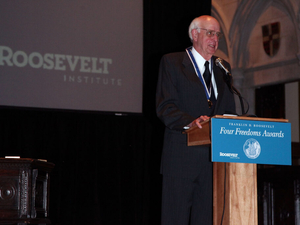
Former Franklin Circuit Judge Roger L. Crittenden dies at 81
Sep 08, 2026 | 9:04 pm ET

Description
Judge Roger L. Crittenden
Former Franklin Circuit Judge Roger L. Crittenden, who issued the landmark legal decision that requires the General Assembly to pass a budget, died Monday at his home in Frankfort. He was 81.
Crittenden also was former chair of the state Executive Branch Ethics Commission and served as a special master to craft a distribution plan for a large class-action settlement involving former clients of disgraced attorney Eric Conn.
“He was a great judge and public servant, and even a greater human being,” said Franklin Circuit Judge Phillip Shepherd. “He was a wonderful role model and one of those rare judges who continued to become a better judge as long as he went.
“Many burn out. He kept going and going and got better and better.”
Shepherd noted that much of Crittenden’s legal career was in state government.
“He understood the balance among the branches of government. That gave him extra insight in his role as a judge.”
Gov. Andy Beshear appointed Crittenden to serve as a member of the Executive Branch Ethics Commission in May 2020. He served in the role through June 2024. Members elected him chair in July 2020 and he continued to serve as chair until the end of his service.
The Executive Branch Ethics Commission presented Crittenden last December with the “Livingston Taylor Ethics Award” for 2023-25. The biennial award was established to recognize individuals, programs or agencies within the executive branch of state government for their outstanding achievement and contributions in promoting the ethical conduct of executive branch employees.
The late Livingston Taylor, an investigative reporter for the Louisville Courier-Journal, served as the Ethics Commission’s first chairman from 1992-1995.
A long career
After three years of service in the U.S. Army including a tour in Vietnam, Crittenden graduated in 1975 from the University of Kentucky College of Law. He was inducted into the college’s Hall of Fame in 2007.
Crittenden served 26 years as an adjunct writing instructor at UK’s law college. The school honored him by naming one of its legal writing groups after him. He joined such figures as Henry Clay, Benjamin Cardozo and Thurgood Marshall.
Crittenden began his legal career in public service at the Kentucky Cabinet for Human Resources and the Kentucky Council on Higher Education.
In 1980, Crittenden was elected as Franklin County District Court Judge where he served for 12 years before being elected as Franklin County Circuit Court Judge in 1992. He retired in 2006 and became senior judge of the Franklin Circuit Court.
Prospect attorney Stephen Houston served three years as staff attorney for Crittenden and former Judge William L. Graham.
“Judge Crittenden was a perfect role model,” said Houston. “I am thankful to have worked for him.”
Crittenden also served as chair of the Circuit Judges Association Education Committee and was board chair of PUSH Infant Pre-School, an organization dedicated to early childhood education.
Budget decisions
One of Crittenden’s most prominent decisions as a judge forced the state legislature to pass a budget.
In 2004, the Kentucky General Assembly ended its regular session without passing a two-year budget. Then-Gov. Ernie Fletcher issued a continuation plan to keep state government running.
Crittenden ruled that Fletcher’s executive order could proceed but he said no state funds could be spent on building projects or expenses that were not approved by the legislature.
The ruling meant that a governor could not fully fund government operations or start major spending without the legislature’s enactment of a budget.
In 2020, Floyd Circuit Judge Johnny Ray Harris appointed Crittenden at the recommendation of Prestonsburg attorney Ned Pillersdorf to be special master in the case of Eric Conn’s multi-million-dollar Social Security disability fraud scheme.
Pillersdorf and a legal team had secured a settlement of about $750,000 with Conn’s malpractice insurer for about 1,500 former clients harmed in the scheme.
Crittenden delivered to the court a recommendation to distribute the settlement money to about 800 of the most vulnerable clients.
“He had a ‘Mission Impossible’ job,” said Pillersdorf Tuesday upon hearing about Crittenden’s death . “He got the assignment during the start of COVID and he did wonders with it.”
Pillersdorf also said he practiced several cases before Crittenden.
“He cared deeply for everyone,” Pillersdorf said. “He paid attention to details. He judged in a thoughtful, deliberative way. He loved to get to the point and he reminded me of that quite often.”
Harrod Brothers Funeral Home in Frankfort is handling arrangements.

Frankfort