Former Kansas prison officials pressure governor to commute death sentences
Sep 08, 2026 | 4:36 pm ET
Description
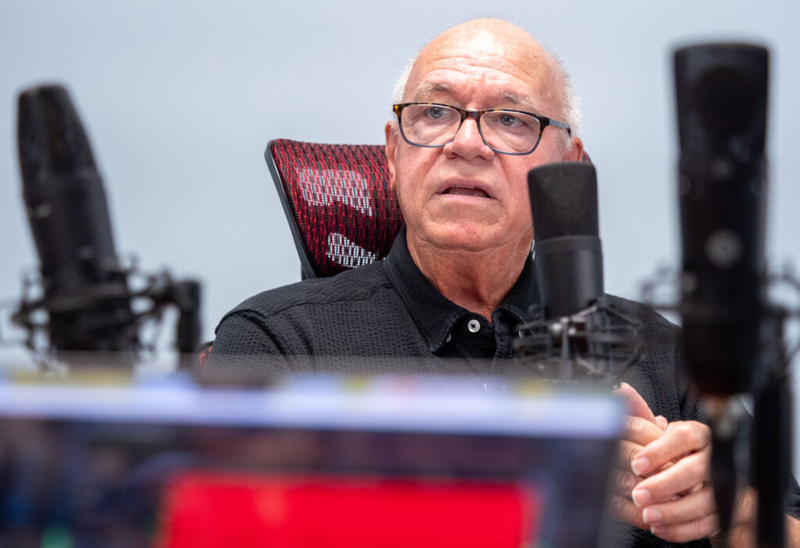
Roger Werholtz, former secretary of the Kansas Department of Corrections, talks about his opposition to the death penalty during a Sept. 2, 2026, appearance on the Kansas Reflector podcast in Topeka. (Photo by Sherman Smith/Kansas Reflector)
TOPEKA — As Democratic Gov. Laura Kelly’s final term wanes, groups against the death penalty are pushing her to commute the death sentences of nine men convicted of capital murder in Kansas, favoring life in prison without the possibility of parole.
Former prison officials were the latest to advocate for abolishing the death penalty in Kansas. They convened Sept. 2 at the Statehouse in Topeka to discuss the death penalty’s inherent risks and deliver a letter to the governor’s office, urging her to commute the outstanding death sentences in Kansas.
“The larger issue for me, in particular, is simply the abolition of the death sentence in Kansas and nationally,” said Roger Werholtz, a former Kansas Department of Corrections secretary, in an interview for the Kansas Reflector podcast. “In my view, it serves no useful purpose. It does not contribute to public safety. It does not serve as a deterrent, and there is too much opportunity for error and misuse of that particular consequence for heinous crimes, and it distracts from other public safety issues and distracts from families of victims of those crimes.”
Werholtz was one of three former state prison officials to speak at the press conference. He was joined by Robert Sanders, a Kansas Parole Board member from 2004-2011 and longtime employee of the corrections department, and Marilyn Scafe, a Kansas Parole Board member from 1995-2006 and Missouri parole and probation officer in the 1970s.
The American Civil Liberties Union of Kansas on the same day put out a call to action, encouraging supporters to send a message to the governor, urging her to commute all remaining death sentences. In 2024, the ACLU tried to abolish the death penalty in Kansas through litigation.
Commuting Kansas death sentences helps “confront the criminal justice system’s deep failures and stop further injustice,” the organization said.
In July, a group of faith leaders similarly called on the governor to commute all existing death sentences
The group of former prison officials emphasized the trauma the death penalty can cause for corrections staff and its ineffectiveness as a deterrent of crime.
“The death penalty does not make us safer, not in our communities or in the correctional institutions,” said Sanders, who began working for the KDOC as a corrections officer in 1978.
Six former Kansas prison employees signed the letter to the governor that requested she commute the nine remaining death sentences in Kansas on the grounds that resurrecting the death penalty would be a “time-consuming and expensive process.” Plus, the letter said, the psychological toll on corrections personnel can have a devastating impact.
“Too often the death penalty is cynically used as a political ploy,” the letter said. “Too often we have seen examples of police, prosecutorial and judicial misconduct, even here in Kansas. There is too much uncertainty in our criminal justice system to allow an irreversible penalty to continue to exist.”
The death penalty hasn’t been carried out in Kansas since 1965, when two men were hanged. It has been banned, barred and reinstated multiple times in the state’s history, most recently in 1994. Nine men sit on death row today. Several of them have outstanding clemency requests with the governor, which state law enforcement officials, including the attorney general, oppose.
Werholtz said that life without the possibility of parole is favored because prosecuting the death penalty is costly, and the risk of a wrongful conviction and execution is too great.
Werholtz served as secretary of the Kansas Department of Corrections from 2002-2010, and as interim secretary in 2019 when Kelly took office.
“I didn’t want any employees of KDOC to have to deal with the potential consequences of an execution in Kansas,” Werholtz said. “When you talk about it in the abstract, sometimes it’s very easy to deal with, and you can be pretty cavalier about what you think you will do until you’re confronted with the reality of what you might actually have to do.”
He added: “Fortunately, I was never required to actually make a decision or participate in the killing of another human being, and I’m very thankful for that.”
The governor’s office declined to answer specific questions about its response to the letter and the risk of unequal application of justice in prosecuting death sentences in Kansas courts.
Olivia Taylor-Puckett, a spokesperson for the governor, said in an emailed statement: “Each request for executive clemency is reviewed on a case by case basis in a process that will continue as it has throughout Gov. Kelly’s time in office.”
Kelly’s term will be up in January. She has denied three clemency requests this summer from death row inmates: John Robinson, who was convicted of killing eight women, and the Carr brothers, who went on a violent crime spree in 2000 known as the “Wichita massacre.”

Topeka, KS