Oregon lawmakers preview Kotek’s prosperity council findings amid economic ‘inflection point’
Sep 08, 2026 | 3:47 pm ET
Description
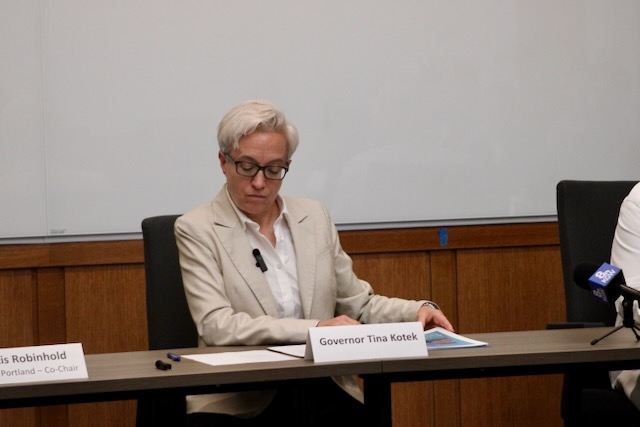
Gov. Tina Kotek reviews a report from her prosperity council on July 25, 2026. Lawmakers discussed the report’s findings at a committee hearing on Tuesday in Salem. (Photo by Julia Shumway/Oregon Capital Chronicle)
SALEM — Oregon lawmakers on Tuesday heard from Gov. Tina Kotek’s economic advisers about next year’s top priorities for legislation to spur economic development, including recommendations to reduce the state’s estate tax, boost infrastructure spending and eliminate excessive regulations.
The Senate Commerce and General Government Committee heard from economic analysts and labor advocates in response to a June set of policy recommendations from the governor’s prosperity council, aimed at boosting economic development and spurring business friendliness in the state.
The council in June recommended a series of policy changes by Kotek and state lawmakers, such as cutting taxes, replacing a key climate program and allocating a quarter of a billion state dollars for business infrastructure needs every two years. It also suggested that a work group by 2029 deliver a long-term proposal to the governor addressing issues such as expiring federal state and local tax provisions, the corporate activity tax, local government funding and reducing the burden of personal income taxes.
“If I could just step back from it, tax is emotional for everybody, but it really is a bipartisan or nonpartisan topic in this state,” Renée James, founder of semiconductor company Ampere Computing and council co-chair, told lawmakers. “We’re at this inflection point where we’re not competitive with our neighbors who largely are ideologically aligned with us.”
But the ideas will largely be up to lawmakers in the 2027 session, including a proposal to raise the $1 million threshold of Oregon’s estate tax on dead people’s assets, an idea that legislators unsuccessfully attempted during the 2026 legislative session. The Oregon Journalism Project reported that four of the major proposed tax cuts in the short-term could cost the state up to $150 million, which could throw cold water on tax cuts as Democratic lawmakers seek to shore up state revenues in the next year.
State Sen. Khanh Pham, D-Portland, noted that lawmakers disconnected from provisions of the federal GOP’s 2025 tax and spending law earlier this year, including a small business stock exemption that the council and Kotek has advocated for reinstating.
Pham signed onto a May letter backed by powerful unions and progressive groups in Salem who challenged the thrust of the council’s mission, writing that “the real question is simpler: Can a person working in Oregon pay their rent? Do they have health insurance? Can they retire with some dignity?”
“In my district, I’m hearing so much from folks who are also talking about how does this impact our families, particularly lower-income families,” she said. “When they look at these recommendations, for tax reform, they’re saying ‘how does this lower taxes for my under $65,000 income household?’ which is a lot of the families in my district.”
State Sen. Christine Drazan, a Republican from Canby who serves on the committee, could end up overseeing lawmakers’ attempt to implement the prosperity council’s findings should she win this year’s governor’s race against Kotek. She expressed concern with an approach put forth by the prosperity council leaders to replicate Washington’s policies not going far enough. Propserity council leaders suggested the state such raise Oregon’s $1 million threshold to $3 million in alignment with Washington’s policies.
“Where businesses are going that I’m talking to, they’re not going to Washington and California. They’re going to Tennessee. They’re going to Idaho. They’re going to Nevada. They’re going to Arizona. They’re going, you name it,” she said. “If they’re going to move, they’re not typically moving from an Oregon environment to a marginally different Washington or California environment.”
Other analysts, labor weigh in on findings
Alice Dale, a Portland-based labor consultant for Service Employees International Union and a member of the prosperity council, argued that raising the state’s estate tax threshold from $1 million to $3 million in alignment with Washington’s tax rate would cost the state significant revenue.
She said the council’s recommendations “harken back to trickle-down economics.” Economic researchers have found that large tax-breaks for high-income earners and corporations do not improve wages or income for middle- and low-income individuals.
“When we talk about growing Oregon’s economy, we have to ask ourselves what is good for the people who show up for work every day, pay their taxes, and are trying to build a decent life for themselves and their families?” Dale told lawmakers. “The answer, I believe, is investing in education, job training, protecting healthcare services and helping families feed their children.”
Joe Cortright, a Portland-based economic observer who leads the think tank City Observatory, pointed to a recent economic forecast from state officials which found that Oregon’s economic output is now catching up with the rest of the nation. He also noted that 95% of Oregon estates do not pay the estate tax and that about 90% of Oregon businesses do not pay any corporate activity tax. That tax is measured based on a business’ amount of commercial activity in Oregon totaling more than $1 million and funds education in the state.
“Do not make Oregon’s tax system regressive,” he said. “That will not do anything to benefit your economy, and it will hurt the affordability problem, which is really a problem, as everybody knows, for low and moderate-income Oregonians.”
John Tapogna, president of the Oregon Business Council, closed the meeting with praise for the work of the prosperity council. He said Oregon’s economic struggles go beyond high-profile job losses at Nike and Intel, pointing to data showing Multnomah County ranked in the bottom 5th percentile for job growth nationwide from 2019 to 2024.
“They got the diagnosis right,” he said of the council. “This is a tough economic cycle for Oregon. We usually win (in) economic expansions. We’ve lost this one.”
Salem, OR