From NJ to Louisiana and back: One Elizabeth woman’s path through ICE detention
Sep 08, 2026 | 6:33 am ET
Description
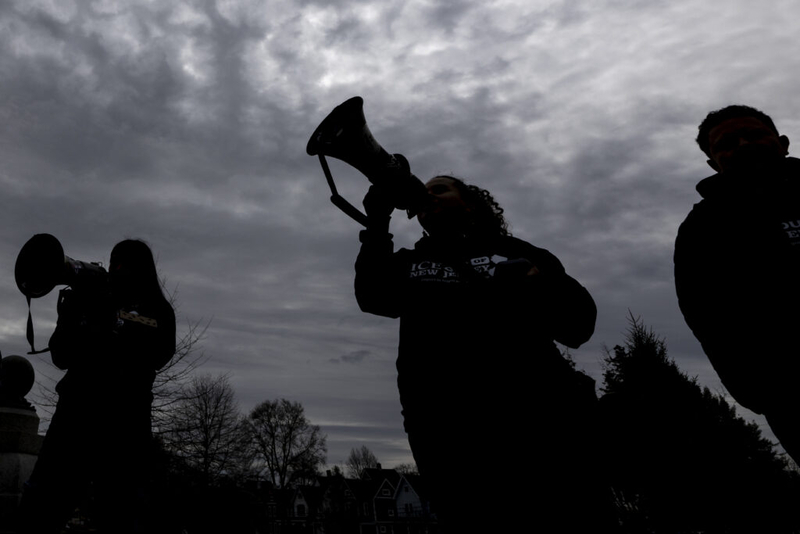
Protesters with Ice Out rally outside the Monmouth County Courthouse in Freehold on March 27, 2025. (Photo by Anne-Marie Caruso/New Jersey Monitor)

This is the first in a three-part series examining President Donald Trump’s mass deportation effort and its effect on New Jersey.
The immigration agents stormed the Savino Del Bene warehouse from every angle: emergency doors, loading docks, the main entrance.
By the time they reached Lourdes Rosero, the warehouse’s cafeteria had been converted into a processing station, with agents holding laptops, checking names against lists. Dogs and drones circled outside. Black cars parked along the front lot as far as Rosero could see.
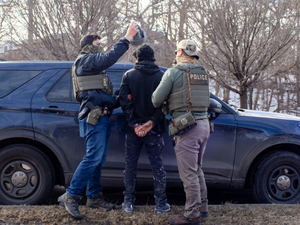
It was the brisk morning of Oct. 29, 2025, when Rosero got detained at a warehouse in the Avenel section of Woodbridge where she had worked daily for months.
“It was like watching a movie,” she said in an interview in Spanish at her second-floor apartment in Elizabeth. “Like they were going after narcos. Not me. It was like they were looking for something very criminal.”
Countless raids have happened in New Jersey since President Donald Trump launched a mass deportation and detention effort at the start of his second term. The raid that swept up Rosero and roughly 50 other workers was one of the largest here since the crackdown began.
The New Jersey Monitor met with Rosero and her daughter, Diana, immigrants from Ecuador who have lived in New Jersey since 2021, over the course of several months. Rosero described her journey from the warehouse floor to her detainment at the Elizabeth Detention Center to the LaSalle ICE processing center in Louisiana to her uncertain future back in Elizabeth.
As a woman living in the U.S. without citizenship, she fears what’s next for her and for others who came to America seeking a better life under a new era of immigration enforcement.

Rosero is one of roughly 11 million immigrants living in the U.S. without legal status. An estimated 500,000 live in New Jersey, with most coming from Mexico, Guatemala, Honduras, and Ecuador, according to the Migration Policy Institute.
She and her daughter flew here in 2021 and overstayed their visa after seeing what they said was the “chance to have better days in our lives,” and the possibility to escape the domestic abuse she suffered for years from her former partner in Ecuador.
Rosero believed she took a legal path. She filed for asylum, obtained an employment authorization document allowing her to legally work, and paid some taxes. She had no prior criminal charges or conviction.
When agents approached her the morning of the warehouse raid, she handed over her work permit believing it would prove she could legally be there. They handcuffed her, and she still hasn’t gotten that work permit back.
“I thought to myself, ‘I’m different because I have a work permit to be here, maybe the others don’t. I’m good, just stay calm. I have protection,’” she said. “Then I saw they didn’t care. They weren’t treating me any different. I said, ‘Why are you detaining me if I have a work permit? Look, I’m working here legally.’”
The agent told her she had two options. She could sign a form for voluntary self deportation and receive $1,000 to restart her life in Ecuador, though she wasn’t sure where she’d end up because the Trump administration has not been deporting people to their native countries. Her other choice: She could be detained and fight her case through the judicial system.
It was a choice thousands of immigrants like her across New Jersey have faced in recent years — fight to stay, or take the money and go.
She texted Diana, who continued to work so they could pay rent that month.
“Fight, Ma,” her text said.
With two migrant detention centers in New Jersey regularly cycling through thousands of people arrested in mass raids or individual targeted stops by U.S. Immigration and Customs Enforcement, immigration court hearings are a revolving door of people trying to find out what’s happening to them.
Newark is home to one of the state’s two immigration courts. People largely appear virtually from jail — though not necessarily in New Jersey — and speak through an interpreter. Many appear in orange or tan jail uniforms, sitting in a metal chair for a hearing lasting mere minutes. Sometimes it takes longer to bring in the next detainee than to hold the hearing itself.
On a December day, one judge saw a steady procession of cases, more than 20 people in one hour. Some were seen hours after being detained. Others had their cases rescheduled after months of detention.
Among the detainees: A mother who sat with her son in her lap. A woman, 27 weeks pregnant, who left the hospital for the hearing. A Passaic County man who begged the judge to give him a work permit, to no avail. And a Toms River man who the judge decided to deport to Ecuador instead of the man’s home country of Colombia.
Other than a prosecutor representing the U.S. Department of Homeland Security, lawyers aren’t typically present. The judge presents a few options: fight the case, accept voluntary departure to countries like Honduras and Ecuador, or explore options for relief with an attorney.
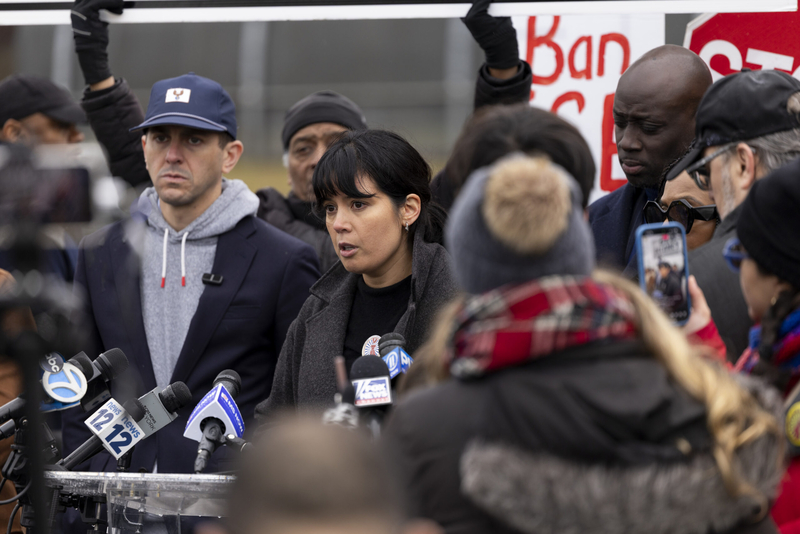
The absence of lawyers is not incidental, said Amy Torres, executive director of the New Jersey Alliance for Immigrant Justice. Unlike U.S. citizens who get arrested, immigrants detained by ICE do not have the right to a lawyer provided by the government, leaving many scrambling hours after an arrest.
“It is on them to find the representation,” Torres said. “And when we know people are getting transferred within a day at times, sometimes put on the path to deportation within a day, you can imagine how difficult it is to find a pro bono attorney within that period of time. It’s just nearly impossible — but that’s exactly how it’s set up to be.”
Nationally, voluntary departures increased by 28-fold in 2025 compared to the prior year, according to the Deportation Data Project, a group that uses public records to track immigration enforcement, detention, and deportations. While ICE is supposed to publish numbers, the agency’s tracker is not updated regularly.
Before Trump returned to the White House in January 2025, ICE was carrying out roughly 300 arrests nationally per day. That number spiked to more than 1,500 per day by July 2026, the Deportation Data Project found. In New Jersey, the numbers were even higher: immigration agents arrested 2,080 people in July, the highest monthly total in four years and a nearly 150% increase from May to July.
New Jersey now ranks eighth in the nation for immigration arrests.
Some people ICE arrests have criminal convictions, but largely for petty offenses. An analysis by the Prison Policy Initiative found that 34% of people ICE arrested in New Jersey between May and October 2025 had pending criminal charges, with the most common charge being a traffic offense. The data did not break out what share of New Jersey detainees had no criminal record at all.
One of the defining features of Trump’s second term — distinct even from his first — is the widening of who ICE targets, Torres said.
“It actually doesn’t matter if you were undocumented or not,” she said. “We’re seeing even people with valid work visas, student visas — we’re even seeing green card holders — being detained and arrested by ICE. Things that used to be a safeguard, like a green card, that’s no longer the case.”
ICE officials did not respond to multiple requests for comment.
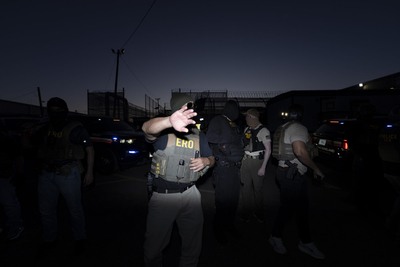
Department of Homeland Security officials have repeatedly defended their sweeping enforcement against visa holders, green card holders, and even people with pending applications, saying any status short of citizenship does not protect people from arrest. Trump has framed the crackdown as a fulfillment of a 2024 campaign promise, claiming ICE targets the “worst of the worst.”
The White House’s website characterizes enforcement as “protecting U.S. sovereignty and safeguarding American communities.”
“By prioritizing enforcement and accountability, the administration is restoring integrity to the immigration system and ensuring the law is applied consistently. These efforts protect American workers, reduce strain on local communities, and reinforce the nation’s right to control its borders and determine who enters the United States,” the website reads.
ICE has grown its footprint in New Jersey since Trump’s second term began. Former Gov. Phil Murphy, a Democrat, signed a 2021 bill banning public and private entities from entering into contracts to house immigrant detainees, but a federal judge struck down the private entities provision as unconstitutional. That allowed private prison firm CoreCivic to retain its contract to detain immigrants at the 300-bed Elizabeth Detention Center and cleared the way for Geo Group to open Delaney Hall, a 1,100-bed immigrant jail in Newark, in May 2025.
Federal officials plan to convert a vacant Roxbury warehouse into a mass processing center that could handle nearly 1,500 people. Gov. Mikie Sherrill and Attorney General Jen Davenport, both Democrats, and the township’s GOP leadership sued in March to block the project, arguing officials bypassed required environmental and procedural reviews before purchasing the $129 million site. The Trump administration in June said it was abandoning the Roxbury plan, then reversed course in July.
U.S. Rep. Rob Menendez, a Democrat whose district includes Delaney Hall, has visited the facility dozens of times since it opened. He regularly meets with detainees inside and checks on medical services and food options in the jail, which he says are both substandard. He maintains the detention center never should have opened.
He noted that 2026 marks just the second year of Geo Group’s 15-year contract with the federal government to house detainees at Delaney Hall.
“It makes me sad. Sad that this is the reality,” he said, speaking outside the jail while alarms blared, as they often do randomly when protesters and press gather. “I fear that not enough people are waking up or opening their eyes to what’s happening here, and that if more people don’t engage and see what’s happening, then they’re going to be silent while these things are happening in all of our communities.”
Menendez remains cautiously optimistic, though, and says he believes the injustices happening inside the immigration detention centers will end someday.
“I hope it’s tomorrow. I hope it’s the day after. I wish it was January of last year, but I know it will end, and we just have to do our best to keep people safe and limit the damage until it is done, finally,” he said.
That damage already is growing. Rosero’s arrest is part of a string of large-scale ICE operations that have hit New Jersey over the past year, uprooting families and workers from their Garden State homes.
The raid that led to Rosero’s arrest saw 46 people detained by federal agents. In July 2025, agents arrested another 20 or so people at Alba Wine and Spirits in Edison. The following month, they took 29 people from an Edison warehouse. This past June, they detained 18 people at El Oaxaqueño, a family-owned restaurant and market in Lakewood, including six of its workers.
Last November, agents raided a seafood market in Newark, the second at that location since Trump took office. Heavily armed agents in masks and bulletproof vests surrounded the business and shut down nearby streets. Alarmed neighbors shouted at them.
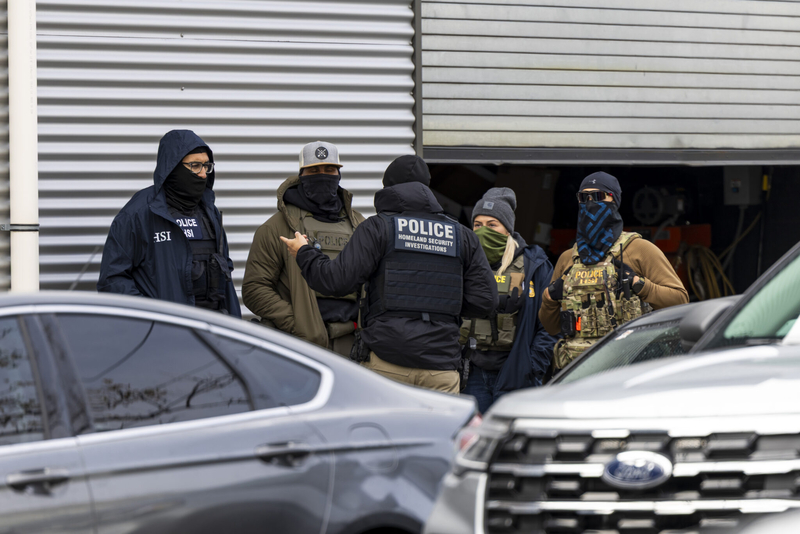
That time, 13 workers were taken to Delaney Hall. But agents swiftly move people from facility to facility, meaning detainees don’t always remain in New Jersey for long.
Sometimes, people are taken in one-off instances: a pastor stopped by agents in unmarked cars in March, a contractor pulled over near the Long Branch Home Depot and taken to Delaney Hall, an 18-year-old detained after visiting her friend at the Elizabeth Detention Center. Immigration groups like Eyes on ICE regularly post on social media when they spot agents detaining residents in places like North Plainfield, Freehold, and Dover.
At a know-your-rights meeting held by local immigration group Make the Road, a landscaper named Victor said a homeowner threatened to call ICE on him after arguing with his boss over the cost. He feared returning to work, knowing co-workers had seen those threats carried out. Other attendees shared stories of the dictatorships they escaped in Latin America and parallels they see under the Trump administration. Even those who have become U.S. citizens said they were scared, asking about racial profiling.
Immigrants’ fear and silence makes it difficult for local advocates to track the people ICE agents take. Torres described enforcement over the past 20 months not as a coordinated strategy but as deliberate disorder: mass raids at warehouses one week, arrests at immigration hearings the next, then targeted stakeouts, then nothing at all.
“The most consistent thing that we’ve seen is chaos,” Torres said. “Whenever we think we’re learning about a new emerging trend, things shift.”
Rosero considered voluntarily leaving. On one hand, it would allow her to return to her home country, where many of her relatives remain, with $1,000 in her pocket. But she had spent years seeking asylum and had obtained a work permit.
“I was between the sword and the wall,” she said. “I just knew I didn’t want to leave my daughter alone.”
Rosero first was held at the Elizabeth Detention Center, two-and-a-half miles from her apartment. She spent eight days there, along with other women from the warehouse. Then an agent woke her at 3 a.m. ordering her to collect her things, and Rosero and other detainees were chained at the waist and handcuffed. They were loaded into a van, and when one woman who spoke English overheard agents talking about airports and airplanes, panic spread through the group.
That tranquility, the feeling of being able to go anywhere, knowing you’re not doing anything wrong, of feeling truly free, it’s totally gone.
They were flown to a detention facility in LaSalle, about two miles northwest of Jena, Louisiana. She believes she arrived at 1 a.m., but she was losing track of time and days. Rosero had no lawyer confirmed to help her, and her daughter — in between work shifts at a daycare center — was piecing together contacts, drawing on a network of immigration organizations in New Jersey to find lawyers and navigating the mountain of paperwork she suddenly faced.
In Louisiana, Rosero was handed an orange uniform. Detainees donned other colors if they were seen as “problems,” Rosero said, or if they were to be deported. She was depressed upon arriving at the dingy facility, and although she made friends, she struggled to see the path forward, she said.
One night after barely eating the detention center food, she said — looking disgusted while recalling it — she sat on her hard mattress observing her uniform. She unfolded the pants in the dim light of the cell block and spotted writing along the leg: “I trust in my God, because for Him, nothing is impossible.”
She cried as she recounted how she felt seeing that. It gave her the strength and courage she had sought throughout her journey.
“I had complained so much about the uniform. That it was torn, used, dirty. And then I saw that, and I said, ‘Forgive me, Father. You’ve given me a message,’” she said.
On Nov. 13, she had a hearing via Zoom inside the jail, where a judge set bail at $15,000. She doesn’t recall what was said, mostly because it unfolded entirely in English and she felt so emotional. But when the translator finally addressed her, she understood the payment requirement. Diana had been working with local organizations to help cover the bail, paid it by Nov. 18, and Rosero was released.
“I felt peace. It felt like freedom,” she said.
A volunteer from a Louisiana-based immigration group picked her up, fed her dinner, housed her overnight, and helped her board a plane the next morning to Newark, where Diana met her.
It’s been nearly a year since her arrest. Rosero remains unable to work without her permit. She measures her recovery in blocks walked outside her apartment. For the first few weeks, she didn’t step outside at all, staying inside her two-bedroom home. Then she started pacing the backyard. Then the front.
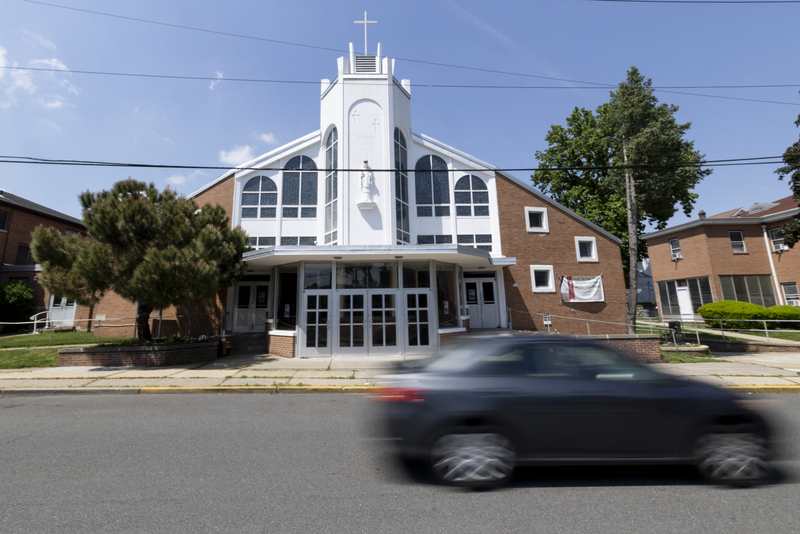
Recently, she started walking to the bodega on the corner, and to Christ the King Church near Elizabeth. She’s still apprehensive when she has to walk to Broad Street, and remains cautious of black cars passing by her.
“That tranquility, the feeling of being able to go anywhere, knowing you’re not doing anything wrong, of feeling truly free, it’s totally gone,” she said. “I don’t know when it will come back. I didn’t do anything wrong when I was arrested, so I fear it can happen again at any moment. I’m working my way to bravery.”
In February, she appeared virtually before an immigration judge for the first hearing in her asylum case. She barely spoke — the hearing was in English and she didn’t understand most of it. The judge set an August deadline to present her evidence, including notarized documents and proof of when she entered the country. The cost of her legal battle has grown to an amount she can barely say out loud, more than $25,000. Most of it is funded through community organizations and her daughter’s hourly salary. They keep a tight budget for food and rent, although their landlord is understanding of Rosero’s situation.
She’s studying for an insurance license now, looking for new ways to support herself and her daughter. She’s also in therapy to work through the nightmares and trauma of what she suffered. She keeps in touch with women she met at the jail through a WhatsApp group chat, “Las Gallinas,” or The Chickens.
She attends prayer groups, and constantly thanks God for helping her stay in America and keeping her from returning to Ecuador, where she says things have gotten worse as drugs run rampant and criminals take over towns.
Some days, Rosero says she’s fine, finding her way to the next day. But other days, she sees through her window a black car driving by slowly.
Her next court date is later this month. She’s hoping she will have her work permit again by then, despite her confusion about how to get it reissued and her fear of visiting government offices.
Still, she remains positive.
“God brought me here for a reason,” she said. “I still have many things to do.”
This story was produced as part of the Center for Cooperative Media at Montclair State University’s 2025 NJ News Commons Investigative Reporting Initiative, and supported with funding from the Robert Wood Johnson Foundation.

Trenton, NJ