Missouri AG trashes state Supreme Court ruling in federal filing
Sep 07, 2026 | 11:25 am ET
Description
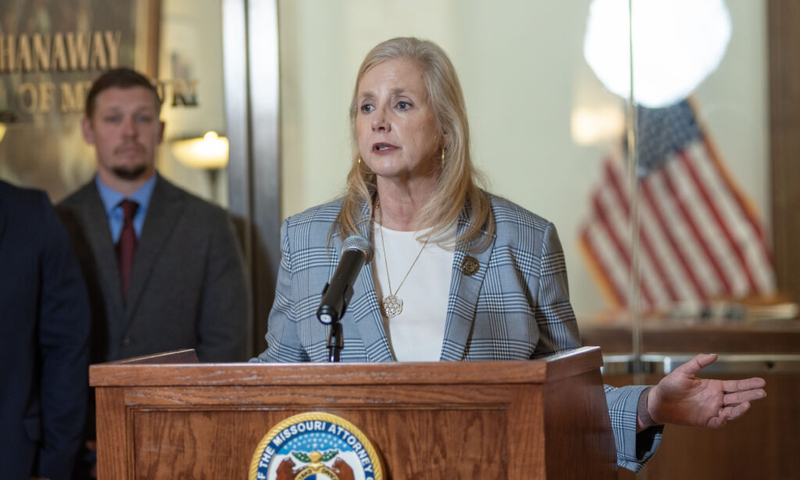
Missouri Attorney General Catherine Hanaway's office is attacking the legal reasoning of the Missouri Supreme Court in federal district court filings (Annelise Hanshaw/Missouri Independent).
Attorney General Catherine Hanaway’s chief litigator on Sunday accused the state Supreme Court of adopting “a legal fiction” when it ruled that putting the state’s new congressional map to a referendum means Missouri must use its previous district lines in November.
In a federal court filing, Solicitor General Lou Capozzi asked U.S. Chief Judge Stephen Clark of the Eastern District of Missouri, an appointee of President Donald Trump, to block the state Supreme Court order. Capozzi wrote that his client, Missouri Secretary of State Denny Hoskins, agreed with the two GOP congressional candidates who filed the lawsuit that the map favoring Republicans drawn in 2025 should be the one used in November.
In the unanimous opinion last week, Missouri Supreme Court Judge Ginger Gooch wrote that People Not Politicians had submitted a legally sufficient petition referendum and the Missouri Constitution required that the legislation creating the new map can have no effect in law until a vote of the people.
Hanaway appealed to the U.S. Supreme Court on Friday afternoon. Justice Brett Kavanaugh set a noon Monday deadline for other parties to weigh in on the application for an emergency stay.
U.S. Rep. Bob Onder, state Sen. Rick Brattin, and two voters filed their lawsuit in the Eastern District court on Friday, with People Not Politicians seeking to intervene to have the case dismissed.
Like Kavanaugh, Clark set a noon Monday deadline for any other intervenors to file and for arguments on whether he had any jurisdiction. Both could issue decisions as early as Monday afternoon.
Tuesday is the deadline for changing the Nov. 3 ballot.One state law prohibits local election authorities from adding or removing candidates or issues after that date and another extends that prohibition to the courts.
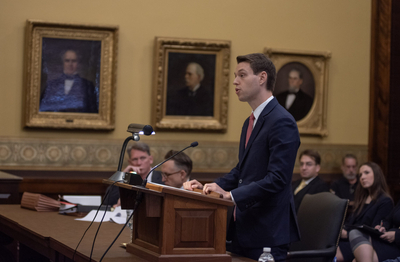
In his Sunday filing on behalf of Hoskins in the Eastern District, Capozzi acknowledges that he cannot dispute last week’s decision on state law grounds.
“The Missouri Supreme Court’s decision rested solely on state law,” Capozzi wrote. “Indeed, the court suggested Secretary Hoskins was barred from even considering federal law in his certification decision.”
The referendum petition was filed Dec. 9. The bill that included the gerrymandered map intended to flip the 5th District — where Brattin is the GOP nominee — was constitutionally set to take effect on Dec. 11.
The provision on a referendum in Missouri’s Constitution, whether lawmakers put legislation on the ballot or it is done by petition, is that it does not take effect until approved by voters. Because the primary was conducted before the ruling that the petition was sufficient, Capozzi wrote, “the Missouri Supreme Court adopted a legal fiction that the (2025) map used in the primary election must be deemed retroactively invalid.”
In the motion to dismiss, attorney Chuck Hatfield argued on behalf of People Not Politicians that the federal district court should not second-guess the Missouri Supreme Court’s decision.
The court does not have jurisdiction, Hatfield wrote. He also questioned whether there was a true dispute between Onder, Brattin and the voters and Hoskins.
Marc Ellinger, the attorney representing Onder and Brattin, argued side-by-side with Capozzi in the case decided by the Missouri Supreme Court. Now his clients have filed suit against Hoskins, who has told the court he agrees with their demands.
“The hallmarks of collusion are unmistakable,” Hatfield wrote in the motion to dismiss the case.
The lawsuit is a true dispute, Capozzi wrote, because Hoskins wants to do as Onder and the other plaintiffs demand, but cannot because he would have to break the law to do so.
Ellinger, in his filing, echoed that argument.
“A defendant who lacks the power to grant the requested relief without a court order cannot collude to manufacture one; the very fact that plaintiffs need an injunction from this court, rather than a stipulation from the secretary, is proof the dispute is real,” Ellinger wrote.
In the motion to dismiss, Hatfield used an argument drawn on repeatedly by Ellinger and Capozzi to urge courts to allow the 2025 map to be used in the general election — it is too late to change and doing so would harm the election.
The Supreme Court appeal will decide all the important questions raised by Onder and the other plaintiffs, Hatfield wrote.
“A district-court injunction directing use of the (2025) map while the Supreme Court considers whether to stay the Missouri Supreme Court’s injunction against that map would create chaos for election officials, candidates, and voters,” Hatfield wrote.
He urged Clark to dismiss the case.
“The pending Supreme Court proceeding demonstrates an adequate alternative forum — the constitutionally designated forum — for plaintiffs’ federal claims,” Hatfield wrote.
One unusual aspect of the Eastern District case is that Hanaway is not defending the decision of the Missouri Supreme Court. Usually, when a Missouri state law or precedent is challenged in federal court, the attorney general’s office works to defend it as a correct application of the law.
Instead, through the state’s filings, Capozzi belittles the work of the state’s highest court.
The decision ignored many of the arguments he made and accepted by the Cole County Circuit Judge Daniel Green, Capozzi wrote. On several occasions, he wrote, the court did “not mention” his effort to use a tie-in to the federal Constitution to block the referendum,
And the court, to his surprise, applied Missouri law to the case.
“Shockingly, the Missouri Supreme Court reversed and directly issued an injunction prohibiting the secretary — ‘and all those acting in concert with him’ — ‘from implementing, using, or mandating the use of the congressional redistricting in (the 2025 map),’” Capozzi wrote.
Capozzi also criticized the court for refusing to accept his version of facts, adopted by Green but disputed in filings directly to the court.
“Even more bizarrely, the Missouri Supreme Court entirely ignored the circuit court’s finding that changing congressional maps would be ‘impossible’ and force Missouri to violate the federal election calendar,” Capozzi wrote. “Instead, the court explicitly eschewed any consideration of the ‘confusion, expense, and practical difficulties’ that ‘may result’ from its injunction.”
Those issues Hoskins and Hanaway have with the court ruling means the attorney general’s office cannot defend the Missouri Supreme Court decision, Capozzi wrote.
“Defendants take their obligation to defend state laws seriously,” Capozzi wrote. “But under the extraordinary and unprecedented circumstances in this case, defendants believe their oath to comply with the U.S. Constitution prevents them from defending the use of a different congressional map for the general election.”

Jefferson City, MO