Vermonters will vote on constitutional amendment enshrining labor protections in November
Sep 07, 2026 | 7:56 am ET
Description
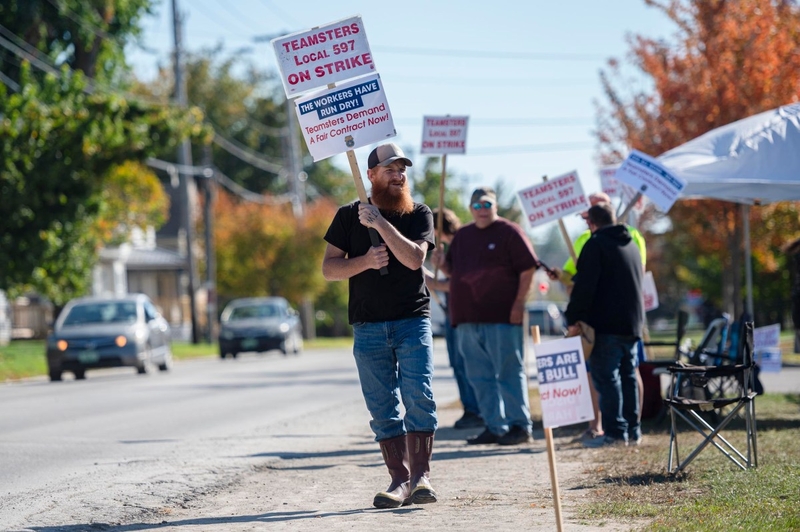
Members of the Teamsters local 597 union picket outside the Dairy Farmers of America plant in St. Albans on Tuesday, September 30, 2025. Photo by Glenn Russell/VTDigger
Theo Wells-Spackman is a Report for America corps member who reports for VTDigger.
Vermont voters will accept or toss an amendment to the state constitution in November that would affirm workers’ right to organize and collectively bargain, and prevent lawmakers from easily reversing labor protections in the future.
The item, Proposal 3, will appear alongside Proposal 4, which would guarantee equal protections under the law regardless of a number of characteristics like race and gender identity. Changes to Vermont’s constitution can be introduced by the Senate every four years, and need to be approved by both legislative chambers in two consecutive bienniums. Proposal 3 was approved by the Legislature in both the 2024 and 2025 sessions, on either side of the 2024 election cycle, and can now be ratified or rejected by voters in the general election on Nov. 3.
Proposal 3, or PR.3, would prevent lawmakers from easily passing legislation in the future that “interferes with, negates, or diminishes the right of employees to collectively bargain” for conditions or terms of work. The language would also specifically protect labor agreements that make union membership a condition of employment at a particular company.
The U.S. Supreme Court ruled in 2018 that such “union shop” agreements are illegal nationwide for public employees. Twenty-six states have adopted measures — commonly called “right-to-work” policies — that ban such agreements in the private sector too.
Constitutional protections like those in PR.3 are relatively unusual in the U.S. Vermont would be the seventh state to adopt an amendment enshrining the right to bargain. Among those six existing instances, only Illinois explicitly forbids “right-to-work” legislation, according to the Center for Labor and a Just Economy at Harvard Law School.
For Larry Moquin, who is president of Vermont’s AFL-CIO labor council and has been pushing for a version of PR.3 since 2022, Illinois has been a primary model. Recent fights surrounding public employees unions in Utah and “right-to-work”-style amendments to numerous state constitutions are part of a larger pattern of efforts to undermine organized labor across the country, he argued, illustrating the necessity of such robust long-term safeguards in Vermont.
“I think that the workers in the state deserve it,” Moquin said of the constitutional protections potentially afforded by PR.3. “People’s children and grandchildren deserve the same rights that we have.”
Rep. Conor Casey, an outgoing Montpelier Democrat who co-led the pro-labor Working Vermonters’ Caucus for the past several years, has mounted a campaign called “Yes on 3” to advocate for the amendment’s passage in November. The effort is a “one-man shop” at present, he said, and seeks to both convince the public of the measure’s necessity and fend off organized opposition to the change from national interests should it arise.
When Moquin approached him with the idea of a constitutional amendment years ago, Casey said, it struck him as the right step for Vermont. He too is worried about what he sees as a national push to restrict the power of U.S. labor movements in recent decades.
Collective bargaining in the workplace “is a form of democracy,” Casey said. “It certainly belongs in our constitution.”
Though PR.3 has seen cross-party support in both of Vermont’s legislative chambers — indeed, no senator voted against its passage last year — the proposal has met pushback from some think tanks and conservative lawmakers.
Clara Morrison, who leads the free-market economic policy think tank Right for Vermont Foundation, said she thought the proposal’s advocates had sometimes misrepresented its true ramifications, particularly given that federal policy already outlines many labor protections.
“What this amendment actually does is prevent workers’ from gaining the freedom to choose whether to join or fund a private union without risking their job,” Morrison said in an email Tuesday.
The proposal’s broad language also essentially “blocks lawmakers from ever limiting what unions can demand,” Morrison added, which she argued could cause legal confusion with both federal and state law, and cost taxpayers in the long term if public employees’ union agreements could no longer easily be shaped through statute.
Rep. Lisa Hango, R-Berkshire, one of 15 House members who voted against the measure last year, expressed similar reservations to colleagues: “I simply do not support taking away a worker’s freedom to decide.”
Peter Teachout, a constitutional law professor at Vermont Law and Graduate School, told lawmakers in 2024 that he supported the language of PR.3, while noting that the measure would be “bounded in its operation” by federal law. He added in an interview that the amendment would likely provide organizing protections to a broader set of Vermont employees than is currently covered by statute — including farmworkers.
The federal National Labor Relations Act of 1935 guarantees organizing protections for many employees while exempting some groups, including agriculture workers. Such groups would not newly gain the ability to unionize in Vermont via the new amendment without judicial involvement or a statutory change, according to Rep. Emilie Krasnow, D-South Burlington, who has co-led the pro-labor caucus along with Casey.
For Moquin, PR.3 would also be a statement of intent to push back against wealth inequality.
“Unions build generational wealth,” he said. Vermont taking the lead on labor protections, he added, would be “some good news in a time where mostly there’s been bad news for working Americans.”
Read the story on VTDigger here: Vermonters will vote on constitutional amendment enshrining labor protections in November.
Montpelier, VT