Policy experts ask Michigan to strengthen workers rights as state grapples with economic challenges
Sep 07, 2026 | 4:00 am ET

Description
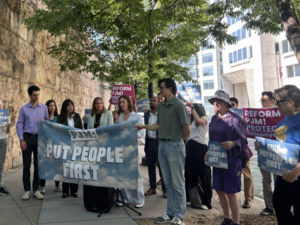
A construction worker listens as a labor leader speaks at a rally for a sustainable road funding solution in the coming fiscal year budget. Sept. 3, 2025 | Photo by Ben Solis/Michigan Advance
As the nation takes a beat in recognition of the American labor movement on Monday, the Michigan League for Public Policy is calling on the state to do more for its workers.
In a report released on Labor Day, Patrick Schaefer, an economic security policy analyst for the organization, analyzed recent trends in Michigan’s labor economy. The result is a series of recommendations on policies Michigan lawmakers could adopt to support its workforce.
At the time of the report’s publication, Michigan’s unemployment rate was at 5%, remaining largely stable over the last year. The nation’s average unemployment rate is 4.2%, with Michigan holding the eighth highest rate in the nation.
The state’s rate of labor underutilization — which includes unemployed workers, individuals who are working part time and would like to work full time, and people who are available and willing to work, but have not looked for a job because they don’t believe there are jobs available to them — is sitting at rates comparable to the end of the COVID-19 pandemic, the report said.
Between July 2025 and June 2026, the state’s labor underutilization rate averaged 9.1%, sitting above the national average of 7.9%.
“While Michigan’s labor underutilization rate is still fairly low compared to its historic rates, the rate at which it is increasing compared to the national average paints an uneasy picture of Michigan’s labor market,” the report notes.
The Michigan League for Public Policy also noted a 1.7% decrease in labor force participation, marking the largest decrease the state has seen since the pandemic.
The decrease was due to a number of factors, the report explained, including retirements, people staying in education longer, job-seeking fatigue, and the increased cost of child and elder care.
“The most recent data indicates there are 1.2 job seekers per job opening in Michigan, indicating there are simply not enough jobs for everyone,” the report states. “Finally, in 2025, the average cost of full-time center-based infant childcare is $14,064 per year in Michigan, leaving some to choose to exit the workforce rather than pay the exorbitant cost.”
The report also addresses the continued decline of manufacturing jobs in Michigan and whether artificial intelligence and the tech industry can provide meaningful economic development in the state.
“It is clear we are looking for a new industry to rebuild a strong working class. However, the truth is that AI, data centers and the tech industry do not seem to be the answer,” the report states. “We cannot bank on the chance of capturing a booming industry. It would be far more prudent to invest funds in removing barriers to employment in the state, not in corporate incentives.”
The report said that large scale data centers deliver significantly fewer permanent jobs than manufacturing facilities, comparing the Open AI data center under development in Saline Township, which is expected to create 450 permanent jobs, with Ford’s Michigan Assembly Plant, which employs more than 6,000 residents.
Instead of spending money in an attempt to bring data centers and tech companies into Michigan, the League of Public Policy argued state funds would be better spent on investments into K-12 and higher education, public infrastructure, and affordable childcare to help bring young families into the state.
It is clear we are looking for a new industry to rebuild a strong working class. However, the truth is that AI, data centers and the tech industry do not seem to be the answer.
Although the median wage in the state has grown 8 cents between 2024 and 2025, the Michigan League for Public Policy said that the median Michigan worker is only making 19 cents more per hour than they did pre-pandemic.
Additionally, not all workers have seen wage increases, the organization said, with the median hourly wage of Black residents falling by 43 cents over the last year, when accounting for inflation.
“That worsens a widening gulf between Black and white hourly wages in the state, with the median white worker now taking home 23.4% more than the median Black worker,” the report states.
The median female worker also saw their wages dip by 16 cents between 2024 and 2025, with women now earning 20.3% less per hour than the median male worker across the state.
In its recommendations, the Michigan League for Public Policy called on lawmakers to increase the state’s $13.73 minimum wage to a rate that ensures full-time workers can afford necessities like housing, food, utilities and medicine.
It also called for the state to eliminate the minimum wage for tipped workers, which allows employees to pay their workers $5.49 per hour if they received at least $8.24 in tips.
The league notes that women, particularly Black women, are more likely to work in tipped positions or other low-paying jobs. The tipped wage is set to increase, but those wages can be inconsistent, making financial planning more difficult, the report states.
The report also called for lawmakers to move forward with a policy to ban employers from requesting salary or credit history during the hiring process, noting that incorporating that information into hiring decisions can perpetuate wage discrimination and have a long-term compounding effect on a worker’s salary.
On labor rights in Michigan, the report noted that the loss of manufacturing jobs often means the loss of union jobs, as the industries that come in to fill vacancies in the job market are often non-union, or jobs that include high barriers to entry.
“Michigan must push for stronger worker rights and better benefits to strengthen both Michigan families and the overall economy,” the report states. “The solution is not to just regrow Michigan manufacturing, though that can be a vital component. What is important is that workers are allowed to organize and negotiate for better wages and benefits.”
On those grounds, the Michigan League for Public Policy advocated for the repeal of state laws barring local governments from having their own minimum wage. It further called for the establishment of prevailing wages, the mandating of paid leave for workers, or otherwise adopting and enforcing employment discrimination or policies that go beyond the benefits and protections guaranteed by the state.
The Michigan League for Public Policy also called for a ban on captive audience meetings, employer-mandated meetings held during organizing efforts where employers advocate against unionization. While the National Labor Relations Board banned the practice in 2024, the ban has since been appealed, and the board’s general counsel has asked for the ban to be reversed.
Lansing, MI