Rural Iowa pharmacy owner tells Josh Turek federal action needed to stay open
Sep 04, 2026 | 4:08 pm ET
Description
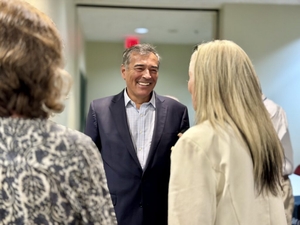
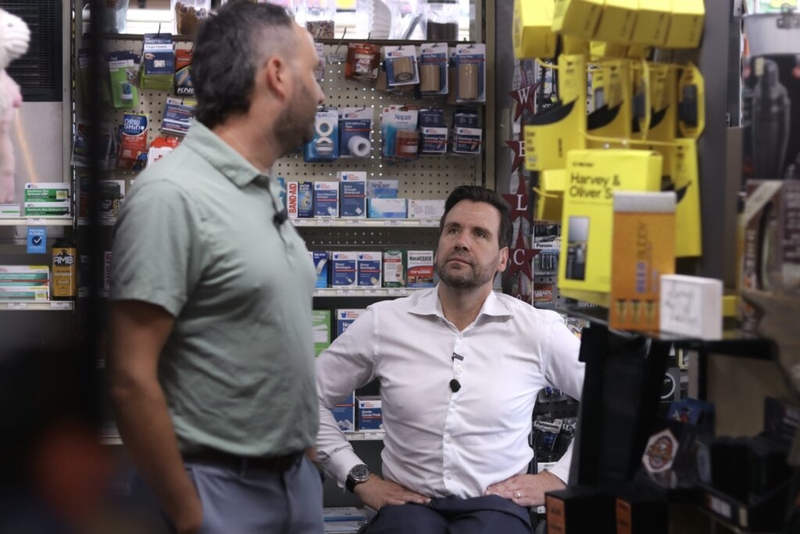
Josh Turek, right, visits with Brad Magg at Spring City pharmacy in Colfax, Iowa Sept. 4, 2026 to talk about Turek's calls for pharmacy benefit manager reform as he runs for U.S. Senate. (Photo by Cami Koons/Iowa Capital Dispatch)
COLFAX – Spring City Pharmacy is stocked with medications, hardware supplies, cards, household goods and runs an old-school soda and ice cream bar.
Brad Magg and his business partners decided to keep the pharmacy running in downtown Colfax because they remember it being a staple store while growing up in the small central Iowa community. But, Magg said it’s a losing business, because “insurance companies pay less than it costs to buy drugs.”
Speaking to Josh Turek, a Democrat from Council Bluffs running for U.S. Senate, Magg said he and his partners lost over $100,000 dollars in the first year of running the business.
“We knew it wasn’t for lack of business,” Magg said while showing Turek around the shop. “It was because we filled too many scripts.”
Turek cut in – “it was because of PBMs.”
Lawmakers on both sides of the aisle have been calling for reforms to pharmacy benefit managers, or PBMs, the entities that serve as middlemen to negotiate prescription drug prices between manufacturers, health insurance companies and pharmacies.
In 2025, Gov. Kim Reynolds signed a bill that put additional regulations and restrictions on the industry, in a move that supporters argued would help rural pharmacies especially as they struggle to recoup the costs of filling prescriptions.
The law has since been tied up in a legal battle with several insurance companies claiming the state law is preempted by federal law. Magg said even if the law were to take effect, it wouldn’t provide protections from PBM influence on the majority of the scripts filled at his pharmacy, which come from Medicare patients.
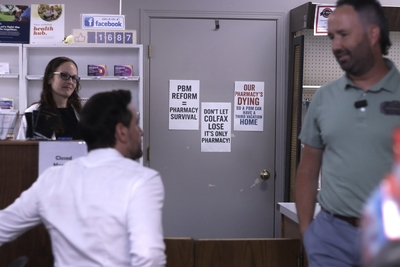
As a federally run health insurance program for older Americans, Magg said prescriptions from Medicare patients would be exempt from the state law.
Turek said even if the state law is able to be effective, it is not “a great idea to always have a patchwork of 50 different standards from state to state operating completely differently.”
“It is absurdity that you end up losing money on every prescription that you fill, and that is directly because of the PBMs,” Turek said. “And what do the PBMs benefit? Only the large multinationals.”
Turek is running against Republican U.S. Rep. Ashley Hinson for the Senate seat. Hinson recently joined U.S. Sen. Chuck Grassley for a forum with Iowa pharmacists to talk about their struggles with PBMs. According to coverage of the event from WHO 13, Hinson said lawmakers need to “keep chipping away” at the issue to eventually provide relief to patients.
Grassley has previously pushed for reform to the industry, as has U.S. Rep. Mariannette Miller-Meeks, another Republican from Iowa.
According to the health policy publication KFF, several measures of federal PBM reform were passed in February 2026 but have yet to take effect.
Turek said he believes a pharmacy is one of the “four pillars” of a rural community. Pharmacies, along with grocery stores, schools and healthcare facilities – which make up the other pillars – are seeing increased closure rates across rural Iowa.
He also noted that cuts to federal programs like the Supplemental Nutrition Assistance Program, Medicaid and Medicare will exacerbate these issues unless the cuts are reversed.
“It’s more people that are going to be underinsured, uninsured,” Turek said. “And in a state with a healthcare crisis and a cancer crisis, that leads to massive problems and more and more closures of places like this.”
Magg and his business partners reopened the pharmacy in 2022 after the large company that took over the more-than-a-century-old town staple pulled out of town and left the shelves empty.
When they took over the pharmacy, Magg said he and his business partners knew it probably wasn’t going to be profitable. But they wanted the community to have the service, which he said has allowed some elderly residents to stay in their homes versus moving to a retirement community, and it has provided some level of care in the community even as its last doctor’s office closed.
“We’re not trying to get rich here,” Magg said. “We just want to break even to keep the doors open.”
Des Moines, IA