


NCAA eligibility lawsuit pits Louisiana, Southern elected leaders against each other
Sep 04, 2026 | 1:09 pm ET
Description
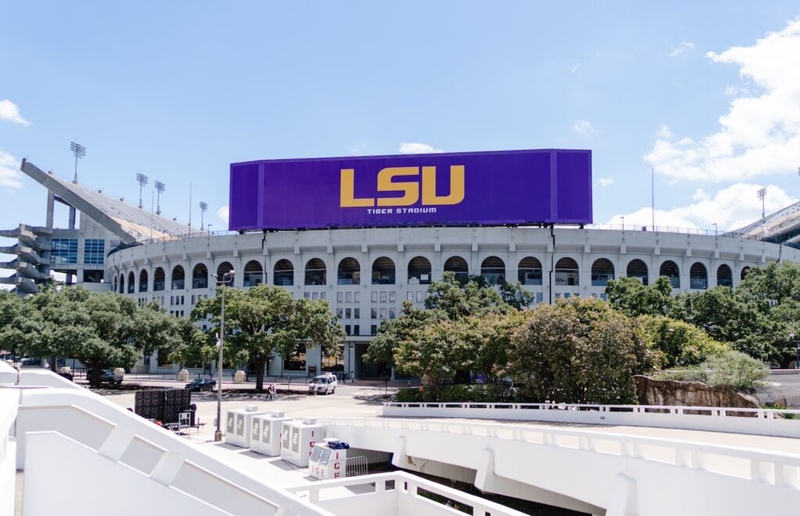
The new video display scoreboard in Tiger Stadium's north side as seen from the Pete Maravich Assembly Center on Sept. 13, 2024. (Matthew Perschall for Louisiana Illuminator)
Inside a Baton Rouge courtroom Thursday, a lawsuit challenging arcane NCAA eligibility rules turned into a political football with prominent elected officials involved on each side.
The case is one of two that pits the Southeastern Conference against LSU in proceedings that have captured national attention and drawn reaction from leaders from around the region watching with interest from the sidelines.
On one team, New Orleans’ District Attorney Jason Williams (who played football at Tulane) represents the SEC. On the other team, Baton Rouge-area prosecutor Tony Clayton is trying to get former NFL athletes on LSU’s roster ahead of its season-opening matchup Saturday against Clemson. Louisiana Attorney General Liz Murrill, though not a party to the case, submitted a brief to the court supporting the athletes’ cause.
“Louisiana’s public universities and their student-athletes are participants in this convoluted arrangement, and have struggled under the ‘broken’ system for years now,” Murrill wrote in her brief.
The lawsuit, Pyburn v. NCAA, was brought by 43 former college athletes who graduated high school in 2022 and exist in a grey area of eligibility. In August 2020, during the COVID-19 pandemic, the NCAA issued a blanket waiver to extend athletes’ eligibility, in some instances allowing them to compete for six years. In June, the rules were changed to provide up to five years of eligibility for a student-athlete, depending on their age, moving forward. Class of ‘22 athletes were excluded from the update, leading to their lawsuit.
After a nine-hour-plus hearing Thursday, Judge Will Jorden issued a preliminary injunction that prevents the NCAA and the Southeastern Conference from keeping the 43 plaintiffs, many from different schools, from rejoining a college sports team. The order also blocks LSU from taking prohibitive actions against them.
Attorneys representing the NCAA and the SEC said they planned to appeal the order.
Meanwhile, the Southeastern Conference filed a federal lawsuit Thursday against LSU trying to stop the school from putting former pro football players on its roster. Coach Lane Kiffin has to decide Friday whether to add them for the Clemson game.
Louisiana politicians have a long history of inserting themselves into LSU sports, dating back to the 1920s when Gov. Huey Long at times acted as an unofficial football coach. Gov. John McKeithen was arguably LSU athletics’ top recruiter during his time in office from 1964-72, and Gov. Jeff Landry most recently took the reins on the dismissal of coach Brian Kelly and the search for his replacement.
The courtroom drama that unfolded Thursday took that tradition in new directions, with a starting lineup steeped in state politics.
Clayton, the attorney representing the players, is district attorney for Iberville, Pointe Coupee and West Baton Rouge parishes. He’s also chairman of the Southern University Board of Supervisors, a position he was hand-selected for by his ally, Landry. Clayton spent the hearing sitting side-by-side with Murrill, whispering to one another throughout the hearing.
The NCAA and SEC’s team featured Williams, who has clashed with Landry and Murrill. Most recently, the attorney general threatened to oust Williams and other New Orleans officials from their positions for disregarding a new state law that removed an elected court clerk from office. Murrill was indicted for alleged intimidation, though the charges were eventually pulled.
Kiffin’s interest in former NFL players has also drawn the ire of other SEC schools, some backed by politicians who have said LSU should be expelled from the conference if the coach carries out his plans.
“If LSU does in fact roster one or more pro athletes or demonstrates concrete plans to do so, we would strongly encourage the SEC to take all measures available to address this conduct, up to and including suspending and/or removing LSU from the Conference,” Georgia Attorney General Chris Carr wrote in a letter to SEC Commissioner Greg Sankey this week.
“College athletics is meant for just that, college students!” South Carolina AG Alan Wilson wrote in a Facebook post, “Putting a previous NFL player on a college roster against the directive of the Southeastern Conference not only circumvents the authority of the conference, but also undermines the spirit of college athletics.”
Mississippi Gov. Tate Reeves and Oklahoma Attorney General Getner Drummond jumped into the fray Friday morning, with Reeves issuing a rebuke of Murrill’s assertion Judge Jorden, a graduate of Millsaps College and Southern’s law school, was a neutral decision maker.
“Anybody that has EVER played under the lights in Tigah stadium, or at the Pistol Pete Assembly Center, or at Alex Box KNOWS there is no such thing as a ‘fair forum’ or a ‘neutral decision maker’ anywhere near Baton Rouge,” Reeves posted on social media.
The statements led Landry to issue a retort against his fellow Republicans.
“Calling them ‘NFL players’ is at best disingenuous, and at worst intentionally deceptive,” Landry wrote on X. “They are not professional football players circling back after years in the NFL. They are college players who were told, by the NCAA, that they were done. So they took the only door that was open — only to watch the NCAA change the lock behind them.”
The drama has also contributed to the villain narrative that has surrounded Kiffin — one that Kiffin and the entire program has leaned into — since he left Ole Miss for LSU.
LSU has posted signs around its football facility reinforcing that message, with images of them placed on social media this week.
“If you want to win at the highest level, you have to become a villain in someone else’s story,” the signs read.
Kiffin is not a party in the lawsuit heard Thursday though his presence was felt in Williams’ closing arguments on behalf of the NCAA.
“Lane Kiffin is as cold as ice … he pushed every limit he can to win a game,” Williams told the judge.
Clayton’s brash style of litigation commanded the attention of the courtroom. He spent three hours questioning with SEC Commissioner Greg Sankey, who afterwards was escorted out a back entrance of the courthouse due to “security concerns,” WAFB-TV reported.
Clayton and Williams sniped at each other almost as much as they swiped at the facts of the case.
“It’s hard for you to get in this head,” Clayton said to Williams following an objection, tapping on his temple. “I see I’m renting space in yours!”
“I see Mr. Clayton is getting hungry,” Williams said after an objection from Clayton, offering to have someone fetch a Snickers bar. “Watching Mr. Clayton is like watching the sunset. You can’t look away.”
“As my grandma said, ‘It’s no fun when the rabbit has the gun,’” Clayton replied.
As Sankey was being questioned, news broke about the SEC’s federal lawsuit against LSU. Kiffin, athletics director Verge Ausberry and President Wade Rousse are also named defendants in that lawsuit. The case was filed with the U.S. District Court for Northern Alabama in Birmingham, where the conference is headquartered.
“It’s just garbage,” Murrill said about the federal lawsuit during a break in the proceedings. “I mean, it’s a nice trick. I just don’t think they made actual plausible, supportable allegations.”
Murrill said she will represent LSU in the federal case as it is a state institution.
Thursday’s injunction hearing follows a temporary restraining order two weeks ago that allowed LSU to sign two players, Dae-Quan Wright and Zxavian Harris, who both played for Kiffin at Ole Miss. After being passed over in the NFL Draft, they reached free agent deals with NFL teams.
The injunction allows them to be added to LSU’s roster.
Jack Pyburn, the lead plaintiff who was a former linebacker for the Tigers, has signed a contract with the Kansas City Chiefs and won’t return to LSU.
Following the temporary restraining order in August, presidents from the 15 SEC schools voted to reaffirm that professional athletes are not eligible to play in the conference. LSU’s Rousse abstained from the vote.
Twelve athletes seeking to join a college team testified at Thursday’s hearing. Most said they played alongside other players who were given more years to play in college. Some had played or attempted to play professionally.
Harris said he received less than $200 in gas money to attend a New Orleans Saints mini-camp, signed a contract but said he was ultimately never paid and did not participate in any pre-season games. Wright said he received a $25,000 signing bonus from the Philadelphia Eagles, who later waived him, and then suited up for a pre-season game with the Cleveland Browns but was never paid.
Paytn Monticelli, a former LSU softball player, played a full season of professional softball. She said she is willing to pay back her compensation to rejoin the Tigers. Other athletes in the case include former athletes at Nicholls, UL Lafayette and Northwestern State.
Though Thursday’s ruling provides temporary relief for LSU, their case still has to go through a full trial. If they lose, the schools that allow them to return to their teams could face sanctions and heavy fines.
“There’s still this cloud over LSU unnecessarily, and hopefully the SEC comes to its senses and … quits threatening LSU,” said LSU Board of Supervisors Vice Chairman John Carmouche, who is an attorney and also attended Thursday’s hearing. “We didn’t do anything. These are players that sued. LSU is not part of this.”

Baton Rouge, LA
