Derby High School yearbook faces backlash, but student press advocates defend free speech
Sep 04, 2026 | 9:20 am ET
Description
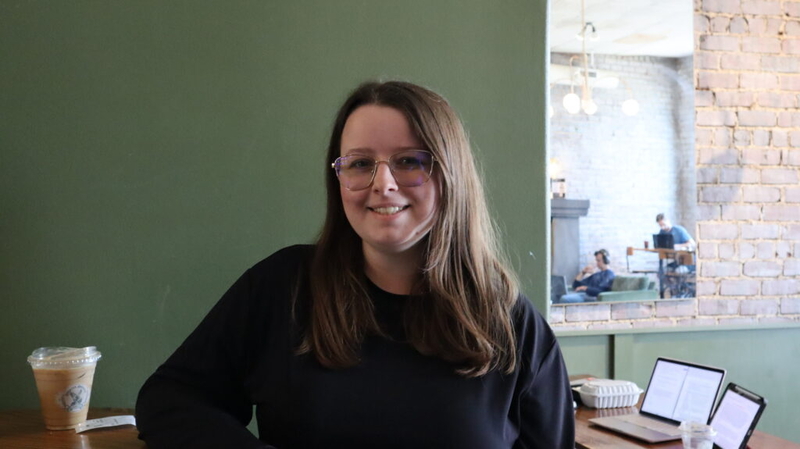
“There’s 2,000 students in the school, and we try to represent everyone in a way,” said Bree Stuhlsatz, former editor of the Derby High School yearbook, in response to a recent outcry. (Photo by Jacinda Hall for Kansas Reflector)
DERBY — When the Derby High School yearbook from the 2025-2026 school year was distributed at the school’s back-to-school night at the beginning of August, students, parents and politicians were quick to react.
Many remarks had to do with content, specifically the pages with student’s hot takes. One student was quoted saying “Trump is the worst president in US history.” Another student was shown in drag. One page was dedicated to the protests against ICE. A spread covered the division among the school that after the assassination of conservative commentator Charlie Kirk.
“There’s 2,000 students in the school, and we try to represent everyone in a way,” said Bree Stuhlsatz, former editor of the Derby High School yearbook. “A lot of people will say that we were anti-Charlie Kirk and all of that, but if you actually read the story, there’s nowhere where it says we’re anti-Charlie Kirk. We just write what’s going on.”
The conservative account Libs of TikTok posted the pages on X and garnered national attention. South Carolina Rep. Nancy Mace commented under the post: “American tax dollars should not be funding this garbage in public schools.”
Republican state Rep. Blake Carpenter, R-Derby, called the pages “unacceptable” on his Facebook page.
“A yearbook should be something students can keep for the rest of their lives. It should preserve memories of their classmates, teachers, activities, athletics, accomplishments, and the moments that defined their time in high school,” Carpenter wrote in his post. “It should not become a vehicle for partisan political attacks.”
Carpenter went on to write that people have defended the yearbook by noting that the student newspaper has published articles on similar topics. He claimed that it was not the same.
“A student newspaper exists to report news, publish opinions, debate issues, and cover current events. People read the article and move on,” Carpenter wrote. “A yearbook is different. ”
Kansas Reflector made multiple attempts to reach out to Carpenter for comment through email messages and phone calls, but he did not respond.
Stuhlsatz said that it was up to students on staff to write yearbook stories and not their adviser.
“I applaud all the younger students who want to write those tougher stories, because it’s a good thing,” Stuhlsatz said. “It’s good for the journalistic world, I would say. And as much as people say that politics shouldn’t really be in schools, it’s just the stuff that happened during our time, and a yearbook is meant to be a time capsule for all of us to look back on.”
Stuhlsatz said that she has different opinions about the yearbook than others in the newsroom, but she understood that this is what her fellow students wanted.
“Because of that, with Hazelwood and Tinker v. Des Moines, it protects student journalists,” Stuhlsatz said. “So our administration legally can’t do anything to censor our yearbooks. … We’re meant as journalists to write what’s going on at the time, no matter if it’s a hard topic, or even if it’s an easy topic, we’re meant to just write about it. That’s what journalists of today do.”
The Supreme Court cases Tinker v. Des Moines and Hazelwood v. Kuhlmeier were landmark cases that protected students’ right to freedom of speech and expression.
Kansas Scholastic Press Association Executive Director Barbara Tholen explained that taking criticism is part of being a journalist.
“Sometimes people are going to be angry with what you write, and the First Amendment protects that,” Tholen said. “And to a certain extent, on those occasions when we would make somebody frustrated, I would think, ‘this is a learning opportunity for them.’”
Tholen explained that sometimes the opportunities for authentic learning in schools involve making a tangible product and dealing with people being frustrated.
”That’s part of journalism,” Tholen said. “It was a matter of thinking like, ‘OK, what were the decisions that we made? Do we stand by those?’ Because sometimes you make a mistake and you regret it, and sometimes you’re like, ‘Yeah, 100%.”
Tholen says that the public doesn’t always understand that process.
“They get mad at something that’s random,” Tholen said. “They think, ‘Oh, it’s the adults, the adults let this happen,’ and I think, ‘Wait, in this case, like, in a lot of cases, we have students who have made decisions, and now they’re getting real feedback on those decisions and that’s OK.”
Tholen says that if the first time students are allowed to make decisions and have someone disagree is after high school, it does them a disservice.
“I think that rather than people always see this as an institutional problem, I think we should see this as just big decisions and carry feedback. … Part of making decisions is living with the consequences,” Tholen said.
Tholen said there’s another side to the situation as well, the First Amendment side, that concerns her.
“I have concerns when people want to have government officials, in this case, the school board or whatever the state lawmaker wants to involve themselves in the free speech decisions that students are making,” she said.
“One, educationally, I think it’s a bad idea, two, we do our students a disservice when we allow them to think that the First Amendment would allow government officials to interfere in the decisions they make.”
Tholen also pointed to the Kansas Student Publications Act, which protects student journalists from interference by school districts or administrators, as long as their work is not obscene or libelous.
“Students need to understand how the First Amendment works,” Tholen said. “You can’t teach the First Amendment in a vacuum. … You want students to have that autonomy to make decisions, to learn from the feedback they get from the decisions that they make.”
Susan Massy, Kansas state director for the Journalism Education Association, said that there have long been misunderstandings about student press rights. Massy was one of the teachers who fought for the Kansas Student Publications Act in 1992.
“ I feel like we are constantly having to define what student press rights are and what that means for school, particularly, school administration,” Massy said. “The content of a student publication is not determined by the adviser, it is not determined by the administrator, it is not determined by the school board. It is determined by the students who create that publication.”
Kansas State Sen. Mike Thompson, R-Shawnee, also wrote on his Facebook page that the yearbook showed that schools in Kansas are focusing on “unnecessary items.”
“School administrators across the state are constantly clamoring for more money, and blaming the legislature … even though the schools are fully funded as required by the Kansas Supreme Court,” he wrote in his post. “But the best evidence that schools are actively wasting money on things that do nothing to educate students was exposed in the Derby School District.”
Massy said that she found Thompson’s comments surprising.
“I feel like they’ve seen a very limited representation of what is in that book. I feel like they don’t truly understand what the bill says,” Massy said. “It clearly gives broad rights to students, not to advisers, not to administrators, it’s to students.”
Massy says that she wishes that lawmakers were more familiar with the Kansas Student Publications Act.
“I think in Kansas, we have a very strong respect for the First Amendment,” she said. “But sometimes, I think that people in general have a strong respect for it, while still only wanting to protect it for those who agree with their opinions.”
Despite attacks the law has seen in the past, Massy is reasonably confident that the act will weather this round of concerns and describes the law as a give and take. She also said that Kansas student journalists need to know is their rights.
”They need to always be aware that they may get feedback from what they publish. I don’t think the knowledge that the feedback is coming is reason not to publish, but I do think it’s important that they consider it,” Massy said.

Topeka, KS