AI money floods into Delaware’s race for AG, just as states ponder new rules
Sep 04, 2026 | 7:10 am ET
Description
Photo courtesy of Spotlight Delaware
Why Should Delaware Care?
Political campaign contributions are one of the most direct and legal ways that special interests can curry favor with elected officials. And this year’s contentious attorney general’s race has drawn large donations from an industry that is engaged in a fight over its government regulations.
A recent ad blitz paid for by a new political entity linked to the artificial intelligence industry is escalating tensions in the Democratic primary race for Delaware attorney general, with incumbent Kathleen Jennings and progressive challenger Dwayne Bensing clashing over her record of regulating the tech industry.
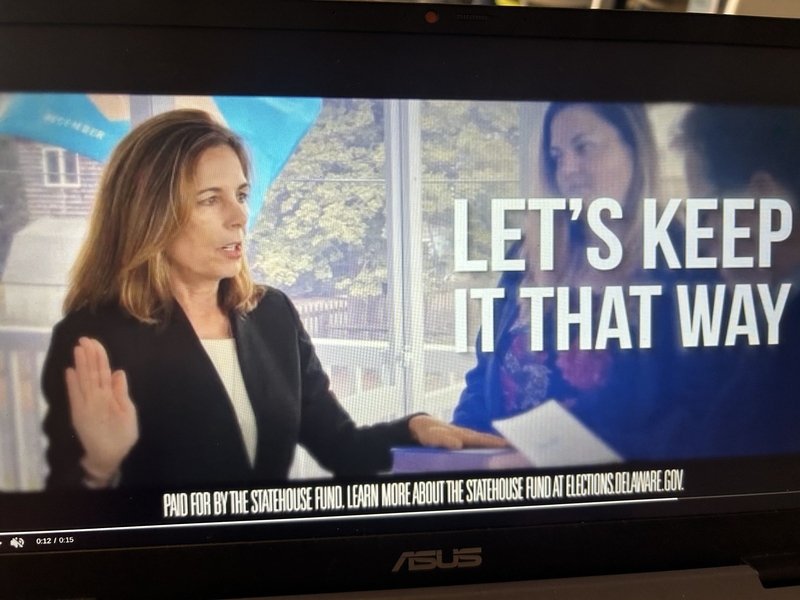
Last month, the entity called The Statehouse Fund launched a $500,000 campaign to support Jennings that included social media ads highlighting lawsuits that her office has joined with other states in filing against the Trump administration.
The ads do not appear to mention AI, even as the Statehouse Fund describes its purpose as promoting regulations on artificial intelligence, and is funded by an organization that has taken in millions from the AI company Anthropic.
On Tuesday, Bensing sent an email to supporters claiming the Statehouse Fund’s campaign shows Jennings “cozying up” to the companies she should be regulating.
In response, Jennings’ campaign manager dismissed the attacks as “cornball rhetoric.” He also described the Statehouse Fund as “a pro-regulation group.”
Asked about the back and forth, the third candidate in the primary race, Patty Rickman, argued that the debate is distracting the campaigns from kitchen-table political issues, noting that Dover had recently been hit by a tornado.
In all, the spat is the latest in a long-running dispute between the candidates over the proper role of the attorney general, including the amount of regulatory scrutiny it should impose on the roughly 2 million companies that operate under Delaware’s corporate law.
The fight also highlights the AI industry’s entry into political campaigns across the country, amid a debate within states, in Congress, and between rival AI companies Anthropic and OpenAI over how best to regulate the fast-growing sector.
Taken together, it is a formula that is adding significant political dollars to a race in little Delaware that already was set to become the state’s most consequential this year.
The Delaware attorney general serves as the head of the state’s Department of Justice, whose mission includes enforcing criminal law – similar to a district attorney. The department also provides legal services to other branches of state government, and has the authority to bring civil actions against a wide range of entities, including companies and the federal government.
According to campaign finance records, the Statehouse Fund launched its half-million dollar campaign last month after receiving $525,000 from Public First Action, a national political organization that has supported a slate of moderate Democrats and Republicans, mostly running for seats in the U.S. Congress.
While Public First Action is not legally required to disclose its donors, Anthropic reported that it contributed $40 million to it since February.
In corporate filings submitted to the Delaware Department of State, Public First Action describes its mission as educating the public about “artificial intelligence, emerging technologies, and other legislation, policies, and initiatives that support the public interest.”
The Washington Post reported that the group’s policy priorities include export restrictions on computer chip sales to China, and opposition to “a White House proposal to stop states from passing AI laws.”
The Post also highlighted how the group has run ads with conflicting ideological messages. One in North Carolina decried recent federal immigration enforcement actions, while another in Texas called on officials to “seal the border.”
Officials from Public First Action — including the organization’s president, former U.S. Rep. Brad Carson (D-Okla.) — did not respond to requests to comment. Messages sent to The Statehouse Fund also were not returned.
Delaware’s race for attorney general did not feature a Republican until last week when Army veteran Dave Graham announced he would run in the November general election.
Do AI companies want to be regulated?
While Anthropic has contributed millions to Public First Action, the company says those donations are not intended to be political.
A spokeswoman for the company said in an emailed statement that dollars given to the organization are to support education and policy advocacy, and “can not be used to influence the election of any candidate.”
But Bensing is skeptical.
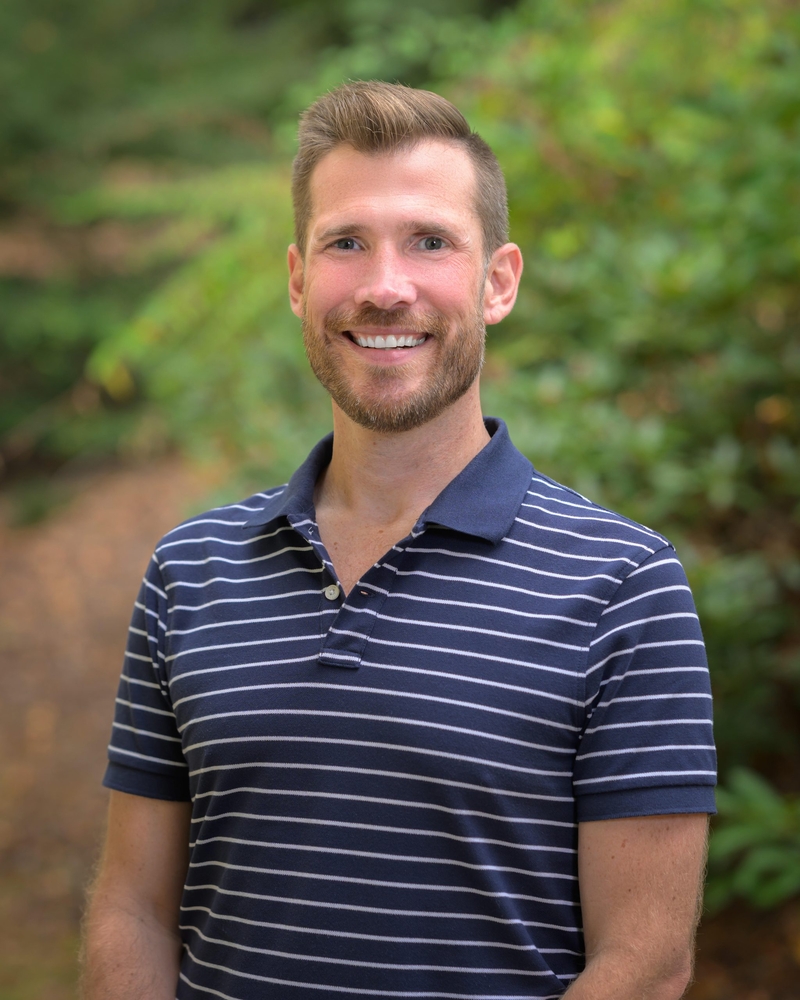
In an interview with Spotlight Delaware, he questioned why Anthropic would give money to an organization that funds political campaigns if the intention is purely educational.
“If that was their purpose, then they could have contributed to a nonprofit organization, a 501(c)3, that doesn’t engage in political activity,” he said.
Public First Action is one of a string of competing advocacy organizations set up by Anthropic and its competitor OpenAI over the past year.
In July, Politico described the two chatbot makers as archrivals seeking to lock in their preferred government regulations, just as the “AI industry is increasingly looking to states” for clarity. The article further stated that Anthropic is pushing states to impose increasingly tougher rules on the industry, while OpenAI seeks a common set of regulations across the states.
When asked about the Statehouse Fund’s political spending, Jennings’ campaign manager Carter Gramiak said in an email that the group likely supports the attorney general because of her “public stance on needing guardrails around AI.”
Pressed for details, Gramiak pointed to OpenAI’s corporate transition last year from a nonprofit company to a for-profit. The restructure needed the approvals of the attorneys general of California, where the company is physically headquartered, and Delaware, where it is legally domiciled.
Both officials ultimately signed off.
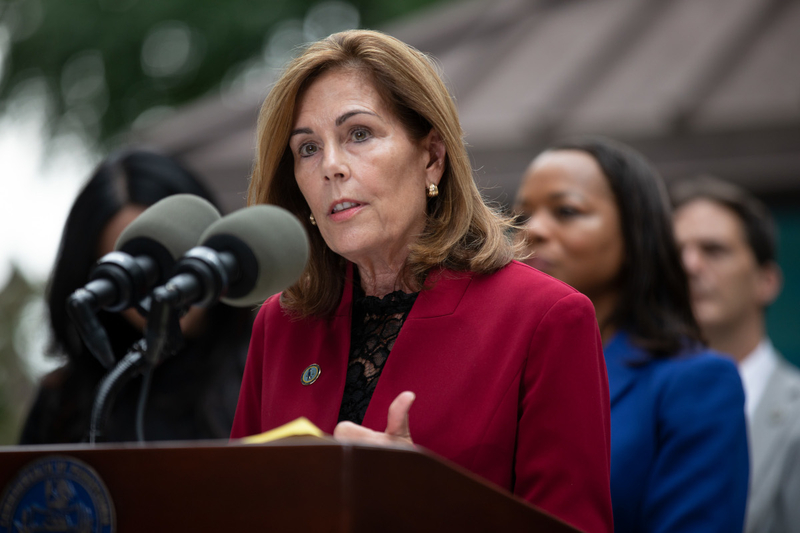
Gramiak said the company’s restructure to a for-profit, public benefit corporation meant its fiduciary duty guarantees safety. He noted that OpenAI continues to be overseen by a nonprofit parent company.
“That doesn’t happen without her,” he said, referring to Jennings.
Bensing disagrees. He argued the new for-profit structure provides less safety from potentially volatile AI agents than it had as a nonprofit.
Open AI CEO Sam Altman “did not do that to advance the public’s interest,” Bensing said.
Last year, Altman said his company restructured because it needed to attract more investment to scale up its costly operations in the fast-growing AI industry.
But ten of his own former employees opposed the move. In an open letter, the former OpenAI employees joined prominent technology and economic academics to argue that the company’s shift away from a nonprofit threatened to concentrate unprecedented power in the hands of a profit-generating entity.
The letter noted that Altman had been among leaders in the industry to warn of the risks of artificial general intelligence — a technology that AI companies are racing toward and would allow bots to replace humans in most work.
What is the primary election really about?
The Statehouse Fund’s spending adds to about $475,000 that Jennings’ campaign has either deployed since the beginning of the year, or has in its own bank account, according to a campaign finance report filed last month.
Bensing, a civil rights attorney, reported spending $45,000 since the beginning of the year with another $80,000 in the bank.
And Rickman, an author and small-business owner, said she spent about $8,600 on her campaign, with about $2,000 left in her bank account.
The differences in war chests highlight the positions that Jennings holds as the incumbent and the choice of the state’s Democratic Party establishment, including Delaware Gov. Matt Meyer.
In her previous two terms as attorney general, Jennings has followed a relatively traditional approach, veering from her predecessors only in the number of lawsuits filed against the federal government.
By contrast, Bensing has called for reforms to the attorney general’s office, asserting its criminal prosecutions have been carried out unevenly, and its regulatory scrutiny on corporations been too light.
Philadelphia’s prominent progressive district attorney, Larry Krasner, has endorsed Bensing’s run.
Rickman is running as the outsider candidate, placing domestic abuse and how state authorities prosecute it at the center of her campaign. She also proclaims that she is not a “career politician.”
As Jennings has turned her lawsuits against the federal government into a campaign issue, the Statehouse Fund appears to have followed.
A recent video the group purchased on Facebook characterizes the civil actions as a sporting match between Jennings and Trump — complete with the sound of a ringside bell.
“Trump keeps losing, let’s keep it that way,” the ad proclaims.
Delaware has joined other states to sue the Trump administration over several issues, including over threats to a crime victims’ fund, and over federal policies restricting access to gender-affirming care.
But Bensing has argued that the cases amount to the attorney general joining a group project without doing much of the work.
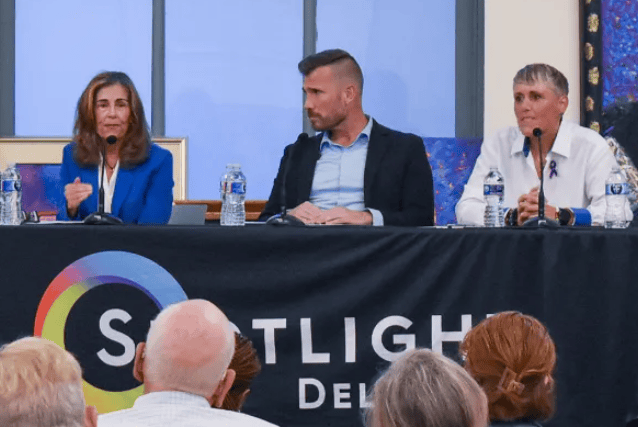
The two sparred over the issue during a Spotlight Delaware debate last month. Asked about the lawsuits, Jennings said they saved Delaware $1 billion because they challenged funding cuts that President Donald Trump has repeatedly threatened.
“We have led on lawsuits over funding and we have joined lawsuits,” she said.
In response, Bensing said none of those federal cases have been held at U.S. District of Delaware, concluding they amounted to Jennings simply signing her name onto a filing.
“What we need is to get real about what we’re taking credit for and the actual impact and work that we’re doing within the state,” Bensing said.
Another PAC on the verge of entering AG’s race
Beyond the Statehouse Fund, another political organization has money waiting in the sideline, ready to be deployed in support of Jennings. And its backers are local to Delaware.
Created last fall, the Justice For All PAC initially received $246,000 from Wilmington attorney Mike Hougton — an individual who had been quietly influential in state government for years, but also publicly feuded with Gov. Matt Meyer in recent months.
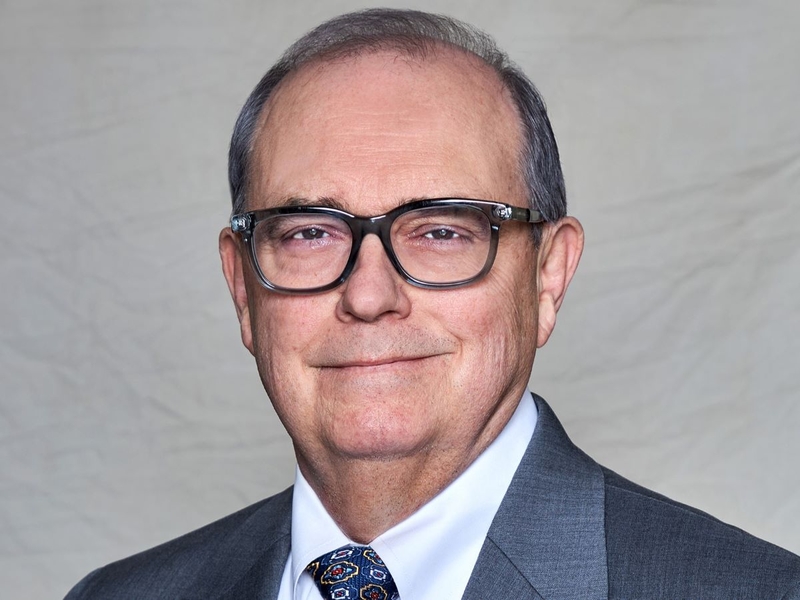
Since Houghton’s contribution, other prominent names in Delaware have given smaller amounts to the PAC, including former-State Sen. Colin Bonini, and John Hynansky, a prominent Delaware businessman and close friend of former President Joe Biden.
While the group’s campaign finance report filed in August shows $35,000 in expenditures, Houghton told Spotlight Delaware that it is now spending about $150,000 to support Jennings.
He said he has known the attorney general for over 25 years and worked with her on several public policy issues.
“We are friends, I have supported her past campaigns and have been pleased to do so this year,” he said.
Houghton also has worked as an attorney for OpenAI in the past. He described his role as limited legal work and said he was not involved in the company’s negotiations with Jennings last year over its restructuring.
He also said that neither OpenAI, nor any of its related entities, have contributed to his Justice for All PAC.
Asked why Anthropic might support Jennings’ campaign, Houghton said the company likely sees regulation as inevitable.
And while it might prefer federal oversight, it likely “has concluded that it is unable to work quickly with the federal government,” he said.
Dover