Plaintiffs say Tuberville is ‘constitutionally ineligible’ for governorship in reply brief
Sep 04, 2026 | 5:59 am ET
Description
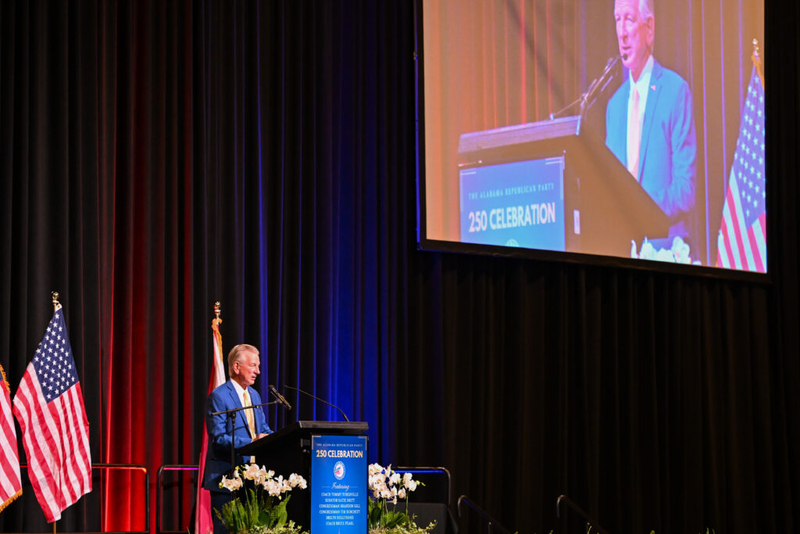
U.S. Sen. and Republican gubernatorial nominee Tommy Tuberville speaking at the Alabama Republican Party's Summer Dinner on July 31, 2026, at the Renaissance Hotel in Montgomery, Alabama. Plaintiffs who are challenging Tuberville's candidacy for governor said the senator is avoiding an "obvious and very inconvenient truth" in a reply brief Thursday. (Anna Barrett/Alabama Reflector)
Plaintiffs challenging Republican gubernatorial nominee Tommy Tuberville’s candidacy told the Alabama Supreme Court Thursday that Tuberville was “constitutionally ineligible” to serve as governor.
In a 23-page brief filed in reply to Tuberville, Alabama Attorney General Steve Marshall and the Alabama Republican Party (ALGOP), the plaintiffs’ attorneys accused them of avoiding an “obvious and very inconvenient truth.”
“Raising every conceivable procedural and legal roadblock they can muster, Tuberville and his political allies ask this Court to simply look the other way while he thumbs his nose at an Alabama constitutional requirement that has existed since this state was founded more than 200 years ago,” the brief said.
Messages seeking comment from the Tuberville campaign, his attorneys, Marshall and the ALGOP were left Thursday afternoon. The plaintiffs are appealing a lower court ruling that it lacked jurisdiction to hear the plaintiffs’ challenge.
Tuberville, currently Alabama’s senior U.S. Senator, has faced questions about his residency for years. The plaintiffs’ complaint cites reporting including a 2023 Florida driver’s license, and homestead exemption in Auburn that Tuberville said he has been on since 2018 but was not added to until mid-2024.
The lawsuit argues that Tuberville does not meet Alabama’s seven-year residency requirement for the governorship.
Tuberville has maintained that he meets the requirement, but does not deny that he owns a home on the Florida coast. His lawyers argued last week that temporary absences do not strip a person’s resident status.
The senator’s attorneys, Marshall and the ALGOP also argued last week that the judiciary does not have jurisdiction in the “election dispute” and that right belongs to the party.
Tuberville’s residency has been challenged multiple times within the party by Ken McFeeters, who ran against Tuberville in the gubernatorial primary. Each was dismissed, including one where Tuberville testified under oath. Plaintiffs said they could not challenge Tuberville’s residency within the party because they do not belong to the party.
The lawsuit is challenging the senator’s authority to be governor through a legal proceeding called “quo warranto,” not his May primary win.
“Alabama has long held that it is up to the judiciary – undisputably a co-equal branch of our government – to uphold and enforce the provisions of the Constitution when threatened by unscrupulous politicians and others more concerned with their own power than the rights enshrined in our most sacred laws,” Thursday’s brief said.
Because the case is not challenging the results of the primary, plaintiffs argued that a centuries-old law that Tuberville and Marshall referenced does not strip the judiciary of its power in this case.
“The statutory language is expressly limited to ‘any proceeding for ascertaining the legality, conduct, or results of any election’ or ‘any injunction, process, or order from any judge or court, whereby the results of any election are sought to be inquired into, questioned, or affected, or whereby any certificate of election is sought to be inquired into or questioned,’” the brief said. “Appellants challenge only Tuberville’s constitutional eligibility to now serve as the certified nominee—which presumes that the results of the primary are valid and correct.”
The parties disagree over whether the quo warranto proceeding can be used in the first place. There is no precedent where the action has been used against a nominee. Under current legal precedent, quo warranto actions have only been successful against those who already hold public office.
The plaintiffs argue that multiple Alabama Supreme Court cases have designated certified nominees as “quasi-officers” because they have access to resources the public does not.
“While declining to hold that quo warranto did not extend to certified nominees, the court has repeatedly held that quo warranto was the ‘exclusive remedy’ for challenging a person’s eligibility to hold office,” the brief said.
Plaintiffs want the justices, all of whom are Republicans, to send the case back to Montgomery County Circuit Judge Brooke Reid, who dismissed the case in July due to a lack of jurisdiction after an hourslong hearing. Reid did not rule on the merits of the case.
Alabama Supreme Court opinions are usually released on Friday mornings. Should they rule Tuberville is not eligible to be governor, there is not enough time for the ALGOP to replace him as a candidate and all votes cast for him would be void. Plaintiffs said that does not make the case moot.
“In any event, Alabama voters deserve to know whether Tuberville is constitutionally ineligible before they go to the polls in November,” the brief said.
Montgomery