Task force warns of worsening drought on track to match last year
Sep 04, 2026 | 4:32 am ET
Description
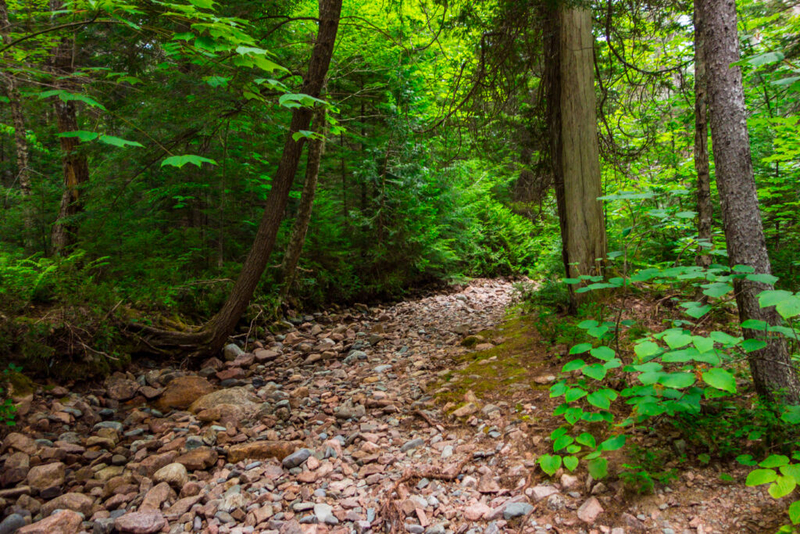
Dried river bed in the forest of Acadia National Park in Maine. (Photo by Adam Mustafa/ Getty Images)
Data from around Maine suggests the state never fully recovered from last fall’s drought, leaving the state in a tough position as conditions worsen once again, according to the Maine Drought Task Force.
The task force convenes when abnormally dry conditions in the state compound, and aims to increase communication and awareness of the conditions. Members from state and federal agencies met for the first time this year Thursday morning to share information on weather conditions and other drought symptoms.
Peter Rogers, co-chair of the task force and director of the Maine Emergency Management Agency, said the current conditions aren’t a surprise.
“I think we knew last year … that we were going to be here again this year,” he said. “I heard somebody say last year’s drought affected this year’s drought, and that’s absolutely the case.”
And looking at the current forecasts, Rogers said, “I don’t see a lot of good news coming.”
He said it’s unlikely that the state will start getting “that one inch of rain every week — the things that we really need to get out of this.”
With all of the troubling signs, residents are encouraged to conserve water and check private wells.
Another hot, dry summer
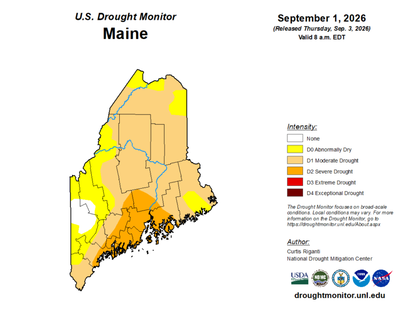
The latest report from the U.S. Drought Monitor on Thursday showed just 4% of Maine with no drought conditions. Roughly 22% of the state is considered abnormally dry, 60% in moderate drought and 14% in severe drought.
Last year’s drought lingered in the midcoast region in particular, said Donald Dumont, warning coordination meteorologist with the National Weather Service. But now, those severe conditions are spreading inland and further north.
That’s because it has been a hot and dry summer, Dumont said. Portland had the 2nd hottest summer on record, and Bangor saw its 4th driest summer.
“It was hotter than normal, you have greater evaporation rates that are occurring, so that means you have more evaporation, more soil drying, and bigger moisture deficits than the precipitation anomalies alone will tell you,” Dumont said. “So again, not as bad as last year, but again, another relatively hot and dry summer.”
And those weather conditions are mirrored in the soil, he said. Both top soil and deeper soil are seeing below normal levels of moisture.
“The big takeaway from this is things could still get much worse as we move into the fall season, depending on what happens,” Dumont said. “So we are kind of in a pretty similar position than we were as of last year for the state.”
And although there was some rain Wednesday night and into Thursday, the areas already in severe drought did not see much of that precipitation, he said.
“So, good wetting rain for most of the areas, but the places that need the work the most did not get that much at all,” Dumont said.
And the forecast further out doesn’t seem to be much more promising, he said. Next week looks like it will be “relatively dry,” and there aren’t strong indications at this point that there will be more precipitation in the fall.
Maine is expected to be influenced by a very strong El Niño this year, but that typically results in a slightly warmer and slightly wetter winter, Dumont said. That might mean more winter rain than snow, which could help recharge some groundwater. But those benefits might be limited to coastal areas, while inland and northern Maine have frozen ground that can’t absorb the precipitation.
Brooks and streams running dry
Nick Stasulis, with the U.S. Geological Survey and the task force’s other co-chair, said that more than half of the agency’s stream flow monitoring stations are showing below normal or much below normal stream levels — although the recent rain may result in a short term change.
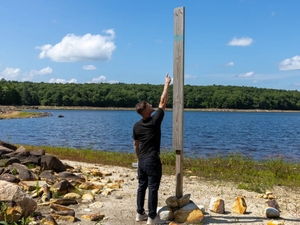
Water flowing through Maine’s brooks and streams was looking stronger in the spring and early summer, but levels have been dropping since July, Stasulis said. As of this week, four monitoring stations are reporting the lowest levels in ten years.
The Maine Department of Inland Fisheries and Wildlife similarly reported many dry brooks across the state. That will likely strand some migratory fish that travel upstream, like salmon and alewives.
The big takeaway from this is things could still get much worse as we move into the fall season, depending on what happens. So we are kind of in a pretty similar position than we were as of last year for the state.
And the department is still seeing the impacts from last year’s drought on the salmon population in particular, which may have lost an entire cohort of juvenile fish.
The state’s groundwater levels are another serious concern, particularly along the 295/I-95 corridor, where the levels never really recovered from the last drought, and now are critically low.
“In my opinion, that’s the biggest concern as far as water resources go, that long-term groundwater deficit there,” Stasulis said.
He pointed to the Sanford monitoring station, where the water levels have been below normal all year. At some points the station was at its lowest on record, even worse than during the drought in the early 2000s.
“I don’t know that we’ve really recovered from that drought and the lack of snow through the winter, as far as groundwater goes,” Stasulis said.
Impact on agriculture
The dry conditions come at a key moment for farms with fall crops, said Tom Gordon with the Maine Department of Agriculture, Conservation and Forestry.
Crops are most sensitive during the two to three week period before harvest, he said, and most need an inch of rain a week to grow.
“So we’re at a very critical time of the agricultural season, and it’s important to point out that 85% of Maine cropland is not irrigated,” Gordon said. “So most of our farmers are relying on hope that we’re going to get rain. As I’ve said to the drought task force every year that we’ve met, hope is not a plan, so we need to do more than that where possible.”
It’s a change from earlier in the year, he said, when berries and the first cut hay did well because of rain in the spring and early summer. But the second cut hay is not as strong, and that’s a concern for livestock operations as winter approaches.
Gordon also spoke about the Farmer Drought Resilience Fund, which was created by the state Legislature after the 2020 drought. The program provides grants to farms to reach new sources of water.
In 2026, the program has provided funding for one gravel-packed well, eight storage ponds, 11 drilled wells, two combination drilled well and storage ponds and eight water management plans.
Gordon said with the current drought conditions, he anticipates another round of grants opening later this fall. But the program’s annual funding of $300,000 is really only enough to cover six to 15 farms.
The department plans to go to the new Legislature in January for more funding, either from a bond or appropriation, he said.
“But we definitely need to consider this because $300,000 a year is not going to allow us to effectively reach all the farms that are in need of assistance for water management,” Gordon said.
The most positive news came from the Maine Forest Service, which reported low wildfire concerns.
“We were on pretty high concerns about 30 days ago, and we’re feeling really good about fire activity now with shorter days, cooler nights, better humidity recoveries and things like that,” said Joe Mints.
So far this year, Mints said, there have been 608 fires, but with relatively low acres of damage.
There was more activity in August, but the risk had dropped back down.
Given the current conditions, the task force plans to meet again next month, and will compile all of its findings into a report in the coming days.
Augusta, ME