Reduced credit hour bachelor degrees approved at 3 Oklahoma colleges
Sep 03, 2026 | 1:43 pm ET
Description
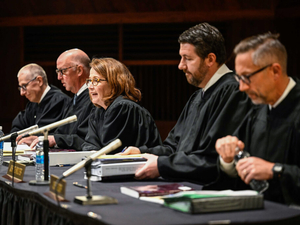
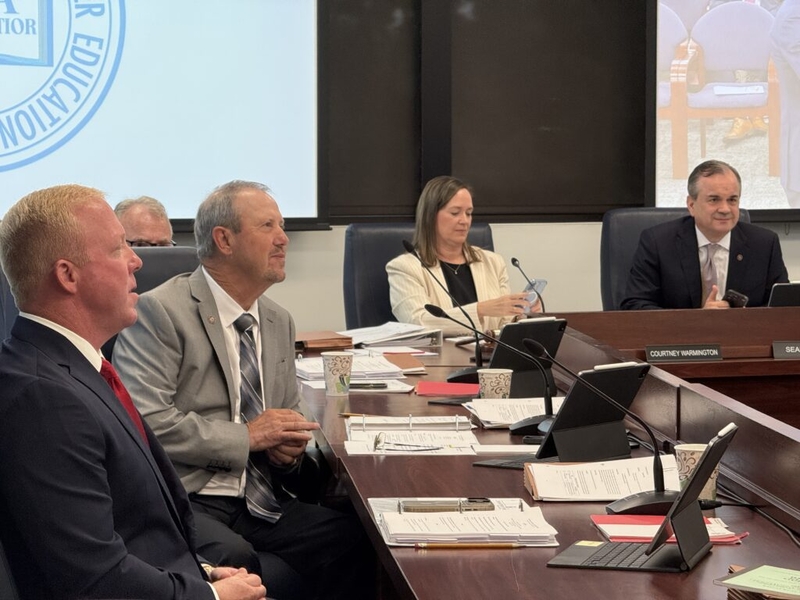
Members of the Oklahoma State Regents for Higher Education listen to a speaker during a meeting on May 29, 2026 in Oklahoma City. (Photo by Emma Murphy/Oklahoma Voice)
OKLAHOMA CITY — Three Oklahoma universities were given the greenlight to offer the state’s first reduced credit hour bachelor degree programs.
The Oklahoma State Regents for Higher Education on Thursday unanimously approved requests to create accelerated degree programs at University of Oklahoma, Oklahoma State University and Rogers State University that would allow students to earn a college degree in as little as three years instead of the traditional four.
The regents approved OU’s request to create a 90-credit hour degree in applied social work. They also signed off on OSU’s plan to offer two shortened degree pathways — a 92-credit hour bachelor of applied science in artificial intelligence and a 90-hour bachelor of applied science in business essentials and applications. Rogers State received approval for a 99 to 103 credit hour bachelor of applied science in workforce development.
The programs still need to go through a months-long accreditation process, but the four accelerated degrees could be offered to students as early as next fall.
The Oklahoma State Regents for Higher Education in May revised their policies to allow colleges and universities to propose bachelor degree paths in as few as 90 credit hours. This came after both Gov. Kevin Stitt and the Legislature charged the State Regents with studying the feasibility of 90-credit hour degrees in an effort to make higher education more affordable and address workforce shortages.
Reduced credit hour degrees are an option at at least 60 schools across the country. Five other states are working to test and develop these programs, according to a report from Georgetown University.
Courtney Warmington, chair of the State Regents, said higher education officials have been “deliberate” and “thoughtful” when designing reduced credit hour programs to ensure academic quality and rigor is not lost.
“The traditional 120-hour bachelor’s degree has served higher education for a really long time, but innovation requires us to be willing to ask whether every degree in every field must always be structured in exactly the same way across the country,” she said.
OU President Joseph Harroz Jr. said Thursday that while the state doesn’t know if these degrees will be perfect, he’s glad Oklahoma is “not leading recklessly, but thoughtfully.” He said reduced credit hour degrees will help to meet the needs of the workforce in Oklahoma.
“This proposal … is a critical moment because we have to understand what the market needs and the impact that has on the wealth and health of our state,” Harroz said.
Chris Francisco, senior vice provost for academic affairs at OSU, said the university wants to streamline pathways into in-demand industries, like artificial intelligence.
“While we think that the traditional, four-year bachelor’s degree has served students very well and continues to serve students well, we want to develop as many flexible pathways as we possibly can to try to serve the needs of the state when that arises,” he said.

Oklahoma City, OK