US Senate challenger says Wounded Knee medals ‘should not stand’; incumbent says more info needed
Sep 03, 2026 | 11:37 am ET
Description
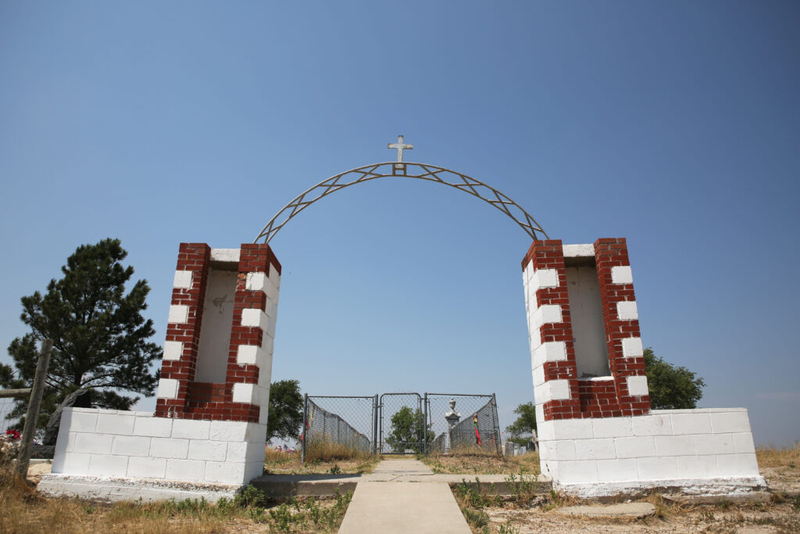
An arch topped with a cross marks the entrance to the Wounded Knee Memorial and cemetery on the Pine Ridge Reservation in South Dakota on June 30, 2024. (Photo by Makenzie Huber/South Dakota Searchlight)
Listen to an audio version of this story produced by reporter Meghan O’Brien. Broadcasters: See below for a downloadable version with a host intro script.
South Dakota Republican U.S. Sen. Mike Rounds said he wants to “get the facts” before deciding whether any medals awarded to soldiers who were at the 1890 Wounded Knee Massacre should be rescinded, while his opponent said the medals “should not stand.”
Independent candidate Brian Bengs is Rounds’ only challenger in the Nov. 3 election after the Democratic nominee withdrew. Bengs served 26 years in the U.S. military and taught at the NATO School in Germany and the U.S. Air Force Academy, including courses on the law of war.
“And I will say categorically: Those medals are not earned. They are not deserved. They should not stand,” Bengs said. “Their continuing standing is a dishonor to the individuals who currently hold the Medal of Honor.”
Bengs spoke to South Dakota Searchlight for a recent episode of its Searchlight Report podcast, after Searchlight interviewed Rounds for an earlier episode.
To hear more from independent candidate Brian Bengs, listen to his full interview on Searchlight Report, a podcast from South Dakota Searchlight.
Rounds is a member of the Senate Armed Services Committee. In a recent report about the pending National Defense Authorization Act, the committee included language directing the secretary of defense to “provide the full report and unredacted materials” from a recent review of the Wounded Knee medals.
In September, Secretary Pete Hegseth announced that a review ordered during President Joe Biden’s administration had been completed and the medals would not be rescinded. The department has said about 20 soldiers were awarded the Medal of Honor for actions at Wounded Knee, though the exact number is unclear due to incomplete or unclear records.
Rounds said he and other committee members are responding to survivors’ descendants who want more information.
“There’s a lot of people in South Dakota that live on the reservations that have relatives that were wounded or killed during that massacre that occurred in December of 1890,” Rounds said. “Those people still feel strongly about the loss to their families.”
Rounds said he ultimately wants the military to decide about the medals, “rather than having Congress get in the middle of it.” Multiple attempts to pass congressional legislation rescinding the medals have failed, with neither Rounds nor any other member of the state’s congressional delegation signing on as sponsors or cosponsors.
To hear more from U.S. Sen. Mike Rounds, listen to his full interview on Searchlight Report, a podcast from South Dakota Searchlight.
“Under the conditions at that time, there may very well have been the delivery or the awarding of those Medals of Honor appropriately, but there may also have been other areas where they may not have been,” Rounds said. “But rather than arbitrarily saying we support it or we don’t support it, let’s get the facts.”
The massacre occurred on Dec. 29, 1890, near Wounded Knee Creek in southwestern South Dakota, where a large group of Lakota people camped while traveling to the Pine Ridge Agency. They were surrounded by hundreds of Army soldiers. A shot rang out while the soldiers attempted to disarm the camp, and the soldiers opened fire.
Fewer than 40 soldiers were killed (some by friendly fire, according to historians), while estimates of Lakota deaths are 200 or more, including men, women and children. After some of the bodies froze on the ground for several days, a military-led burial party placed them in a mass grave.
The Department of Defense created a five-member panel to review the medals in 2024.
In a redacted report obtained by South Dakota Searchlight, the panel’s Defense-appointed chairman wrote, “While the actions of leadership were suspect, circumstances chaotic, and non-combatants tragically killed, three of the five panel members believe that individual soldiers distinguished themselves in action and found no disqualifying information.”

Pierre, SD