Why the rushed Postal Service plan for mail-in voting has states in a panic
Sep 02, 2026 | 5:19 pm ET
Description
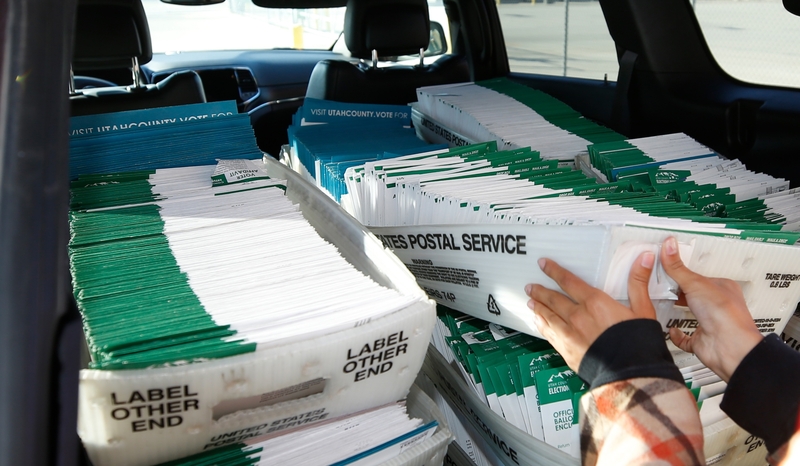
A Utah County election worker picks up mailed ballots from the United States Postal Service office on Oct. 26, 2020 in Provo, Utah. (Photo by George Frey/Getty Images)
President Donald Trump’s executive order placing new restrictions on mail-in voting would assign state officials a Herculean task to reach compliance before the crucial midterm elections.
The order directed the U.S. Postal Service to strictly regulate the envelope design of mail-in ballots and to collect voter data from each state through an online portal, among other things.
The Postal Service has argued in court that its rule is not an election regulation, but is within the agency’s purview as a standard for a specific type of mail.
But some state officials tasked with fitting their systems to the new regulations say it presents massive — if not impossible — challenges to reach compliance for the November midterms, when voters will decide whether to continue Republican control of the U.S. House and Senate.
Ballot designs and printing are typically done months in advance of ballots being sent to voters, which begins this week. North Carolina is set to mail out ballots for the Nov. 3 general election on Friday.
“In some States, it would be impossible at this point to comply with the last-minute rollout of USPS’ novel ballot-verification program,” more than 20 Democratic-led states suing to block the order said in a Wednesday court filing. “In other States, there will be chaos.”
The states presented a list of tasks state and local elections administrators would have to complete.
That list includes: redesigning ballot envelopes and obtaining USPS approval “on an unprecedented timetable,” purchasing new envelopes, developing technological systems to meet barcode standards in the rule, uploading voter-specific information to the USPS portal that they have not yet received access to and training state and local officials and voters on the new standards.
“Each step of this process is fraught with an extreme risk of error,” they said.
‘Courts will stop it’
Because of the unworkable timeline and a general principle not to change voting policy too close to an election, officials believe courts will ultimately block the rule from going into effect for this year.
“There's a pretty universal feeling that the courts will stop it from happening,” Katy Owens Hubler, the director of elections at the National Conference of State Legislatures, said in an interview.
“In general, you don't want to be changing things right before the election. So in a lot of ways, it is already too late. Part of the rule relates to the absentee ballot envelopes themselves. And … almost universally, those have already been designed and printed.”
A Massachusetts federal judge has paused the rule from taking effect through Sept. 11 while multiple legal fights play out.
Tammy Patrick, the chief programs officer at the National Association of Election Officials, a nonpartisan industry group for state and local elections officials, said in a court declaration filed Aug. 28 the timeline was unworkable for the midterms.
“None of the Rule’s requirements can feasibly be implemented before the November 3, 2026, General Election,” she wrote. “Administration of the 2026 election is already well underway, with timelines, budgets, and staffing already set, many of which are unmovable or unchangeable.”
The rule's requirements “will place new and heavy burdens” on election offices whose budgets are “already constrained,” she added.
Election officials and USPS began preparing for the 2026 election months ago, she said. And states already set funding levels.
“The infeasibility of the Rule for election officials is obvious when you consider the calendar and preparation for the 2026 general election next to the Rule’s requirements and implementation,” she wrote.
The rule would force states to push through in a matter of weeks what should take a year, Matthew Weil, the vice president for democracy and bipartisanship at the Bipartisan Policy Center, a Washington think tank, said.
“A year of lead time is the best practice before any new policy,” he said.
Envelope design
Some of the requirements themselves are not objectionable, according to experts.
The standards for envelope design, for example, largely codify best practices the Postal Service has recommended for years.
But the rule also requires that USPS approve each design, possibly through an online portal that has yet to be introduced and has reportedly seen major problems in development.
Nationwide, there are about 40 mail design analysts who would be qualified to judge mail ballot designs. Asking every state, and many counties that have their own designs, to submit them at the same time would be unworkable.
“If even a fraction of election offices has to submit their new envelopes and materials … before the 2026 election, it would take weeks for USPS to work through the sudden volume,” Patrick wrote.
A similar problem could face election offices seeking to order printing of new ballots and envelopes, she said. The turnaround time for new envelopes could stretch 12 to 16 weeks, she said.
Despite those obstacles, the rule would mean any ballots that do not fit the new specifications would be rejected, possibly stopping many voters from casting ballots.
IT problem
Like the implementation of ballot envelope standards, the rule’s requirement that states electronically share voter files with the federal government has suffered from a rushed process, according to an explosive whistleblower complaint published Tuesday.
The Postal Service lacks the capacity to implement the executive order, David Becker, the executive director of the Center for Election Innovation and Research, said in a statement Tuesday.
“They secretly rushed development of the technology the order demanded, trying to piece it together in a few months rather than taking the time required for a proper rollout,” he said. “This slapdash effort is guaranteed to result in significant problems just weeks before the election, potentially disenfranchising thousands of voters.”
Owens Hubler said states have not yet gained access to the portal.
“It’s a pretty big (information technology) project to have done very quickly,” she said. “And I don't know that anybody's actually seen it yet. So, that's another aspect of putting it into place before the election that could be pretty tough.”
The Bipartisan Policy Center predicted the difficulty in building the portal in a July 6 comment on the notice of proposed rulemaking by the USPS. The center noted that state and local officials would have difficulty complying.
“Whether election officials can meet this burden at all depends on the successful deployment of a tool that does not yet exist,” the group wrote. “Building, testing, deploying, and training election officials to use a portal before October 4 (the beginning of the 30-day window during which election officials will be supplying lists to USPS) will be an enormous undertaking, and the risk of delay in the deployment of this portal is significant.”
The Postal Service did not respond to a message seeking comment Wednesday.
In a Tuesday statement, a spokesperson said the agency was finalizing the portal’s development, and called it “just one part of a broader, year-round effort” to ensure election mail is properly handled.
“The Postal Service is now finalizing the portal and will soon make it available to election officials who voluntarily wish to familiarize themselves with the platform,” the spokesperson said. “USPS will also provide tools, presentations, and other resources to help election officials understand the platform and make informed decisions about whether and how they wish to use it.”
Universal mail states
States that already mail ballots to every registered voter, and the large jurisdictions within those states, may have an easier time meeting the standards, Owens Hubler said. If they are not already in compliance, they likely have a relationship with a commercial printer that could possibly handle a short order.
But smaller, less-resourced counties and states that don’t have a robust mail-in voting program may have more trouble finding last-minute fixes.
The eight states that have universal mail voting — California, Colorado, Hawaii, Nevada, Oregon, Utah, Vermont and Washington — “will be affected, but everyone's affected,” Owens Hubler said. “And I think it is important to think of the ones that just don't have to do this as often. They may, in the end, be more affected.”
All States Newsroom content is free to republish. Read our republishing policy for more information.